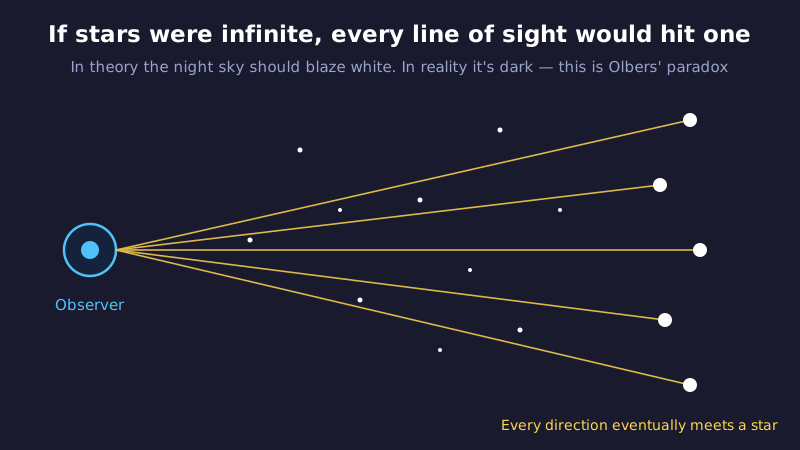
Stars are, by any practical measure, uncountable. Point in any direction, and somewhere along that line, eventually, there should be a star.
If that’s true, the night sky shouldn’t have a single dark patch. It should be packed edge to edge with starlight — brighter than daytime, blazing white.
But look up, and the sky is dark.
That mismatch has the whole nature of the universe hiding inside it.
Every Line of Sight Should Eventually Hit a Star
Picture standing in a dense forest and staring straight ahead. The nearest trunk, then the one behind it, then the one behind that — no matter how far your eye travels, it eventually runs into bark. You never see clear through to the other side.
A universe packed edge-to-edge with infinite stars works the same way, in theory. Send your gaze in any direction, go far enough, and you’ll eventually hit the surface of some star.
You might object: distant stars look dimmer. True — but here’s the catch. The farther out you look, the more stars are packed into each successive shell of space at that distance. The dimming and the crowding cancel out exactly.
The upshot: every point in the sky should glow, on average, about as bright as the surface of a star. The whole sky should be scorched white, like the surface of the sun.
This contradiction has a name. Nineteenth-century astronomer Heinrich Olbers gets the credit, so it’s called Olbers’ paradox — a gut feeling (stars exist, so why is the sky dark?) boiled down into hard logic.
It’s the kind of question a kid might stumble onto by accident. Push on it, though, and it goes impossibly deep.
It’s Not a Shortage of Stars, and It’s Not Dust Either
Let’s clear out the easy objections first. “Maybe there just aren’t enough stars” doesn’t work — the paradox already assumes infinite stars. It’s asking why the sky is dark even then.
The next candidate sounds more promising: maybe cosmic dust and gas block the light from distant stars before it reaches us.
Here’s where that idea runs into trouble. Dust that keeps absorbing light keeps heating up. And anything hot enough eventually radiates its own light. Over long enough timescales, dust can’t function as a permanent curtain — it ends up glowing at the same brightness as its surroundings, adding to the problem rather than solving it.
No amount of tinkering with what’s in space fixes this. The real answer isn’t about space at all. It’s about time.
The Universe Has a Beginning, So the Farthest Starlight Hasn’t Arrived Yet
Here’s the decisive point: the universe had a beginning.
NASA’s WMAP satellite measured the cosmic microwave background with enough precision to pin down the universe’s age at roughly 13.77 billion years, give or take about half a percent — call it 13.8 billion, rounded. The universe hasn’t existed forever. It started at a finite point in the past.
That matters because light, however fast, isn’t infinitely fast. It travels at about 186,000 miles (300,000 km) per second — blisteringly quick, but not instantaneous. Even the most distant starlight has had, at most, 13.8 billion years to make the trip.
So light from anything beyond a certain distance simply hasn’t reached Earth yet. It may have been emitted. It’s just still traveling.
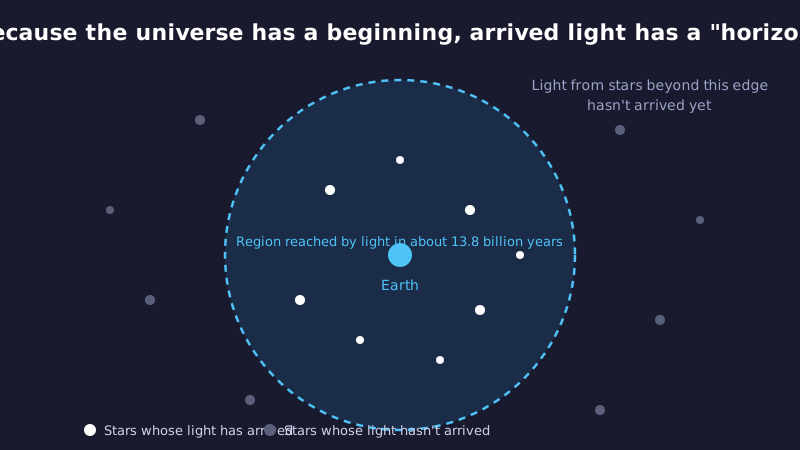
In other words, the observable universe has an edge — a horizon. Stars beyond it might exist, but as far as tonight’s sky is concerned, they haven’t sent us a single photon.
Imagine pointing a powerful telescope at one patch of sky and peering deeper and deeper. You’d catch nearer stars, then farther ones, and eventually hit a wall where light simply hasn’t arrived yet. The forest, in effect, hasn’t finished growing out to where you’re looking.
There’s a related idea worth mentioning: looking farther away also means looking further back in time, for the same reason — light’s finite speed. It’s the flip side of the same coin. I wrote about that in the night sky as a collage of the past. But that’s not quite what’s driving this paradox. What matters here isn’t that we see the past — it’s that beyond a certain distance, nothing has arrived at all.
Expansion Stretches Distant Light Into Colors We Can’t See
A finite cosmic age alone already dims the sky considerably. But the universe has a second trick up its sleeve: expansion.
Space itself is stretching, right now, as you read this. And according to NASA, that expansion has actually been speeding up in recent cosmic history — a conclusion reached in 1998, after distant supernovae turned out fainter than astronomers expected.
When space stretches, any light traveling through it stretches too. Wavelengths get pulled longer, an effect called redshift.
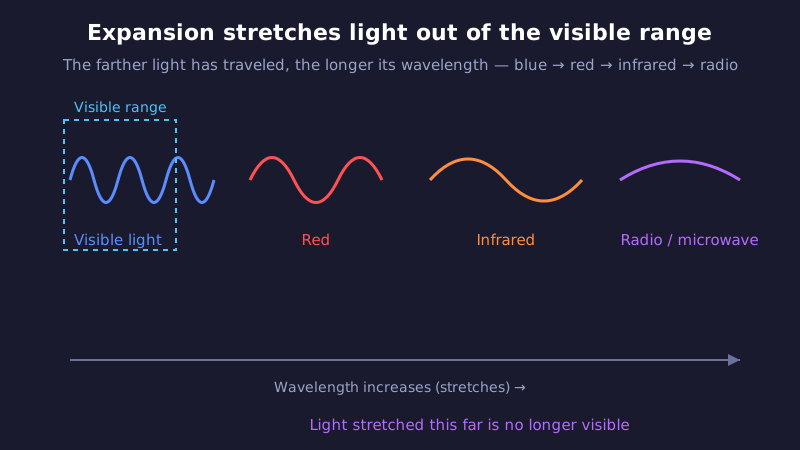
A longer wavelength means a color shift from blue toward red. Stretch it further, and it slides past red entirely, into infrared, then radio waves — territory the human eye can’t register at all.
The farther away an object sits, the longer its light has been traveling, and the more it’s been stretched. Distant light, in other words, keeps sliding right out of the visible spectrum.
Light that technically arrives still gets pushed outside what our eyes can detect. That’s strike two against a blazing-white sky.
The Night Sky Really Is Glowing — Just Not in Visible Light
This next part might be my favorite piece of the puzzle.
Olbers’ prediction — that every direction should eventually meet light — turns out to be correct. Light really is pouring in from every direction in the sky. We just can’t see it.
That light is the cosmic microwave background (CMB): the oldest light in existence, released across the entire universe roughly 380,000 years after the Big Bang. When it was emitted, it was a searing, sky-wide blaze of heat.
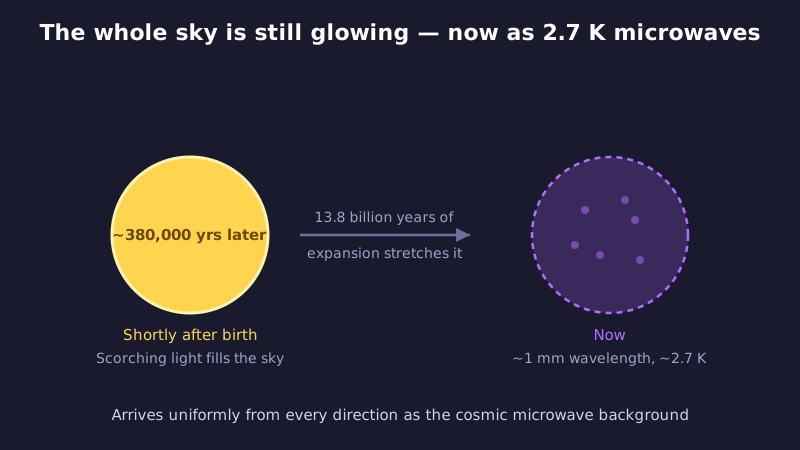
Then 13.8 billion years of expansion stretched that light almost beyond recognition. According to observations from ESA’s Planck satellite, the CMB now arrives as microwaves roughly a millimeter long, carrying a temperature of about 2.7 kelvin — a mere 2.7 degrees above absolute zero, or roughly -270°C (-454°F). And it falls on us nearly uniformly, from almost every direction in the sky. Because you can pick it up no matter where you point an instrument, astronomers use it to map the entire sky.
Microwaves, incidentally, are the same general wavelength band your kitchen microwave uses to heat food. Honestly, learning that reframed how I look at the night sky for a while afterward.
If human eyes could see microwaves, the night sky wouldn’t look dark at all — it would glow faintly and evenly in every direction. The white-hot sky Olbers predicted is, in a sense, really there. It’s just a different color than he imagined.
That glow is the afterglow of the Big Bang itself, though, so it’s nowhere near as fierce as the surface of a star. Expansion cooled it all the way down to 2.7 kelvin. That’s the reason our nights stay quietly, comfortably dark.
What the Dark Sky Is Really Telling You
Put it all together, and the darkness of the night sky was never about a shortage of stars, or an empty universe.
The darkness itself is quietly confirming two things: the universe had a beginning, so light from the farthest reaches hasn’t caught up to us yet. And the universe is expanding, which drags even the oldest light that has arrived into wavelengths we can’t see.
If the universe were infinitely old and static — no beginning, no expansion — the night sky really would be blazing white. The black sky we take for granted every night simply couldn’t exist in that kind of universe.
Next time you look up and see the inky black between stars, remember: that patch of “nothing” has light hitting it right now, light that set out 13.8 billion years ago. Our eyes just can’t keep up with the microwaves it arrived as — so to us, it looks like darkness.