The Sun is roughly 400 times wider than the Moon. Yet look up during an eclipse, and the two appear almost exactly the same size. That improbable match is the only reason the Moon can slide in front of the Sun and blot it out completely.
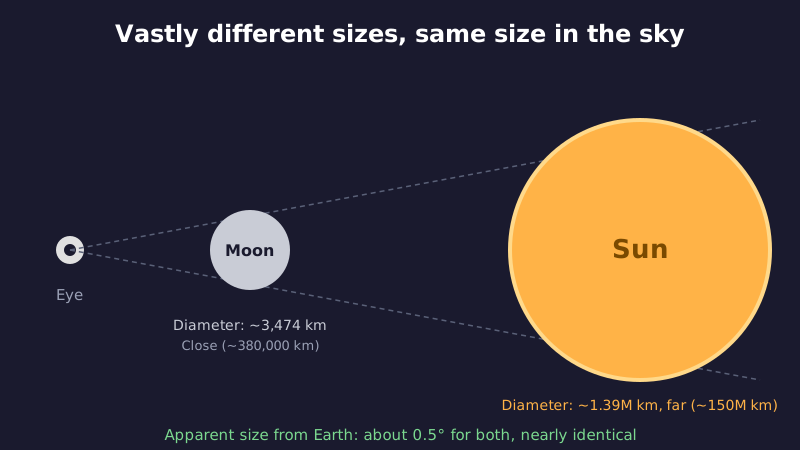
Two wildly different objects, one identical size in the sky
The Sun’s diameter is about 1.39 million kilometers. The Moon’s is about 3,474 kilometers. Line up roughly 400 Moons side by side, and you’d just about span the width of the Sun.
One is a self-igniting furnace of a star. The other is a cold ball of rock and dust. In scale and substance, they’re not remotely in the same league.
And yet during a solar eclipse, the Moon covers the Sun with startling precision. No overhang at the edges, no gap where sunlight leaks through — just a near-perfect overlap.
The solar system is full of moons, but as far as we know, no other planet has one that lines up this cleanly with its parent star. In that sense, Earth’s sky is something of an outlier.
So how do two objects this mismatched end up looking identical from where we stand?
400 times bigger, 400 times farther
The trick isn’t size. It’s distance. Earth sits about 150 million kilometers from the Sun, and only about 384,000 kilometers from the Moon on average — meaning the Sun is roughly 400 times farther away.
“400 times bigger” and “400 times farther” cancel each other out almost exactly. A giant object far away and a tiny object nearby end up looking the same.
Picture holding a bean at arm’s length while a beach ball sits across the room. Get the distances right, and that little bean can blot out the ball entirely. That’s essentially the trick the Sun and Moon are pulling off.
Both objects span roughly 0.5 degrees in our sky. If you’ve ever tried to cover a full moon with your fingertip, you know it’s smaller than you’d expect — about the size of your pinky nail held at arm’s length.
Here’s another way to grasp how small 0.5 degrees really is. The sky spans about 180 degrees from horizon to horizon. Line up full moons edge to edge across that whole span, and you’d need roughly 360 of them. The Moon looks big and bright hanging there at night, but against the full sky, it’s a barely-there speck. And that speck happens to overlap perfectly with an object vastly larger than itself. Put that way, it starts to sound almost too convenient.
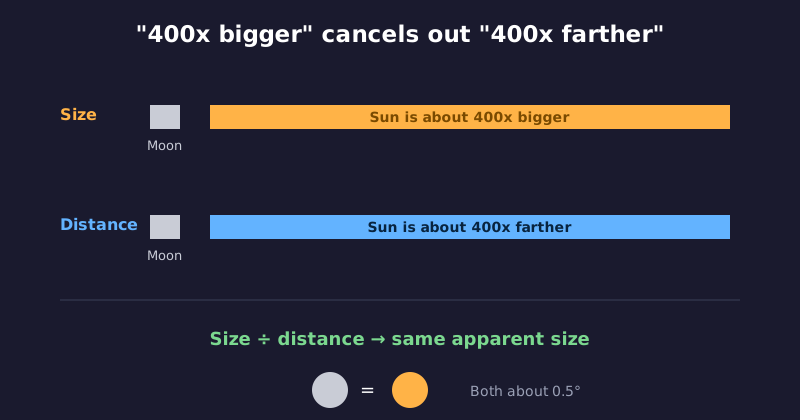
I’ll admit, for a long time I chalked this up to “the Moon just happens to be the right size.” But size alone isn’t what matters — it’s the ratio of size to distance. If the Moon orbited twice as far out as it does now, it could never fully cover the Sun, and the phrase “total solar eclipse” might not even exist.
The margin is razor-thin, which is why we also get “ring of fire” eclipses
Here’s where it gets interesting: this balance is barely holding together.
The Moon doesn’t orbit in a perfect circle — its path is a slightly stretched ellipse. So there are stretches when it swings closer to Earth and stretches when it drifts farther out. Closer means it looks a bit bigger; farther means it looks a bit smaller.
If an eclipse happens to fall during one of those farther stretches, the Moon can’t quite cover the Sun. A thin ring of sunlight rims the edge like a golden band. That’s an annular eclipse — sometimes called a “ring of fire.”
Same basic phenomenon — Sun and Moon lining up — but a difference of just a few tens of thousands of kilometers in the Moon’s position is enough to tip the outcome from total to annular. It’s a good reminder of how tight this balance really is.
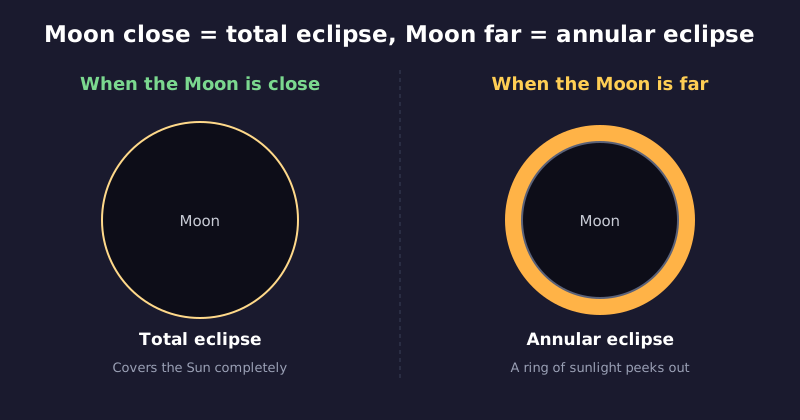
Globally, annular eclipses actually outnumber total ones. On average, the Moon’s apparent size sits just slightly below what’s needed to fully cover the Sun. A total eclipse, in other words, is what happens when an already tight balance gets a little extra help.
That tightness also explains why total eclipses are so hard to catch. The tip of the Moon’s shadow barely reaches Earth’s surface at all, tracing a path only a couple hundred kilometers wide. Step outside that narrow band, even by a short drive, and all you’ll see is a partial eclipse.
Which raises a natural question: will this delicate balance hold forever?
The Moon is fleeing at 3.8 centimeters a year
Short answer: no. Right now, at this very moment, the Moon is inching away from Earth.
Apollo astronauts left mirror-like reflectors on the lunar surface. Scientists bounce lasers off them from Earth and time how long the light takes to return. The measurements show the Moon retreating by about 3.8 centimeters every year.
That number might not mean much at first glance, but it’s roughly the rate your fingernails grow in a year. On cosmic timescales, the Moon is creeping away just as slowly and steadily as a fingernail lengthens.
Why is it drifting? The Moon’s gravity tugs on Earth’s oceans, raising tides. Because Earth rotates, that tidal bulge gets dragged slightly ahead of the Moon’s position overhead. The bulge, in turn, pulls the Moon forward, nudging it into a slightly wider orbit over time.
Earth pays a price for this tug-of-war too. As the Moon gets nudged outward, Earth’s rotation slows in tiny increments — day length is thought to be stretching by roughly 2 milliseconds per century. The Moon’s slow retreat and the barely perceptible lengthening of your day are two sides of the same coin.
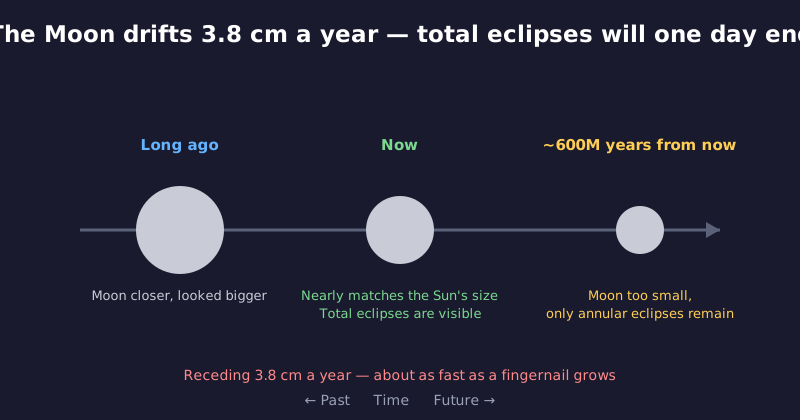
Flip that around, and the ancient Moon must have hung closer, and larger, in the sky. Whatever dinosaurs happened to glance upward would have seen a noticeably bigger disk than we do.
Had an eclipse occurred back then, the Moon would have swallowed the Sun with room to spare — a “thicker,” more dramatic totality than anything we witness today. So what happens as the Moon keeps drifting outward from here?
What only shows up during those few minutes of totality
The brief window when the Moon lines up perfectly with the Sun matters to more than just skywatchers. Even at its longest, totality lasts only a few minutes before the light returns.
The Sun is wrapped in a layer of scorching-hot gas called the corona. Normally, the Sun’s blinding disk drowns it out entirely.
But during totality, the Moon blocks that glare completely, and the corona blooms into view — a pearly halo hanging in a suddenly dark sky. Just before totality begins, one last sliver of sunlight escapes through a valley on the Moon’s edge, flaring like a jewel on a ring. That instant has a name: the diamond ring effect.
This is the key difference between total and annular eclipses. During an annular eclipse, a ring of the Sun’s disk stays visible, and that residual glare is enough to wash out the corona entirely. Only a true total eclipse, with the Sun fully blocked, lets that hidden structure show itself.
The corona is also where the solar wind — a constant stream of charged particles — originates. Disturbances there can knock out satellites, scramble radio communications, even trip up power grids on the ground. Researchers have long used those precious minutes of totality to study the corona up close, piecing together how the Sun behaves. A quirk of celestial geometry turned out to matter for understanding the technology we rely on every day.
If you ever stand beneath a total eclipse, you’ll watch daylight collapse into a few minutes of night, with a ring of white fire circling a black disk overhead. It’s a sight only possible on a world where the Moon happens to fit the Sun this precisely — which, as far as we know, means only here.
Someday, there will be a last total eclipse
As the Moon keeps drifting outward, it will eventually shrink too small to cover the Sun. Its apparent size will slip below the Sun’s, and total eclipses will stop happening altogether. What’s left will be annular eclipses, rings of light with nothing at the center.
Researchers estimate that day is roughly 600 million years away. That sounds distant, but measured against the 4.6-billion-year age of Earth and the Sun, it’s not even that far off. Every total eclipse humanity has ever witnessed, or ever will, turns out to be a brief scene in a much longer cosmic story.
Strange as it sounds, we happen to be living during the narrow window when the Sun and Moon appear the same size. Earlier in Earth’s history, this balance didn’t exist. Later on, it won’t either.
Next time you find yourself watching a total eclipse, remember this: two circles slipping into perfect alignment, small enough to hide behind your pinky nail at arm’s length, is a coincidence with an expiration date — one that belongs, for now, only to this particular moment on this particular planet.