Old Kiyo had one small wish: move the stool a little closer to the house. For fifty years, her husband Zen had refused.
Two low stools sat side by side at the edge of the hill. Every evening, Zen carried a tray of tea and walked Kiyo out to them. Sitting down together to watch the sky — that had been their ritual for fifty years.
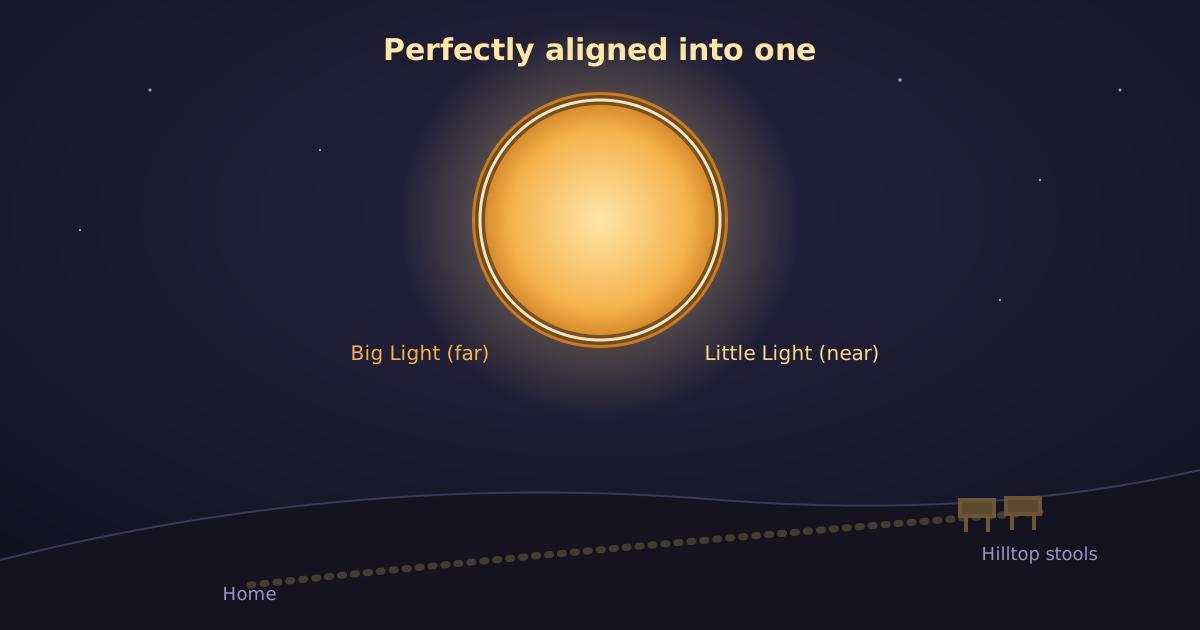
Two lights hung in the sky. Far away, the huge Big Light. Close by, the small Little Light. Strangely, the two looked exactly the same size. Stand in just the right spot, and the Little Light dropped perfectly inside the Big Light — like a coin falling into a teacup — until the two became a single ring.
In this town, Zen and Kiyo were the only two odd enough to go watch it on purpose. Everyone else looked up just once a decade, on what they called the Night of Overlap. But from that one spot at the edge of Zen’s hill, somehow, the two lights lined up every single night.
“Hey, old man. Let’s move the stool a little closer to the house,” Kiyo said again that evening. “This walk feels longer every year. My knees can’t take it.”
She really believed it was her knees. Maybe that was just the easiest thing to believe.
“No,” Zen muttered. “It has to be here. Nowhere else.”
“Why?”
“It just has to be here.”
That was the whole conversation, every time, for fifty years. Kiyo figured her stubborn old husband was just being stubborn — clinging to a spot he’d gotten used to.
That winter, Zen’s legs finally gave out. He couldn’t stand anymore.
Kiyo walked out to the hill alone. With every step, the resentment crept back in. Why did they have to come all the way out here, every single night? She dragged the stool toward the house, grumbling the whole time. Twenty paces closer.
She sat down, looked up — and froze.
The lights weren’t overlapping. The Little Light had slipped off to the side of the Big Light, leaving a blinding sliver of space between them. In fifty years, she had never once seen that.
Shaken, she dragged the stool back toward the edge. One step, then another. And as she did, the Little Light drifted slowly back toward the rim of the Big Light. When she reached the very edge of the hill, it slid neatly back inside.
— It was the place.
The lights hadn’t drifted apart at all. Only from that one corner where Zen always sat did the two align. From anywhere else, they were already out of true.
Kiyo looked down at her feet. A thin bare track ran through the grass — a single curving line, tracing a shallow arc from near the house all the way to where she now stood.
So it hadn’t been her knees after all. The walk really had gotten longer, year after year. Every year, the Little Light slid a hair’s width farther away. And every year, the one spot where the two lights still lined up crept a little closer to the cliff’s edge. Zen had been chasing it — on foot. Carrying the stool outward, just a little, year after year. Twenty paces over fifty years. So that Kiyo would never once have to watch the two lights come apart.
He hadn’t been stubborn at all. For fifty years, this man had been holding the lights together with his own two feet.
The next day, Kiyo said nothing to Zen. When evening came, she simply carried the stool out to the hill and set it down one pace beyond the spot where Zen had sat for fifty years, closer to the cliff. A year had passed; the Little Light would have drifted another hair’s width.
That night, at Kiyo’s new spot, the two lights lined up into a single perfect ring, just as they always had.
By spring, Zen could move his legs a little again. Kiyo held his hand and helped him totter out to the hill. He seemed to notice the stool had shifted — one pace closer to the cliff than where he’d always set it. But he said nothing. He just lowered himself onto the stool Kiyo had placed. This time, it was Kiyo’s turn not to drag it back toward the house.
Neither of them counted how many paces of hill remained. But that night, too, the bare track in the grass stretched one more step toward the cliff.