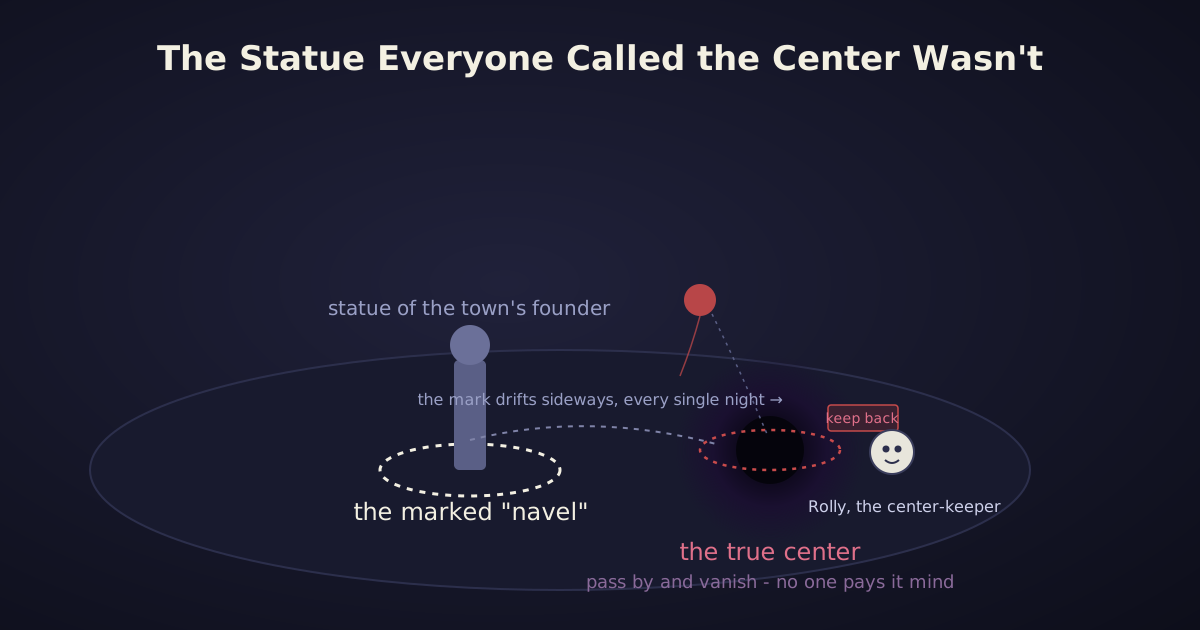
Rolly kept the center of the Moon’s Navel Plaza.
Every morning, first thing, he’d roll out and trace a careful white circle right in the plaza’s middle. The townsfolk called it “the navel.” Rolly’s own body happened to be round and white too — the one thing he had in common with his handiwork.
Rolly had exactly one joy in life: the annual Centerpoint Festival, when the mayor would read out, “Dead center again this year!” So every day he measured. Meticulously. It was, you might say, his pride.
There was just one small problem with the plaza.
The white circle he’d drawn first thing that morning would, by the next morning, have crept a little sideways. Just a finger’s width. Rolly never complained — he’d simply nudge it back into place, precise as ever. The townspeople had theories. “Must be the night wind.” “Tourists kicking it, probably.” Nobody took the drift seriously enough to actually wonder why.
An old statue stood at the plaza’s center — the town’s founder, cast in bronze. Tourists posed in front of it: “I stood at the exact center of the Moon!” The souvenir shops sold Centerpoint buns. This was, it’s fair to say, a town that loved being in the middle of things.
But just off to the side of that statue —
There was a spot nobody went near. Not a single pigeon landed there. The fountain water leaned that way for no reason anyone could name. When kids dropped coins near it, the coins would drop with a strange little thunk and never turn up again. “That spot’s creepy,” the children said. The adults just laughed it off and walked past, same as always.
It was the day before the festival.
Someone hanging decorations let a bundle of balloons slip from their hand. A red one drifted across the plaza — and got pulled, gently but surely, toward that corner. Then it vanished with a soft crunch. Only the string drifted back down, alone.
Rolly rolled over. He stretched out his measuring line and checked. Checked again. He flipped through his logbook and added up decades of drift, every last measurement.
The answer didn’t budge.
The true center of town was there — a few steps to the side of the statue. Invisible, but something heavy had clearly been sitting in that spot for a very long time. The whole town had been built right beside it, which meant the whole town had been quietly leaning that way for as long as anyone could remember. The old builders hadn’t found the real center at all — they’d just planted a statue somewhere near the unseen thing and called it good. The line Rolly redrew every single morning hadn’t been drifting off course. It had been getting pulled toward the real thing the entire time.
Rolly carried his logbook to the mayor’s office.
The mayor’s face fell. “The festival’s… tomorrow,” he said. “The flowers are ordered, the ribbons are up, everything’s set in front of the statue. Everyone takes their photos there. We can’t exactly move the center now.”
The next day, the festival went ahead exactly as planned, in front of the statue. The mayor puffed out his chest and read the announcement: “Dead center again this year!” The crowd threw flowers at the statue and clapped.
Rolly didn’t object.
While the festival noise carried across the plaza, he quietly strung a rope around the true center, precise as ever, and planted a sign: DANGER — KEEP BACK. Then he stood there alone, just off to the side, where nobody was looking.
The flowers went to the empty statue. The rope, the sign, and small round Rolly stood at the real center of everything.
The next morning, the white circle he’d just redrawn had already crept a little farther sideways — toward the true center that no one ever came to fix.