Supermassive black holes are supposed to live at the very center of their galaxies. That’s been the working assumption for decades. But a recent observation turned up something odd: a black hole sitting about 2,600 light-years off-center, one that had gone completely unnoticed until the moment it swallowed a star.
Stranger still, that same galaxy already has a perfectly normal supermassive black hole parked right at its center. So this one galaxy is hosting two supermassive black holes at once.
I’ll admit I had the wrong picture in my head for a long time — I figured supermassive black holes were basically pinned to galactic centers, full stop. This discovery throws a bit of cold water on that assumption.
Something That’s Supposed to Be at the Center Turned Up Just Outside It
At the heart of most large galaxies sits a black hole with a mass somewhere between a few million and a few billion Suns. The Milky Way is no exception. Ours is called Sagittarius A*, weighing in at about 4 million solar masses, and an international team of radio astronomers actually photographed it in 2022.
So “one supermassive black hole, dead center” has functioned almost like a rule of thumb in astronomy.
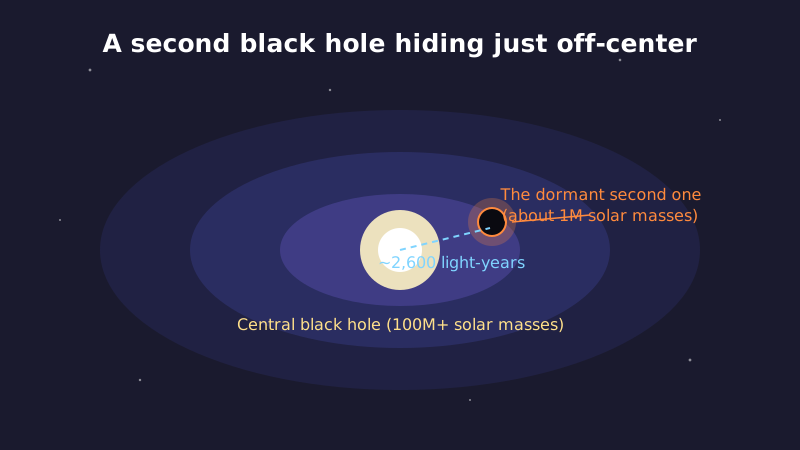
This new find breaks that rule twice over. The black hole the research team spotted weighs roughly a million Suns, and it sits about 2,600 light-years away from the galaxy’s actual center — where a far heavier black hole, over 100 million solar masses, already resides. There’s a heavyweight champion sitting right where it should be, and a much lighter contender was hiding just off to the side.
And this second black hole wasn’t feeding on much of anything. It was, essentially, dormant.
A black hole that barely emits light raises an obvious question: how did anyone find it at all? That’s the first mystery here.
It Gave Itself Away by Eating a Star
A dormant black hole is, for all practical purposes, invisible. It’s not devouring anything, so it’s not glowing — which means one sitting quietly inside a distant galaxy is nearly impossible to spot.
What exposed this one was a single star that wandered too close.
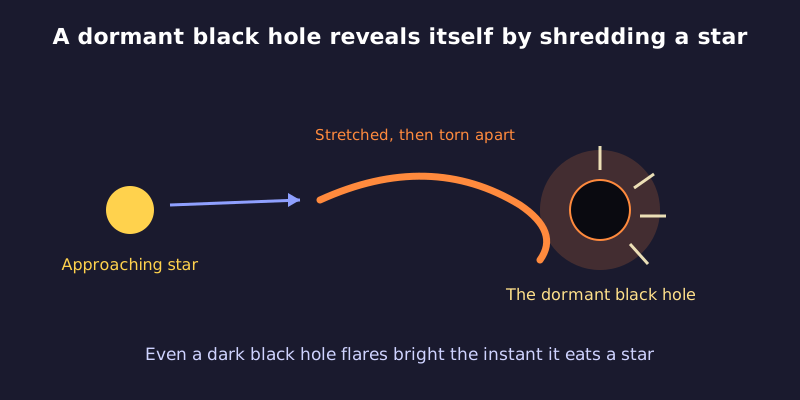
When a star passes near a black hole, the pull on its near side and its far side differs enormously. That difference is tidal force — the same basic force by which the Moon tugs at Earth’s oceans to create tides. Get close enough to a black hole, though, and that force becomes monstrous. The star stretches like a noodle and eventually snaps apart.
The shredded gas spirals around the black hole, heating up violently and lighting up in the process. Astronomers call this a tidal disruption event — a flare produced when a black hole rips a star to pieces. A black hole that’s normally dark suddenly broadcasts light across the cosmos, for as long as it takes to finish off one unlucky star.
The flare brightens fast, then fades slowly over months to years. That fade pattern is the giveaway: it’s not a stellar explosion, but a star being torn apart piece by piece.
If you happened to be standing on that star as it fell in, you’d watch a single point in the sky swell larger and larger while the ground beneath your feet stretched vertically into oblivion — for a brief, horrifying moment. It’s not a pleasant thing to picture.
This particular flare was named AT2024tvd. It’s reportedly the first clearly off-center tidal disruption event ever caught by wide-field sky surveys that repeatedly scan the entire sky. The research team confirmed the flare’s position was distinctly offset from the galaxy’s center using the Hubble Space Telescope, the Chandra X-ray Observatory, and the Very Large Array radio telescopes — and traced it back to a hidden black hole.
Why Isn’t It at the Center?
So why would a black hole end up just off-center in the first place? Take a second to think about it — heavy objects should, in theory, settle toward the middle.
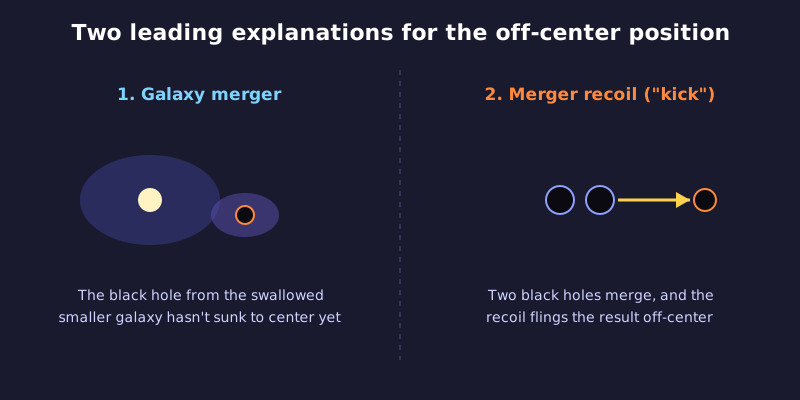
Researchers have two main scenarios in mind.
The first is galaxy mergers. Galaxies collide and merge with each other over vast stretches of time, growing larger by swallowing smaller neighbors. When a smaller galaxy gets absorbed, the black hole at its center comes along for the ride. But actually sinking all the way to the host galaxy’s center and merging with the resident black hole takes an almost unimaginably long time. This second black hole might simply be partway through that journey, still drifting somewhere short of the finish line.
The second scenario is rougher around the edges. When two black holes merge, the gravitational waves — ripples in spacetime — they emit can radiate unevenly in one direction. That asymmetry produces a recoil, kicking the newly merged black hole off in the opposite direction, the same way a cannon jerks backward when it fires. Astronomers call this a “kick.” Get a strong enough kick, and you can end up flung well away from the center.
Which of these two paths this particular black hole actually took is still an open question. The honest answer seems to be that researchers can’t yet rule out either the merger-in-transit story or the recoil-kick story. Either way, though, it chips away at the assumption that a galactic center is always represented by exactly one supermassive black hole.
How Far Off-Center Is 2,600 Light-Years, Really?
The number 2,600 light-years doesn’t mean much on its own. But stick with me for a second, because it lines up with a distance that’s actually pretty familiar.
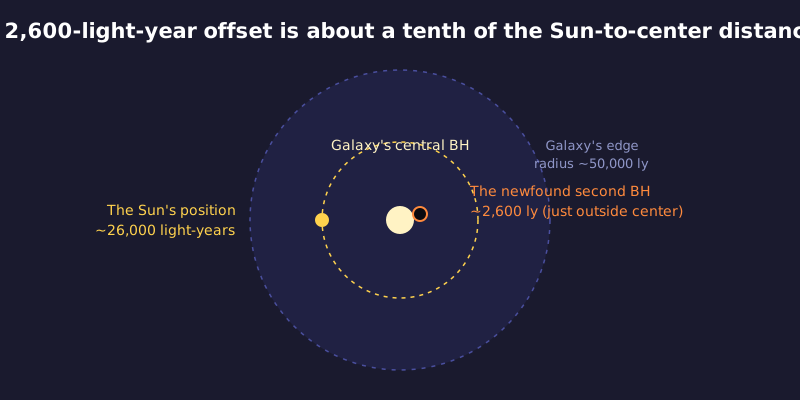
Our Sun sits about 26,000 light-years from the Milky Way’s center — we live in the suburbs, not downtown. The offset of this newfound black hole, roughly 2,600 light-years, works out to exactly one-tenth of that distance.
Honestly, my first reaction was that the number looked like a typo. I’d assumed “off-center” meant “out in the boonies,” but it’s the opposite. This black hole sits much closer to the middle than the Sun does — practically in the galaxy’s heart. And yet it’s still not quite at the very center.
To be fair, 2,600 light-years is an absurd distance by any human measure — even traveling at the speed of light, the trip would take 2,600 years. But set against a galaxy roughly 100,000 light-years across, that same distance shrinks down to essentially next door to the center.
Try transplanting the scenario onto the Milky Way. It would mean a second black hole, weighing about a million Suns, lurking ten times closer to our galactic core than we are — almost within arm’s reach of the resident heavyweight, but still not quite settled in.
There Might Be a Lot More Hidden Ones Out There
Here’s where it gets interesting. This isn’t just a story about one oddball black hole.
Think about it: a dormant, dark black hole sitting off-center in some other galaxy would be completely invisible under normal circumstances. This one only turned up because a single star happened to wander close enough to get torn apart, producing a flare. In other words, without that one lucky (for us — decidedly not for the star) meal, it would have stayed hidden forever.
Which raises the question: how many other quietly dormant, off-center black holes are lurking in other galaxies right now? The team behind this discovery suspects these “wanderers” might not be rare at all. Given how many times galaxies have merged over cosmic history, it would hardly be surprising if plenty of black holes are still scattered around, never having made it all the way to the center.
Tidal disruption events are one of the few tools we have for flushing these hidden black holes out into the open. Wide-field surveys that repeatedly photograph the entire sky and automatically flag sudden bright spots are getting better all the time. Keep watching patiently for these flares, and it becomes possible to pin down the location and mass of black holes that never emit light on their own — essentially, a census of the ones hiding in plain sight.
Waiting Just Short of the Center, for the Next Star to Wander By
The prime real estate at a galaxy’s center isn’t necessarily claimed by just one supermassive black hole. Sometimes a second one is crouched just short of it, staying out of sight.
Somewhere out there, in the outskirts of a distant galactic core, a black hole drifts quietly — emitting no light, swallowing nothing, just waiting. The only reason we ever notice it is if a single star has the misfortune of drifting too close and gets torn apart, producing a brief flash of light.
So the next time an unexplained point of light flickers on somewhere in the night sky, it might just be a black hole that woke from a long sleep just shy of a galaxy’s center — and quietly finished off a star that wandered too close.