Picture a photograph of a galaxy: a spiral disk of light, an almost dizzying number of stars. It’s tempting to think that image captures the whole thing. But it doesn’t. Most of a galaxy’s mass sits outside the frame, wrapped in a sea of invisible, diffuse gas many times wider than the star-filled disk you can actually see.
A small satellite called ASPERA is setting out to measure that sea. Weighing about as much as an adult human, this modest spacecraft is reaching for a “hidden body” of the galaxy that even the largest ground telescopes have never been able to photograph.
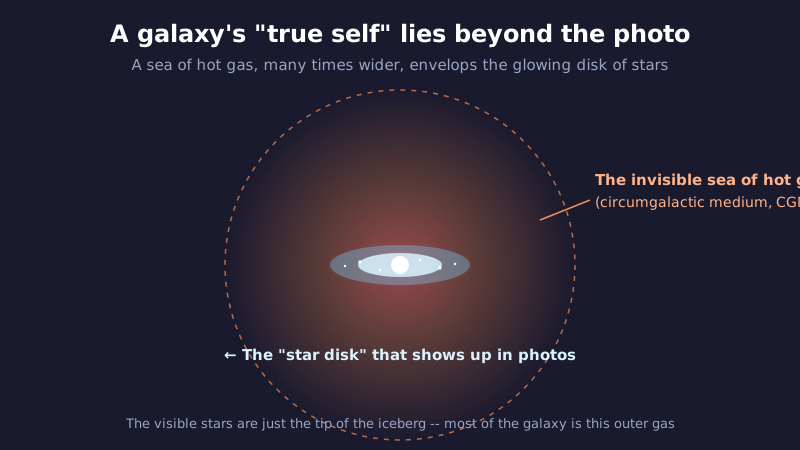
A galaxy’s “true self” lies beyond the photo
What we usually think of as a galaxy is really just the disk densely packed with stars. But beyond that visible disk, gas spreads out in a way our eyes can barely register. Astronomers call this the circumgalactic medium, or CGM — matter drifting thinly around the galaxy.
The tricky part is scale. This gas seeps out far past the star disk, extending several times wider than the galaxy itself. And most of it is so thin and spread out that it emits almost no visible light. The swirl of stars in a photograph, it turns out, is just the tip of the iceberg.
For a long time, we studied only the flashiest part of a galaxy and assumed we understood the whole picture. The glare of starlight was simply too bright, and the faint gas surrounding it slipped past our instruments. So how do you go looking for something you can’t see?
How do you “see” gas that’s invisible?
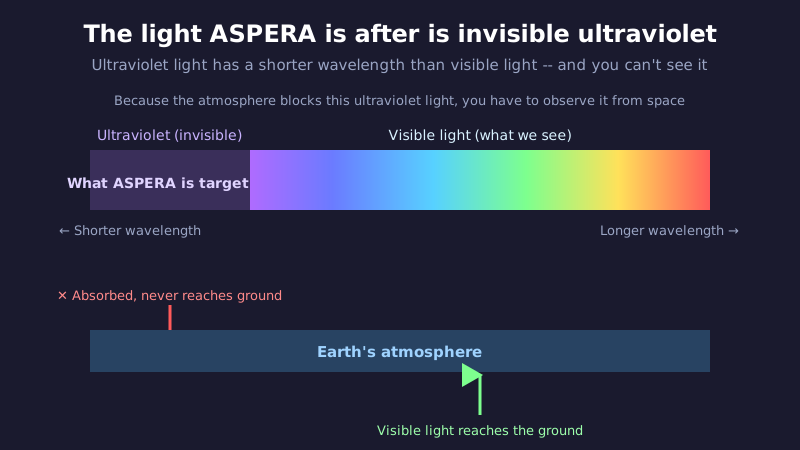
The hot gas enveloping a galaxy doesn’t reveal itself in visible light — it announces its presence in ultraviolet. ASPERA is built to follow that ultraviolet trail to a kind of gas that has, until now, remained essentially undetected.
Most people know ultraviolet light as the thing that gives you a sunburn. It has a shorter wavelength than visible light, and the human eye simply can’t register it. The ultraviolet glow from galactic gas is no exception — invisible to the naked eye, full stop.
There’s a second complication, too: this particular flavor of ultraviolet light gets almost entirely absorbed by Earth’s atmosphere before it reaches the ground. No matter how large a telescope you build on a mountaintop, you’ll never catch this gas glowing. The only option is to leave the atmosphere behind. It isn’t sunscreen protecting us so much as the atmosphere itself, screening out intense ultraviolet radiation before it ever gets close.
What’s striking is that this circumgalactic gas has never been clearly observed at all. The mission team believes ASPERA could be the first spacecraft to actually pull it off. The name itself is telling: ASPERA is Latin for “difficulties” — a name chosen deliberately for a wall nobody has managed to climb.
Not a giant telescope, but a deliberately small satellite
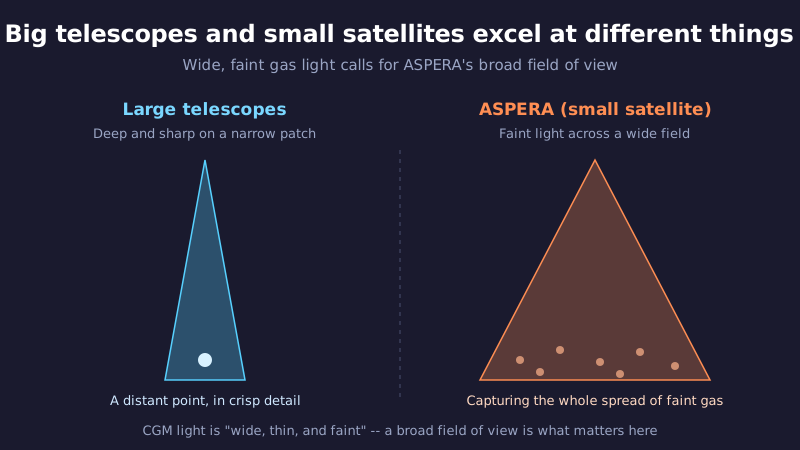
Here’s the interesting twist: the spacecraft taking on this challenge isn’t some massive space telescope. ASPERA is a SmallSat — genuinely compact. It weighs roughly 120 pounds, less than 60 kilograms. A probe about the weight of one adult is heading out to measure a galaxy’s hidden bulk.
Why does small work here? Because the light from circumgalactic gas is “wide, thin, and faint.” Large telescopes excel at staring deeply into a narrow patch of sky to sharpen up a distant galaxy. What they’re not built for is scooping up a dim glow smeared across a huge swath of sky. ASPERA flips that trade-off: a wide field of view, built specifically to capture faint light spread across an area.
The mission sits under NASA’s Pioneers program, which funds low-cost, small-scale astrophysics missions that tackle questions bigger programs don’t have the bandwidth for. ASPERA was selected under that banner and is led by a team at the University of Arizona’s Steward Observatory — helmed, notably, by one of the youngest principal investigators in NASA’s history.
The hardware build stays lean, too. The spacecraft bus itself was built by Toronto’s Space Flight Laboratory. While large telescopes aim to be all-purpose instruments — capable of almost anything, at enormous cost in time and money — ASPERA does the opposite: it has exactly one job. Map the faint ultraviolet glow of gas surrounding nearby galaxies. That’s it. The target is a faint, fingerprint-like signal from relatively nearby galaxies — not the far edge of the observable universe, but galaxies close enough that researchers can start sketching a map of this invisible sea within reach.
Being small means you can bet everything on a single question. Strange as it sounds, that kind of focus might be exactly what it takes to capture an image nobody has ever managed to catch. Launch is planned for 2026, aboard Rocket Lab’s Electron rocket.
Galaxies grow by inhaling gas and breathing it back out
So what do we actually learn by measuring gas we can’t see? The answer connects to an old, big question: how do galaxies manage to keep making stars at all?
Stars form when gas collects together. Logically, once a galaxy burns through its supply of gas, star formation should grind to a halt. And yet many galaxies have kept forming stars for billions of years — as if fuel keeps arriving from somewhere.
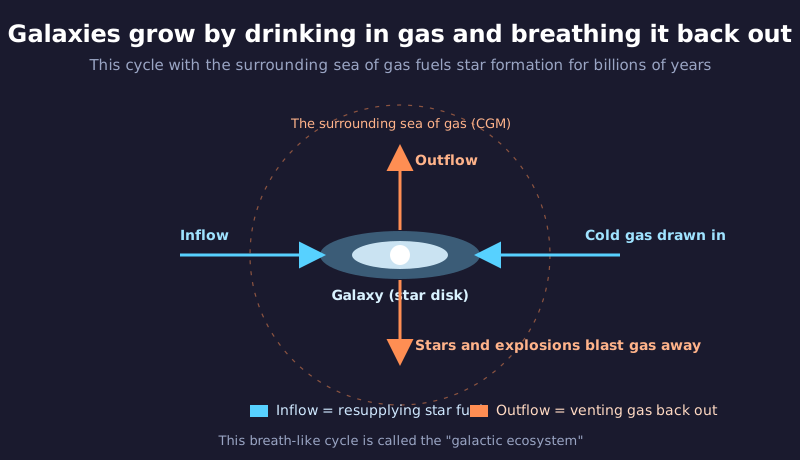
That somewhere is thought to be the circumgalactic gas surrounding the galaxy. Galaxies pull matter in from this outer sea of gas — an inflow — and use it as raw material for new stars and planets. Cold gas, tugged inward by gravity, settles quietly into the disk and eventually ignites new stars. Think of it like drawing water from a well to irrigate a field.
At the same time, newly formed stars and the explosive deaths of others blast gas violently back out of the galaxy — an outflow. Some of that ejected gas travels far before cooling and eventually falling back in. Drink, exhale, drink again. A galaxy isn’t a sealed box; it’s something closer to a living system, constantly trading matter with its surroundings. This inflow-outflow cycle is exactly why researchers are so interested in this gas.
For years, researchers have simulated galaxy growth on computers, modeling how gas flows in and blasts back out. What they’ve lacked is a direct way to check that real gas actually behaves the way the simulations predict. The mission team hopes the map ASPERA produces can serve as a kind of answer key — a way to check computed predictions against physical reality.
If that works, there’s a real payoff: it could tell us whether a galaxy still has fuel left to keep forming stars, or whether it’s running toward empty — a forecast built from how much gas is pooled in its outer reaches. Eventually, the same question gets pointed at the galaxy we call home, the Milky Way.
That sea is connected to your own body
Imagine setting up a camera outside the Milky Way, tuned to an extreme sensitivity for ultraviolet light. It wouldn’t just capture the star disk. You’d see our galaxy wrapped in a much larger, dimly glowing cocoon of gas — with the disk itself reduced to a small, bright core at the center.
The atoms that make up your body were forged in stars born from that circulating gas. The oxygen you’re breathing right now traces back, ultimately, to atoms manufactured inside a star. The invisible sea surrounding a galaxy and the air in your lungs share the same origin story.
A galaxy that looks like nothing more than a cluster of stars is, in truth, far bigger and far more dynamic than that — drinking in gas, lighting stars, breathing gas back out. A satellite weighing about as much as one adult, named for the very difficulty of the task, is setting out to measure that enormous breath for the first time. Next time you see a beautiful photo of a galaxy, remember the invisible sea of gas spreading far beyond the swirl you can actually see.