In November 2026, a spacecraft will catch up to an asteroid. Its name is Hera, and it belongs to the European Space Agency (ESA).
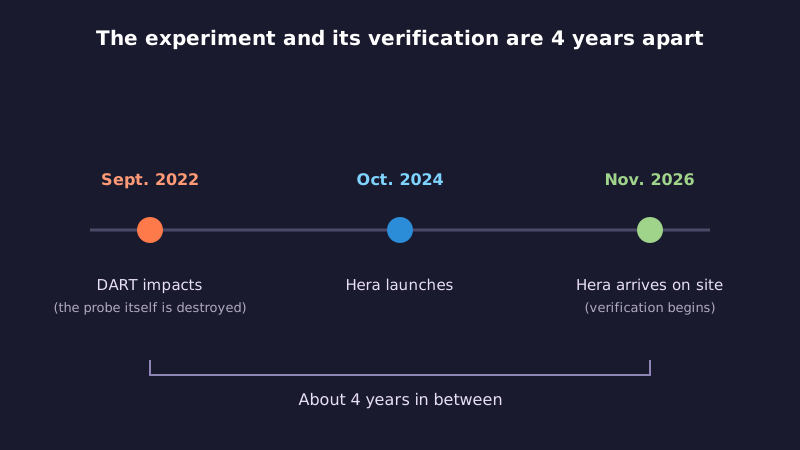
But the “incident” it’s heading toward wrapped up four years ago.
The perpetrator won’t be there. Hera is showing up purely for cleanup duty — to check the results and tie up loose ends.
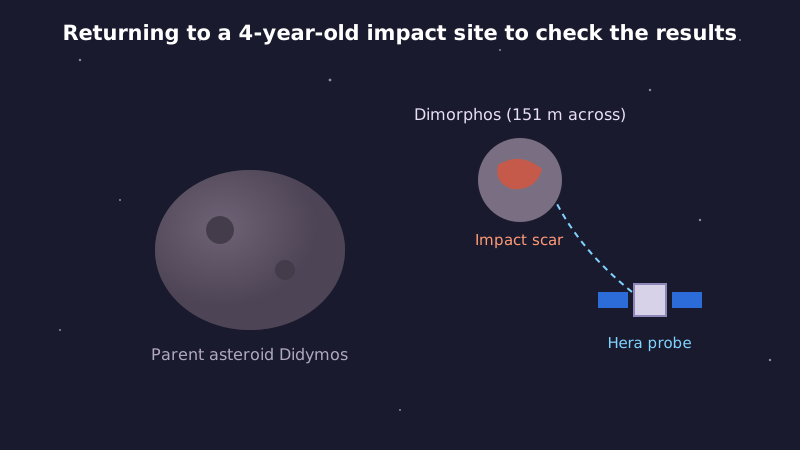
The perpetrator was a different probe called DART. In 2022, it slammed into an asteroid at tremendous speed and shattered into pieces. On purpose.
So why crash a spacecraft into a rock, and why send another one out later just to look? That roundabout process turns out to hold the entire logic of planetary defense.
What Happened to That Rock Four Years Ago
Let’s start with the “incident” itself.
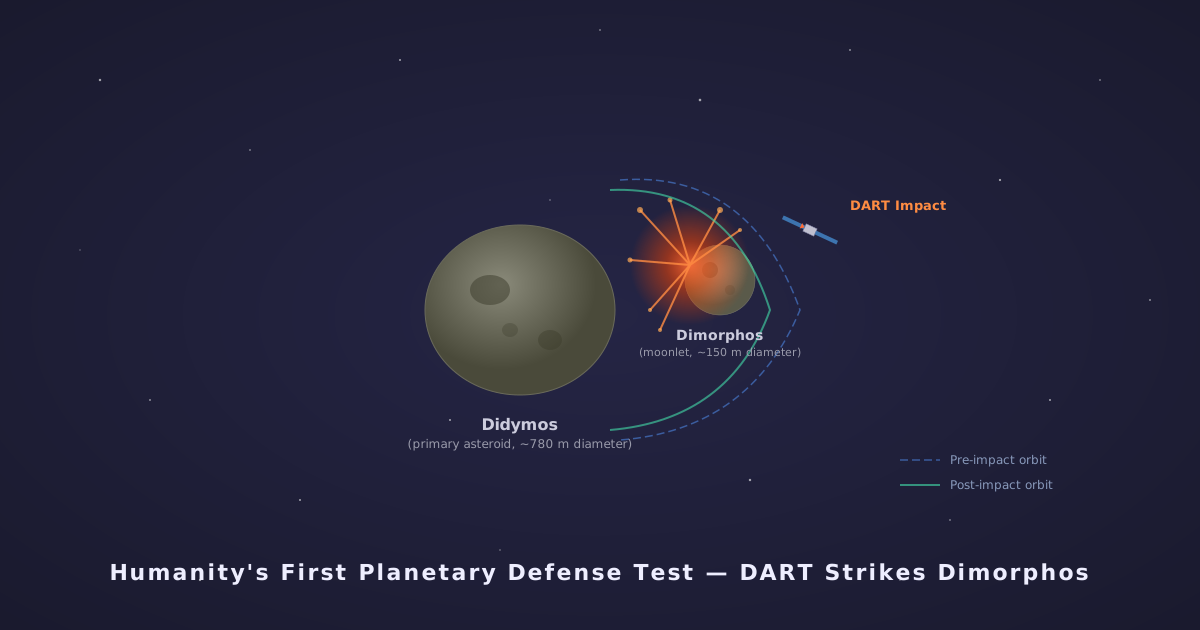
On September 26, 2022, NASA’s DART spacecraft rammed head-on into an asteroid called Dimorphos — a rock about 151 meters across, roughly the size of the Great Pyramid of Giza in Egypt (which stands about 139 meters tall).
The impact speed was staggering: around 22,500 kilometers per hour, roughly 25 times faster than a jet airliner. DART smashed into the rock at that velocity, spacecraft and all.
There was exactly one goal: find out whether ramming an asteroid could actually change its path.
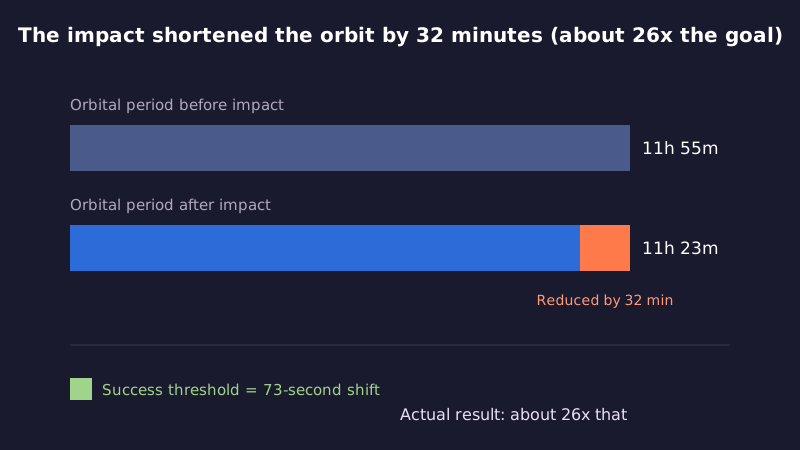
Dimorphos orbits a larger parent asteroid called Didymos. The test hinged on one question: would that orbit speed up?
The answer was unambiguous. Before the impact, Dimorphos took 11 hours and 55 minutes to complete one orbit. Afterward, that dropped to 11 hours and 23 minutes — a shift of 32 minutes.
NASA had set the bar for success at a minimum shift of 73 seconds. What actually happened was about 26 times that. The impact worked far better than anyone expected.
Here’s the strange part: DART, the probe responsible for this success, no longer exists. It shattered on impact and became part of the rock itself. That’s as far as ground-based telescopes could follow the story. Nobody has gotten a close look at what actually happened at the crash site.
From Earth, You Could Only See the Result
Pause here for a second. How did anyone on Earth even know the orbit had shrunk by 32 minutes?
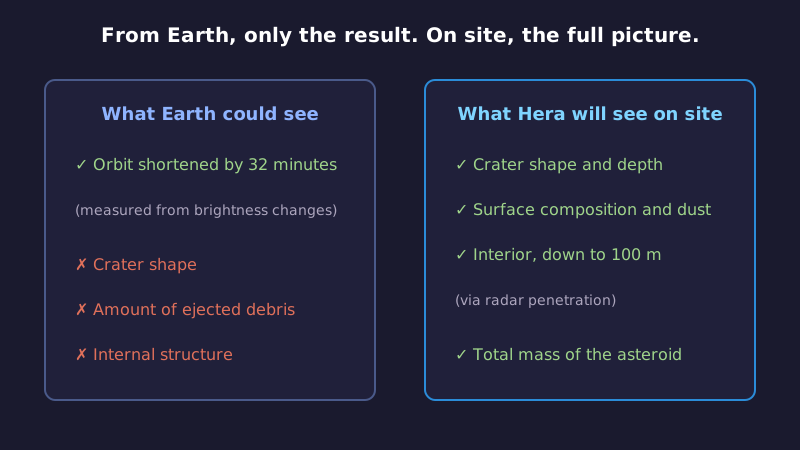
Every time Dimorphos swings behind its parent asteroid, the combined brightness seen from Earth dips slightly. By timing that flicker, astronomers can calculate how long one orbit takes. In other words, ground telescopes were only measuring the outcome — how much the path had shifted — from a distance, indirectly.
At the moment of impact, telescopes also captured a long tail of dust streaming off the rock — almost comet-like. Dramatic to watch, but limited in what it actually revealed.
The crucial details were simply out of reach from Earth.
What shape and depth was the crater? Was Dimorphos a solid slab of rock, or a loosely bound “rubble pile” of pebbles? How much material actually flew off in total? None of that can be measured when your target looks like nothing more than a point of light.
Why does the interior matter so much? Because the same impact force produces wildly different results depending on whether you’re hitting solid rock or loose rubble. It’s entirely possible that debris flying backward off the surface gave the push an extra kick, multiplying the effect several times over.
Without pinning down why the impact worked, there’s no way to know whether that 32-minute shift was a fluke or something you could count on repeating. Someone has to go back and check.
Hera, the Spacecraft Sent to Grade the Homework
That’s where Hera comes in. It launched on October 7, 2024, and has spent roughly two years cruising toward the site.
According to ESA, Hera will be humanity’s first spacecraft to rendezvous with — and fly alongside — a binary asteroid system. Once it arrives, it will study Dimorphos in detail using twelve separate instruments.
Here’s where it gets interesting. Hera is carrying two small companions: palm-sized CubeSats named Milani and Juventas.
Milani’s job is to analyze surface composition and the dust drifting around the asteroid. Juventas is more ambitious — it will use radar to peer up to 100 meters into the rock’s interior, essentially scanning the 151-meter body almost down to its core.
Hera is also practicing something else: flying on its own judgment. ESA calls this autonomous navigation. Radio signals from Earth take too long to arrive for tight maneuvers around a small asteroid, so Hera has to read its own camera feed and make navigation calls in real time.
Picture yourself looking through Hera’s camera. You’d be slowly descending on the very scar left by a spacecraft that sacrificed itself four years earlier — a crater no one has ever seen up close, gradually resolving into focus. A rock that’s only ever been a point of light from Earth is about to become an actual place, with actual terrain.
I’ll admit, this whole arrangement struck me as anticlimactic at first. The impact felt like the main event, and the follow-up mission seemed like an afterthought. But the more I looked into it, the clearer it became: this “grading the homework” role is the real point of the experiment.
Why Does the “How Well It Worked” Part Matter So Much?
Why go to all this trouble to slam a spacecraft into an asteroid in the first place?
The idea behind it is called planetary defense — broadly, spotting asteroids on a collision course with Earth well in advance and nudging their orbit just enough to avoid impact. Think of it as space-age disaster prevention.
Unlike earthquakes or typhoons, an asteroid strike is one of the rare disasters you can actually prevent before it happens. But that only works if you know the orbit years in advance and give it a small nudge while the asteroid is still far away. There’s no last-minute save — you can’t shove a house-sized rock aside at the eleventh hour.
You obviously can’t test this technique on a genuinely dangerous asteroid, which is why Didymos and Dimorphos were chosen. Neither poses any threat to Earth — they’re a safe practice target where the actual numbers behind a deflection can be nailed down precisely.
Honestly, this is my favorite part of the whole story. Behind the grand phrase “defending Earth” is a surprisingly unglamorous process of careful measurement.
The recoil from ejected debris matters enormously. On top of the direct force of the collision, the material blasted backward off the surface pushes the asteroid even harder, like a rocket firing in reverse. How much that “bonus push” contributed can only be measured by counting the debris on site.
DART proved a single fact: hitting an asteroid changes its path. But if Hera can measure the amount of debris and the internal structure, scientists can build an actual formula — what kind of rock, hit at what speed, with what mass, produces what deflection.
It’s the same principle as tasting a dish while you cook, or double-checking a finished piece of woodwork. You take something that worked once and figure out exactly why it worked. Only then does a single success turn into a repeatable technique — a procedure you can trust to work again. That conversion is Hera’s job.
Science Doesn’t Just Walk Away From Its Experiments
Laid out like this, the shape of the whole plan starts to look unusual.
One spacecraft does the hitting. A completely different spacecraft does the checking. And the two events are separated by four years. DART, the one responsible for everything, shattered and became part of the rock — and its follow-up exam is being administered years later by a probe that had nothing to do with the original impact.
The impact itself is the dramatic part, no question. But what turns that single collision into something meaningful is the quiet verification work that comes after. Planetary defense isn’t built on a bold, singular strike — it’s built on this kind of patient, unglamorous follow-through.
In November 2026, Hera will quietly catch up to a four-year-old crime scene. All that will float in front of its camera is a rock whose perpetrator vanished long ago, carrying a single scar and waiting, still, for someone to check the answer.