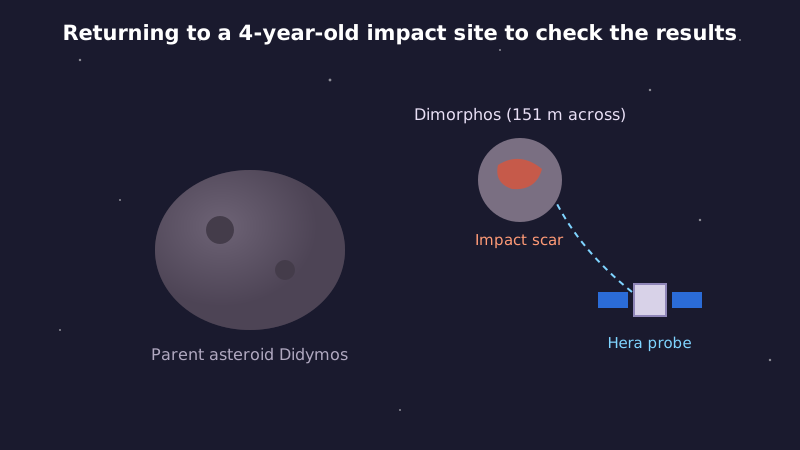
On September 26, 2022, humanity deliberately changed the path of another world for the first time. A spacecraft flew straight into the asteroid Dimorphos and shifted its orbit by 32 minutes. And yet, all these years later, nobody fully knows why it worked quite so well.
The impact moved the asteroid 25 times more than expected
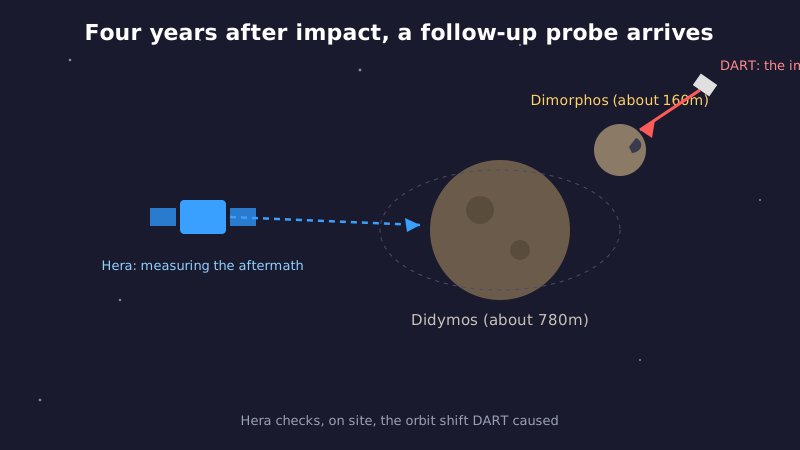
The spacecraft was NASA’s DART — short for Double Asteroid Redirection Test. Launched in November 2021, it spent about ten months crossing space to reach its target: a roughly 160-meter chunk of rock called Dimorphos.
A number like 160 meters doesn’t mean much on its own, so picture this: it’s about the size of the Great Pyramid of Giza, floating loose in space. That rock orbits a much larger asteroid, Didymos, some 780 meters across, the way a moon circles a planet. Together they form what’s called a binary asteroid system.
DART hit Dimorphos at roughly 6 kilometers per second — fast enough to cross central Tokyo in about a second. A refrigerator-sized spacecraft, thrown at full speed into something the size of a pyramid.
DART itself didn’t survive the encounter. It kept photographing the asteroid’s surface right up to the final seconds, beaming the images back to Earth as it closed in — a one-way mission that ended in the collision itself.
The payoff: Dimorphos’s orbit around Didymos shrank from 11 hours 55 minutes to 11 hours 23 minutes. A difference of 32 minutes. NASA’s threshold for calling the mission a success was a shift of just 73 seconds. The actual result beat that bar by more than 25 times over.
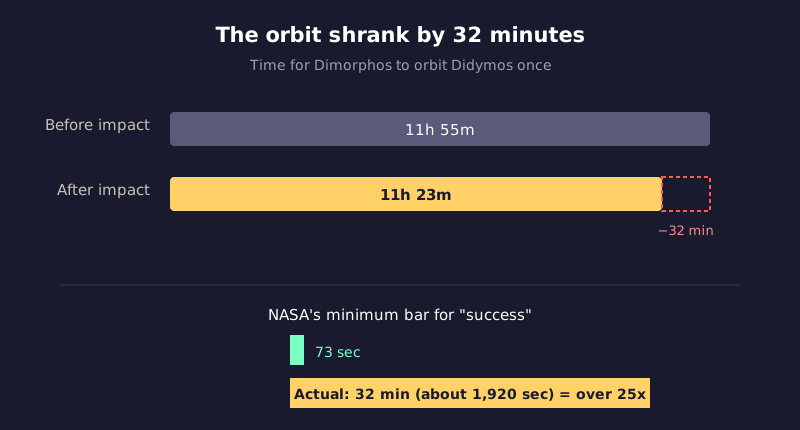
Honestly, my first reaction to that number was “wait, isn’t that too much?” The mission team hadn’t expected it to work quite this well either. And that overperformance became the next big question.
Why target a binary asteroid in the first place?
Here’s a puzzle worth pausing on: how do you even measure a tiny course change in a 160-meter rock, tens of millions of kilometers away?
It turns out the choice of a binary asteroid was itself the trick. If DART had hit a lone asteroid, any small shift in its orbit around the sun would have been nearly impossible to detect from Earth. But because Dimorphos orbits Didymos, it periodically passes in front of and then behind the larger rock — and each time it does, the combined brightness of the pair dips slightly.
By patiently tracking that flicker with ground-based telescopes, scientists could read the change in Dimorphos’s orbital period directly. That 32-minute figure wasn’t measured by the spacecraft at all — it was teased out of the brightness data collected by telescopes back on Earth.
In other words, DART chose its target not for ease of impact, but for ease of verification. As experimental design goes, that’s a pretty thoughtful setup.
The overperformance was the real mystery
This is the part I find most interesting.
If DART had simply hit Dimorphos like a cue ball striking a billiard ball, the asteroid would have absorbed a single, predictable push. But that’s not what happened. The impact blasted a huge plume of rock and dust off the surface — and that ejected material acted like rocket exhaust, shoving the asteroid even further in the same direction.
So Dimorphos got hit twice: once by the spacecraft itself, and again by the recoil from its own material flying off into space. That “bonus kick” is the leading explanation for why the result beat expectations by 25 times. It’s even possible that the ejected debris pushed the asteroid harder than the spacecraft did.
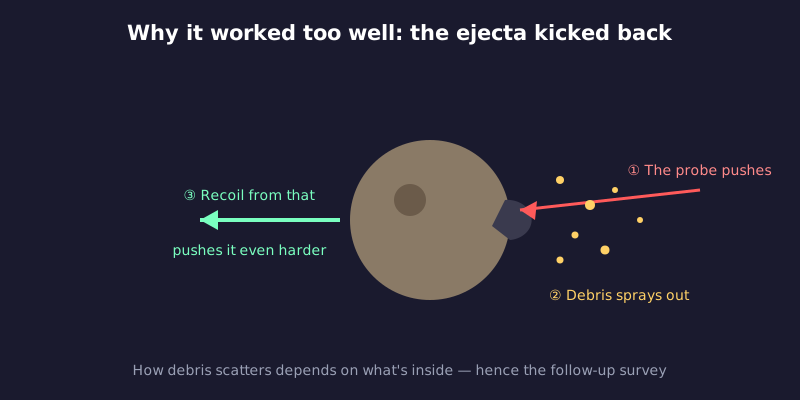
This is a fine-grained detail, but skip it and the rest of the story stops making sense. How much recoil you get depends heavily on what the asteroid is made of — whether it’s one solid slab of rock or a loosely packed pile of rubble determines how debris scatters. Kick a sandbox and kick a concrete slab: wildly different amounts of dust fly up. Something similar just played out in space.
Think of it like a recipe. Getting a great result once, by accident, doesn’t mean you can repeat it — not unless you understand why it worked. DART succeeded spectacularly, but without knowing why the multiplier was what it was, there’s no way to calculate what would happen against a genuinely dangerous asteroid next time.
A single success isn’t yet a technology. Someone has to go back to the scene, measure the mechanism behind that shift, and confirm it firsthand.
Four years later, Hera arrives to check the math
That fieldwork now falls to ESA’s Hera spacecraft. Launched in October 2024, it’s scheduled to reach the Didymos-Dimorphos system in November 2026.
If DART was the one that threw the punch, Hera is the one doing the cleanup and measurements. Arriving at the same site years later, it will carefully survey the scars the impact left behind — the first time humanity has studied a binary asteroid system in this much detail up close.
The four-year gap between impact and arrival isn’t a sign anyone was dragging their feet. Launch windows only open at certain times, and the journey itself takes years. Confirming what happened out there is, by nature, a slow business.
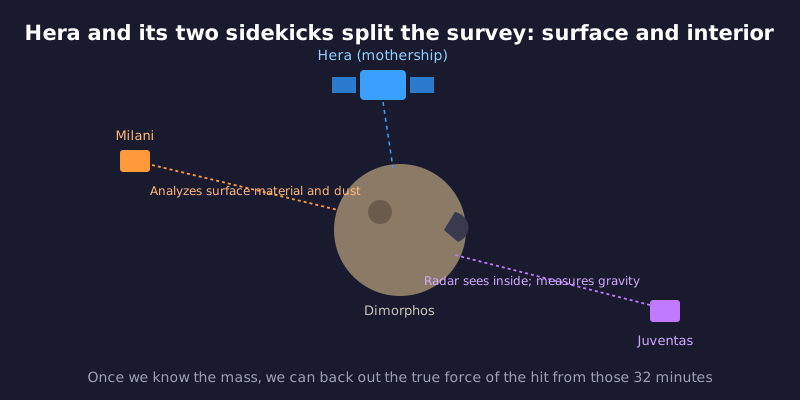
What Hera wants to know most is Dimorphos’s mass. Once that’s known, scientists can work backward from the 32-minute shift to calculate exactly how much momentum DART’s impact delivered — finally putting a number on why the mission overperformed.
So how do you figure out an asteroid’s weight and interior structure? As it turns out, Hera isn’t traveling alone.
Two shoebox-sized companions will look inside the rock
Hera carries 12 scientific instruments along with two small companion satellites, known as CubeSats — each roughly the size of an oversized shoebox, working independently near the mothership.
One, named Milani, will analyze sunlight reflecting off Dimorphos’s surface to determine what it’s made of and study the dust drifting around it. The other, Juventas, will use radar to peer up to 100 meters into the asteroid’s interior — the first time this kind of internal scan has ever been attempted on an asteroid. Is the ground beneath the surface riddled with voids, or packed tight? That internal structure, which shapes exactly how debris scatters on impact, will finally come into focus. Juventas is also planned to gently touch down on the surface near the end of its mission, measuring the asteroid’s gravity directly.
Imagine standing where Hera’s camera will be, slowly approaching the rock. You might see the crater DART carved into what was once untouched stone. Some researchers even suspect the impact reshaped Dimorphos more broadly than a single crater suggests — that’s how violent an event a 25-times overperformance really represents.
Even a well-studied asteroid can hold plenty of unanswered questions. I wrote about another spacecraft chasing a rock closer to Earth in Tianwen-2’s approach to an asteroid that might be a fragment of the Moon. The closer these rocks are to us, it seems, the more we still have to learn.
Turning a one-time success into a reusable insurance policy
Once Hera finishes measuring Dimorphos’s mass and interior, the DART experiment will finally become a solved problem — one confirmed data point. Given a certain kind of asteroid and a certain impact speed, we’ll know how much of an orbital shift to expect. Nail down even one of these relationships and the rest becomes a matter of calculation.
Imagine, someday, astronomers spot a real asteroid on a collision course with Earth. Instead of scrambling to improvise a desperate impact mission, we could plan the response on paper first: given this size and composition, how many spacecraft, at what speed, would shift the orbit by how many minutes? That estimate could exist before the threat ever arrives. There’s a world of difference between throwing in a panic and throwing with precision. That, unglamorously, is the heart of planetary defense.
The dramatic footage of the collision itself wrapped up back in 2022. What’s quietly unfolding in space right now is the less flashy part — the measuring tape and the calculator. Two shoebox-sized spacecraft are about to peer closely at the scars left on a small rock, far out past where our eyes can follow.