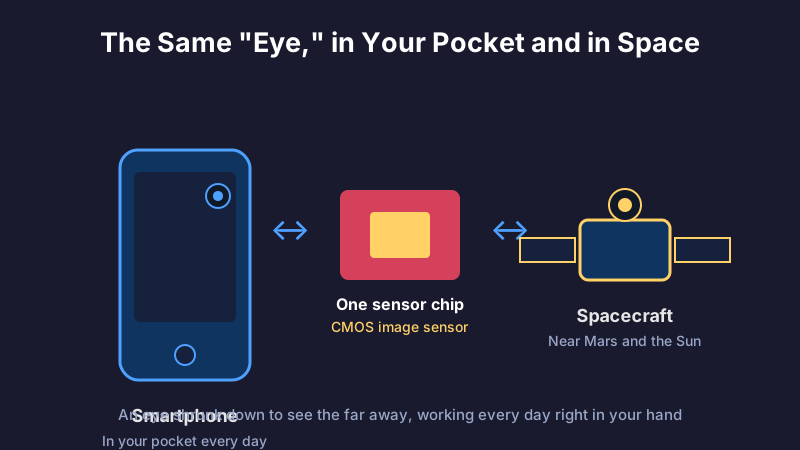
That photo you snapped on your phone this morning came from a chip that was never meant to shoot pictures of Earth. Its design traces back to an “eye” engineers shrank down as small and light as they possibly could, so it could ride along on missions to Mars and to the Sun.
Even the person who built it probably didn’t expect things to go this far. An eye designed to squint at distant worlds is now working overtime in pockets all over the planet.
Honestly, once I learned this backstory, the phone in my hand looked a little different. So today, let’s trace how that “eye” made its way down from space.
The Eye in Your Pocket Started Out on a Spacecraft
The person at the center of this story is Dr. Eric Fossum. He joined NASA’s Jet Propulsion Laboratory (JPL) in 1990 with a single assignment: make the imaging sensors that fly on space missions better.
Cameras built for spacecraft face constraints that cameras on Earth never do. Power is scarce, weight and space get trimmed to the bone, and once the thing launches, nobody’s flying out to repair it. What you need is an eye that’s light, sips almost no electricity, and still captures a sharp image.
At the time, the gold standard for image quality was a sensor called the CCD, or charge-coupled device. Picture quality was excellent. The problem was that it carried a bit too much baggage for a spacecraft.
Why too much baggage? Understanding this is the key that unlocks everything that follows.
Why the CCD, for All Its Virtues, Was Too Heavy for Space
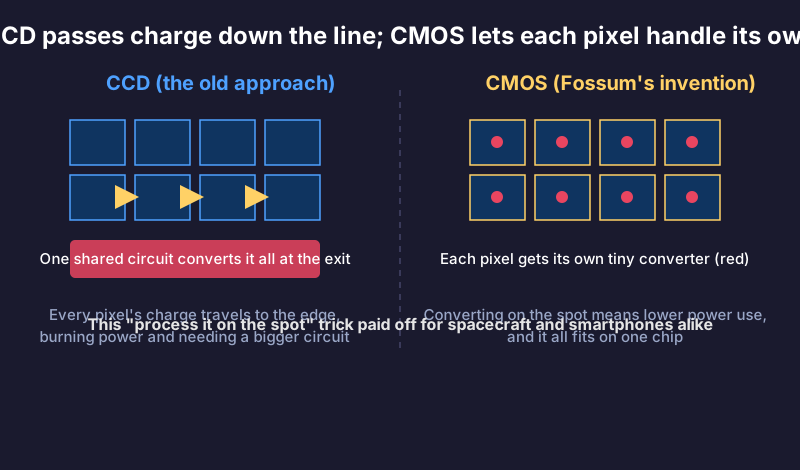
Think of how a CCD captures an image as a bucket brigade. Each pixel, the tiny square on the sensor that catches light, stores the light it receives as an electrical charge. So far, so good.
The trouble starts after that. The stored charge has to be shuffled from pixel to pixel, all the way to a dedicated circuit waiting at the edge of the sensor. Every pixel’s charge makes that same trip to the edge before it finally gets converted into a number. That relay to the edge is what burns through power.
Worse, the circuit that does the converting has to sit separately from the sensor itself. More parts, more power draw, a bigger overall package. On the ground, in a studio, that difference barely registers. On a spacecraft running on a power and weight budget cut to the bone, it matters enormously.
Put simply, the CCD was a gifted student who traveled with too much luggage. Weight that nobody notices on Earth becomes a dealbreaker out in space. What Fossum set out to do was rebuild the whole structure from the ground up.
A Camera on a Chip: Where Every Pixel Does Its Own Math
What he built is called a CMOS active pixel sensor. CMOS is just the name of an ordinary, widely used method for manufacturing semiconductors, so the underlying idea is simple: build a camera the same way you’d build any other chip.
The key move was giving each individual pixel its own small conversion circuit. Instead of relaying charge all the way to the edge, every pixel turns light into an electrical signal right where it sits. Shorter distance means lower power draw, and the conversion circuitry fits onto the same single chip as everything else.
Put another way, if a CCD works like a bucket brigade where everyone passes the charge along and one person at the end does the counting, CMOS is more like everyone counting their own bucket on the spot. Once the job is distributed, the wasted travel disappears.
That difference shows up in the pictures too. When a CCD’s single charge pathway got blocked, bright points of light could smear into a streak. A CMOS sensor closes out its processing pixel by pixel, on location, so stray signal has less chance to bleed into a neighboring pixel. A shorter trip also means less room for noise to creep in along the way.
Processing everything on the spot does introduce a new headache, though: pixel-to-pixel variation shows up as noise, that grainy look in an image. This is where Fossum borrowed a trick that CCDs already used, a technique called correlated double sampling, which cleans up an image by subtracting out the stray signal. He took one of the CCD’s best qualities and moved it into a new, far less power-hungry body.
According to NASA, the result was an eye that used less power than a CCD while still delivering sharp images. As an answer to the spacecraft’s original assignment, it was close to a perfect score.
Here’s where it gets interesting: this eye didn’t stay in space.
How a JPL Invention Ended Up in Your Pocket
Light, power-efficient, and mass-producible using the same process as any other chip: once those three things lined up, the sensor’s future beyond spaceflight was practically written in advance.
In 1995, Fossum and his colleague Dr. Sabrina Kemeny licensed the technology from Caltech and launched a company called Photobit to bring it to market. The inventors of a lab technology had stepped into the role of shipping it out into the world themselves.
In 2001, the semiconductor company Micron Technology acquired Photobit, and that’s when mass production really started grinding into gear. It’s fair to call that the moment a lab prototype turned into a product churned out by the thousands on a factory line.
A technology born in a research lab as “the spacecraft’s eye” was reshaped by industry into “everyone’s eye.” It’s a pretty clean example of what people call a spinoff: space technology trickling down into daily life.
So how far did it spread? Look at the numbers, and the scale changes entirely.
7 Billion a Year: An Eye for Nearly Everyone on Earth
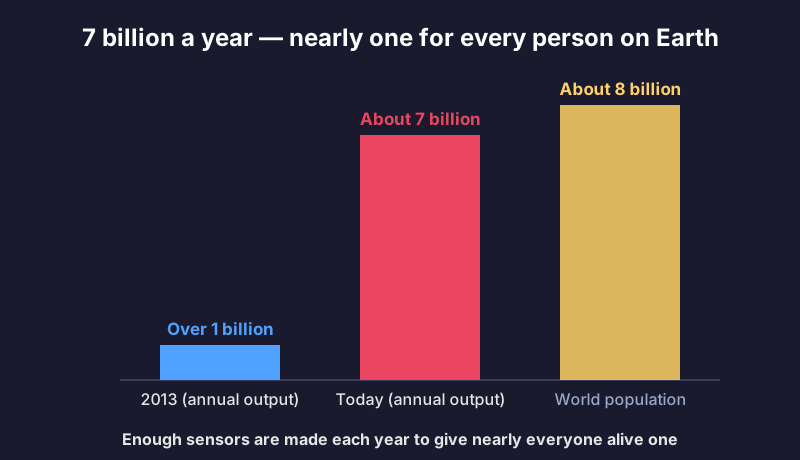
According to NASA, this type of CMOS sensor was already being produced at a rate of over 1 billion units a year by 2013. Today that number has climbed to roughly 7 billion.
Seven billion doesn’t mean much on its own, so let’s set it next to a number you already know: the world’s population is roughly 8 billion. That means, every single year, enough new sensors are produced to hand one to nearly every person on the planet. When I first read that figure, I assumed I’d misread a zero somewhere.
And the demand keeps climbing. It’s now completely normal for a phone to pack several cameras on the front and back alone, so a single device can carry a handful of these eyes by itself. Even a supply large enough to cover all of humanity still gets soaked up almost as fast as it’s made.
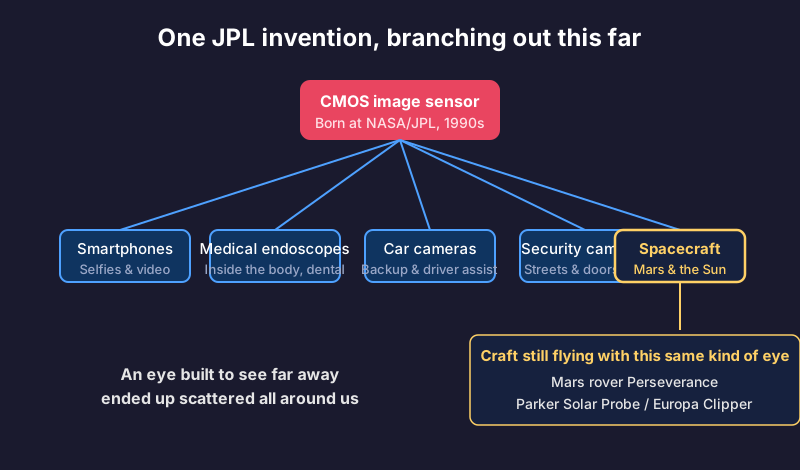
And where do all those sensors end up? All around you. Smartphone cameras, sure, but also medical and dental imaging, car backup cameras and driver-assist systems, security cameras on street corners and front doors. NASA lists exactly this kind of everyday use.
The footage from an endoscope and the image on your dashboard backup monitor both trace back to the same basic idea of an eye. It’s a little startling how deep into the details of daily life a space story can reach.
And we shouldn’t forget the place this technology was born: space itself.
Built to See Far Away, Now Seeing What’s Closest to You
Sensors of the same lineage are still flying on active missions today. NASA counts the Mars rover Perseverance, the Parker Solar Probe skimming close to the Sun, and the Europa Clipper headed for Jupiter’s moon among the spacecraft using this technology.
Which means, right now, an eye built on the same idea is staring at a Martian crater or peering at the Sun’s immediate surroundings. The motion of your finger tapping a selfie and an observation happening light-hours from Earth are connected by the design philosophy behind a single chip.
Fossum, the inventor, is set to receive the Charles Stark Draper Prize from the National Academy of Engineering in 2026 for this work. Call it a recognition that arrived a little late: an eye shrunk down for space ended up changing the daily lives of billions of people on the ground.
Next time you hold up your phone, spare it a thought. That small chip behind the lens was originally designed to look at Mars and the Sun. The thing built to see the farthest is now the thing capturing what’s closest to you.