Cancer treatment often means a needle in your arm, an IV line, and a chair you sit in for an hour while the bag drains. Now imagine swapping that for a single injection that takes a few minutes. Part of the blueprint for that drug was worked out 400 kilometers overhead, aboard the International Space Station.
The patient receiving that shot probably has no idea space had anything to do with it. But it did.
Why Earth Makes Lousy Crystals
Most drug molecules, like salt or sugar, can form crystals. A well-ordered crystal is pure, stable in storage, and easy to dose precisely. Pharmaceutical companies have prized them for decades.
Gravity, though, gets in the way.
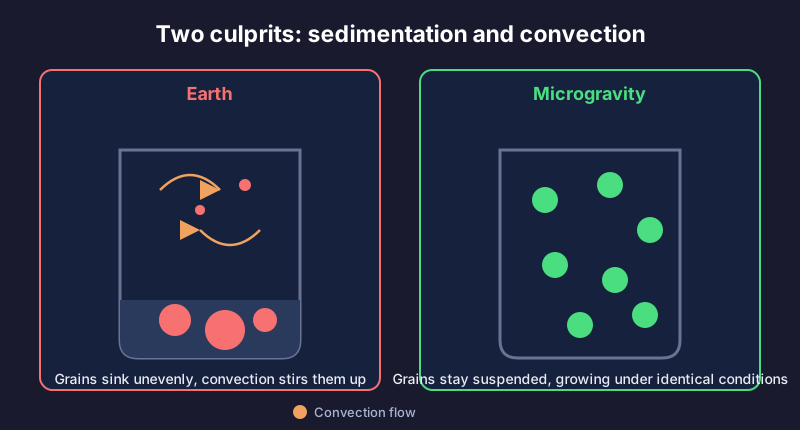
As a crystal starts to grow in a beaker, the heavier grains sink to the bottom. That’s sedimentation. Add in temperature or concentration gradients, and the liquid starts to convect slowly, stirring up the environment around the growing crystal. The result is a messy mix of large and small grains.
The frustrating part: on Earth, there’s almost no way to switch off sedimentation without triggering something else. Stir the liquid and you get more convection. Leave it alone and things sink. As long as gravity is around, one problem or the other always shows up.
This gets especially hard with big, floppy molecules like antibody drugs. Small drug molecules are one thing, but crystallizing these large, bendable molecules cleanly has been a long-standing headache for the pharmaceutical industry.
That’s where space comes in. Inside an orbiting space station, nothing falls — it’s a microgravity environment. Sedimentation barely happens, and convection all but disappears. Crystals hang suspended in the liquid, and every grain gets to grow under the same slow, steady conditions.
When the Cancer Drug Keytruda Went to Space
I’ll admit it: for a long time, I filed space experiments under “romantic, but not much use down here.” This particular story demolished that assumption.
Researchers at the pharmaceutical company Merck Sharp & Dohme teamed up with the ISS National Laboratory to crystallize a drug in orbit. That drug was pembrolizumab — better known by its brand name, Keytruda.
Keytruda works by releasing a brake the immune system normally keeps on itself, letting the body’s own defenses attack cancer cells. It’s a flagship cancer immunotherapy, used worldwide — and, notably, it’s exactly the kind of large, floppy antibody molecule that has always been hard to crystallize.
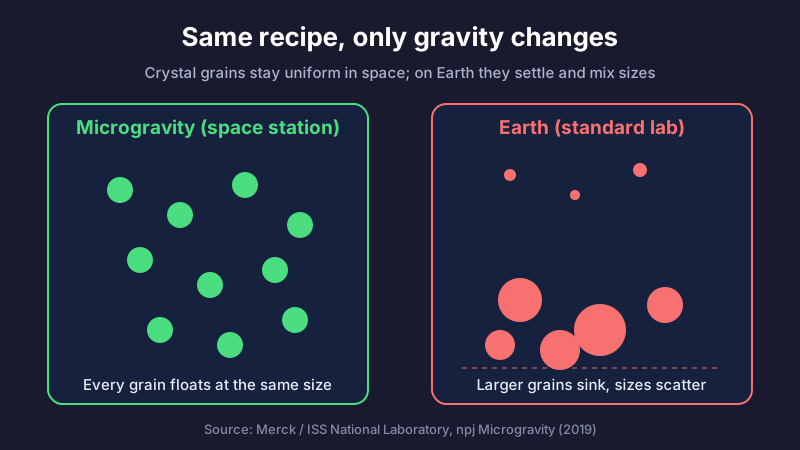
A cargo ship carrying the drug launched on a SpaceX rocket and arrived at the space station. There, the team ran the exact same materials and recipe used on Earth, with gravity as the only variable that changed. A matching batch stayed behind on the ground as a control, which meant researchers could isolate the effect of gravity alone — about as clean an experiment as you could ask for.
Crystallizing a molecule as large as an antibody had long been considered nearly impossible, and the research team was upfront about just how difficult it is. That’s exactly why removing gravity from the equation made such a difference.
The results were published in 2019 in the journal npj Microgravity. What couldn’t be made on the ground turned out to be possible in orbit. And that’s where the story gets interesting.
How 39 Micrometers Changed the Difference Between a Drip and a Shot
The crystals grown in space came out remarkably uniform in size, averaging around 39 micrometers. A micrometer is a thousandth of a millimeter, so 39 micrometers works out to 0.039 millimeters — grains thinner than a human hair (roughly 0.07 millimeters) and nearly identical to each other in size.
The crystals grown on Earth, by comparison, told a different story. That batch ended up as a scattered mix of small 13-micrometer grains and large 102-micrometer grains. Same recipe, wildly different outcome — all because of whether gravity was present.
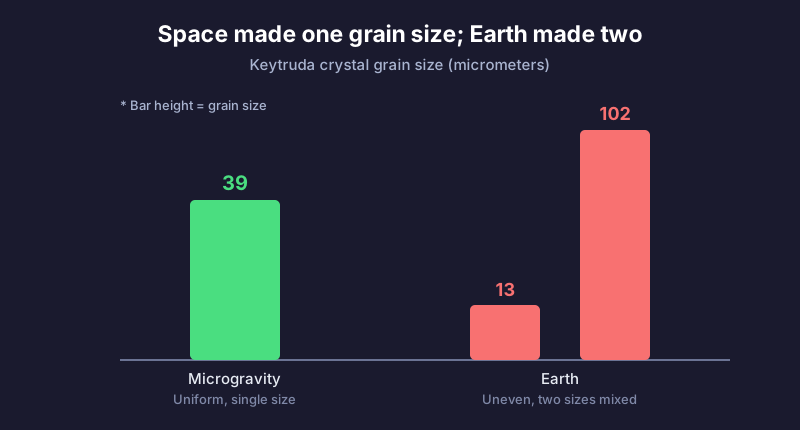
Why does uniform grain size matter? According to the research team, the suspension made from the space-grown crystals was less viscous and settled more evenly than the Earth-grown version. In practical terms, it flowed smoothly through a syringe — exactly what you’d want in an injectable drug.
Here’s where it’s worth pausing. Most cancer drugs are delivered slowly, through an IV line — the arm prick, the chair, the wait while the bag empties. Turning that into a quick shot under the skin would meaningfully change what a hospital visit feels like.
Picture the difference: sitting tethered to an IV pole, watching the minutes crawl by, versus getting a shot and walking out the door moments later, jacket back on. If the drug works just as well either way, that difference matters enormously to the person on the receiving end.
The team then brought what they learned in orbit back down to Earth’s factories. By rotating and cooling the liquid to suppress sedimentation and temperature unevenness, they managed to produce a uniform crystal suspension on the ground too — this time with grains between 1 and 5 micrometers. According to their report, the resulting suspension met the viscosity threshold needed for injection (under 12 centipoise) and pushed smoothly through a syringe.
Get the insight in orbit, then scale it up on the ground. That round trip is the real point of this story.
After Crystals, It’s Nerve Scaffolds
Keytruda is just one example. In its 2025 research roundup, NASA reported that space station research has contributed to the development of newly approved injectable drugs — the reasoning being that a gravity-free environment can produce higher-quality crystals than any lab on Earth.
Growing protein crystals in orbit, by the way, isn’t some one-off stunt. It’s practically a routine item on the space station’s research menu, repeated again and again — French astronaut Thomas Pesquet, for instance, has worked on a crystal-growth study called Protein Crystal Growth-5. Results like this rest on a long foundation of unglamorous, repeated work.
Oddly enough, crystals aren’t the only thing benefiting.
That same 2025 NASA roundup noted that eight medical implants designed to help regenerate nerves were 3D-printed on the space station and sent down for preclinical testing on Earth. The company behind the work, Auxilium Biotechnologies, had the same reason for printing in orbit as the crystal researchers did: gravity.
Try to 3D-print a fine structure on Earth, and the material’s particles tend to settle unevenly as they print. In microgravity, particles don’t settle at all, which NASA says allows for more uniform, stable structures.
Whether you’re growing a crystal or printing a nerve scaffold, the enemy is the same: sedimentation, a problem Earth can’t escape. The one place that can switch it off just happens to be orbiting overhead.
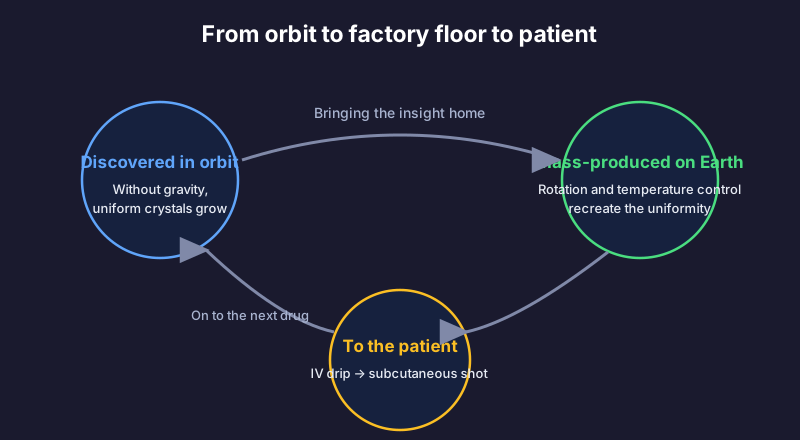
How a Space Experiment Trickles Down to Earth
When people picture research on the space station, they usually imagine astronauts floating around or dazzling photos of stars. What’s actually happening up there, most days, is something far less glamorous — tiny containers quietly growing crystals.
But that unglamorous work is exactly what makes it effective. Armed with the one trick no lab on Earth can replicate — switching off gravity — the space station chips away at hard problems one at a time. The answers come back down as papers, patents, and manufacturing recipes, quietly filtering into everyday use.
It’s easy to assume space research is a distant payoff, something that might matter someday. But the Keytruda crystals, and the nerve scaffolds too, are already pointed squarely at patients on the ground. This isn’t some far-off future — it’s already wired into medicine today.
Next time you or someone close to you gets an injection at a hospital, nobody but the people who made it will think twice about why the drug’s grains turned out so consistent. But part of that consistency may have been worked out 400 kilometers up, over a few gravity-free days. In the instant a needle taps your arm, space is quietly mixed in.