Spend a whole day stuck in bed, and the moment you stand up, your legs wobble. Anyone who has had the flu, or spent time in a hospital, knows the feeling. It turns out researchers can trigger that same “lie down and weaken” response on purpose, in a lab, and make it mirror almost exactly what happens to an astronaut’s body in orbit. The trick: float a person in water.
Five days in water, and the body starts to think it’s in space
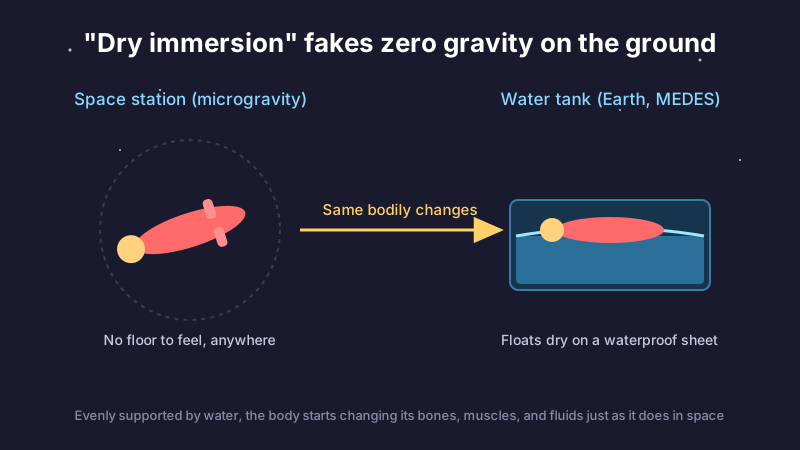
The European Space Agency runs an experiment at MEDES, a space-medicine facility in Toulouse, France, using a technique called “dry immersion.” Researchers fill a bathtub-like container with water and stretch a large waterproof sheet across the surface. Volunteers lie down on top of that sheet.
The body sinks into the water along with the sheet, wrapped entirely by it, yet stays completely dry. Hence the name: dry immersion.
Here’s the interesting part. Supported evenly by water on every side, the body stops feeling any “floor” at all. ESA calls this condition “unloading.” Even the pressure your back feels against a mattress while lying in bed mostly disappears.
That sensation turns out to be remarkably close to the floating feeling astronauts experience aboard the International Space Station.
ESA launched this line of research, called VIVALDI, in 2021. In the first round, 20 women each spent five days submerged for nearly 24 hours a day. Sleeping, eating, even having blood drawn all happened while floating. In a third round in early 2025, 10 men stayed submerged for 10 days.
The first round was deliberately all-women for a specific reason. According to ESA, data on how women’s bodies respond had barely existed until then. It was, in fact, the first all-female dry immersion study ever run in Europe.
Picture yourself inside one of those tanks. At 7 a.m., technicians draw blood and collect a urine sample. Showering, moving to another test, all of it happens flat on your back. For days, you barely get the freedom to roll over.
The body ruthlessly discards whatever it doesn’t use
Why go to the trouble of floating people in water at all? The answer lies in how honest the body really is.
Living under gravity, we use our bones and muscles every single day just to stand, walk, and hold a posture. Take that workload away, and the body concludes it no longer needs the equipment. According to ESA, astronauts in microgravity lose muscle and bone density, while body fluid shifts upward toward the head, altering their vision in the process.
As fluid rises toward the upper body, the face puffs up while the legs grow thinner. That rounder look in astronaut photos isn’t a trick of the camera. Dry immersion triggers the same shift. Bones and muscles, no longer called upon, get handed over for recycling, while fluid climbs from the legs through the torso and up to the head.
From the body’s point of view, it’s simply economizing. Maintaining bone and muscle you don’t use still costs energy. So the instant the load of gravity disappears, the body wastes no time shutting things down.
I’ll admit it: I didn’t expect the body to abandon its own functions quite this readily.
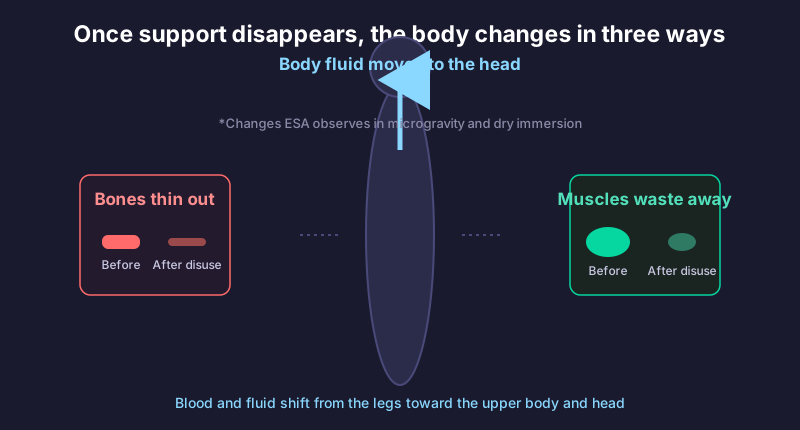
That fluid shift turns out to be a tricky variable to control. In ESA’s experiments, volunteers stay flat on their backs even when pulled out of the tank, with the head tilted just 6 degrees below horizontal the whole time. The point is to stop fluid from draining back down into the legs.
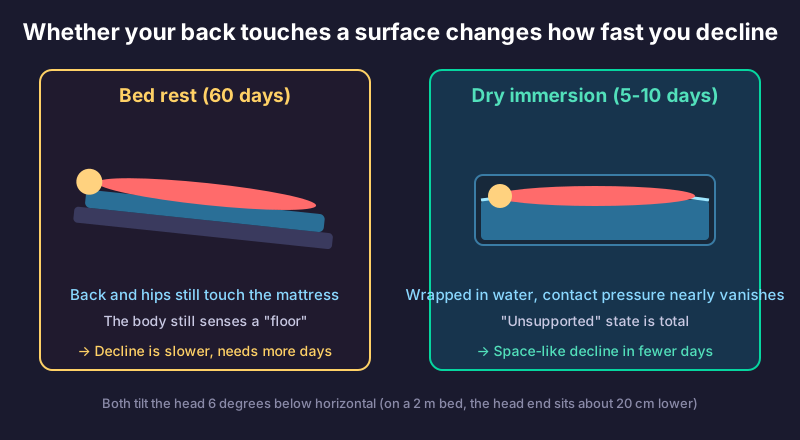
Six degrees doesn’t sound like much on its own. But picture a two-meter-long bed: it’s the equivalent of the head end sitting roughly 20 centimeters lower than the foot end. A tiny tilt, yet the body reacts to it all the same.
Why ordinary bed rest alone isn’t enough
A natural question follows. If the goal is to weaken the body, why not just keep someone in bed for a long time?
ESA actually runs that version too, called “bed rest.” Volunteers stay on a bed tilted 6 degrees below horizontal around the clock, under strict rules: eating, showering, using the bathroom, all while keeping at least one shoulder touching the bed at all times. Some of these bed rest studies run for 60 days straight.
Sixty days. Two months without ever lifting a shoulder off the mattress.
So why bother with dry immersion at all, when it only takes five or ten days? The key is how completely “unloading” gets carried out. Even lying in bed, the back and buttocks still press against the mattress, carrying weight. The body still feels a floor beneath it.
In dry immersion, wrapped entirely in water, even that residual contact pressure nearly vanishes. That’s why fluid shifts and physical decline show up faster and more intensely. Researchers can recreate a space-like state in far fewer days, which also means less strain on volunteers and a shorter, cheaper study.
The point isn’t just to break the body down
One thing worth clearing up: the goal of these experiments isn’t weakening the body for its own sake. The real question is how to stop that decline once it starts.
ESA’s bed rest studies include a centrifuge, a device that spins volunteers to generate centrifugal force as a stand-in for gravity. Some setups add an exercise machine mounted right on the spinning arm, letting researchers compare three groups: people who exercise while spinning, people who just spin, and a control group that does neither.
Which combination best protects bone and muscle from wasting away? Each variable gets tested on its own.
These centrifuge studies run at two sites: MEDES in Toulouse and the Jožef Stefan Institute in Slovenia, each running 60-day protocols. Similar work has long been underway at DLR, the German Aerospace Center, in Cologne, inside a dedicated facility called :envihab. The same institutions sharpen both skills side by side: how to make a body decline, and how to protect it from doing so.
The same insight works on a hospital bed, too
Here’s the part of this story that’s genuinely striking. Research meant for astronauts is turning out to help people who will never leave Earth.
It makes sense once you think about it. After surgery, after a broken bone, after weeks confined to a hospital bed with a serious illness, the body undergoes a decline that looks remarkably like what astronauts experience. Unused bone thins, muscle wastes away, fluid balance tips out of whack. That’s exactly why patients who’ve been bedridden for a long stretch often can’t simply stand back up when the time comes.
ESA notes that findings from this research could benefit “long-term immobile or elderly patients.” What kind of exercise, what kind of stimulus, actually halts the decline? Data gathered in service of spaceflight can become, almost directly, a blueprint for hospital rehabilitation.
Consider the numbers: only a few hundred people worldwide have ever been to space. Meanwhile, people confined to beds by illness or old age number in the thousands of times more. Knowledge refined to protect a handful of astronauts may end up saving, in sheer numbers, far more people recovering right here on the ground.
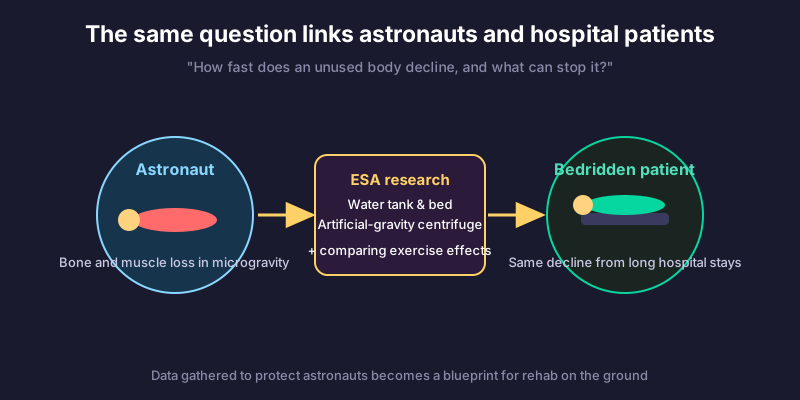
Decades of knowledge have been built up to protect astronauts, knowledge about how to avoid wasting away while immobile. That same knowledge turns out to double as a way to help bedridden people on Earth stand back up. The two paths point in opposite directions, but they start from one and the same question.
A hospital bed might be the closest thing to space
A hospital bed and an astronaut floating in water seem like worlds apart. But a single question ties them together: how fast does an unused body decline, and what can stop it?
Next time you’re laid up for a few days and your legs wobble the moment you stand, remember this. Somewhere along that same thread is a volunteer floating for five days in a French water tank, and an astronaut quietly losing bone density aboard the ISS. The same body, weakening for the same reason, in the same way.


