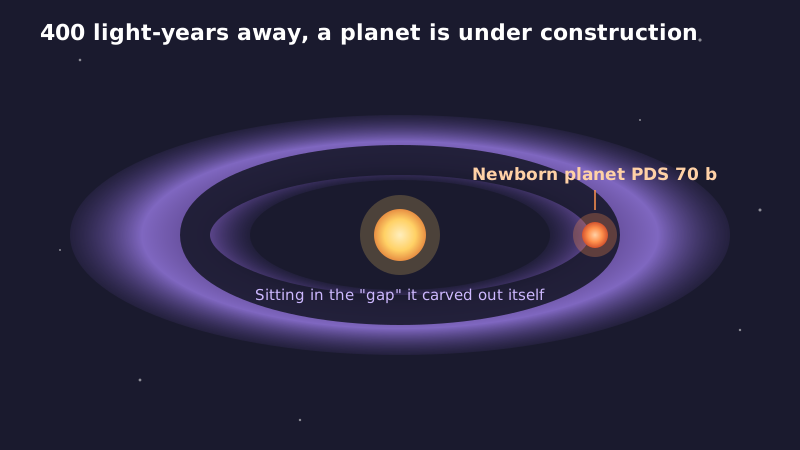
About 400 light-years from here, a planet is being assembled right now. This isn’t a story about finding a finished world — it’s a story about catching one in the middle of being made. Call it a baby picture, except the baby is a planet.
The setting is PDS 70, a young star in the direction of the constellation Centaurus. Wrapped around it is a disk of gas and dust, and punched into that disk is a gap. Inside that gap, something was glowing — a Jupiter-sized planet still under construction.
Honestly, the first time I read about this, I said something out loud. “A planet is born” always sounded like a figure of speech to me. Turns out the whole process can actually show up in a single photograph.
A Point of Light Hiding in the Gap
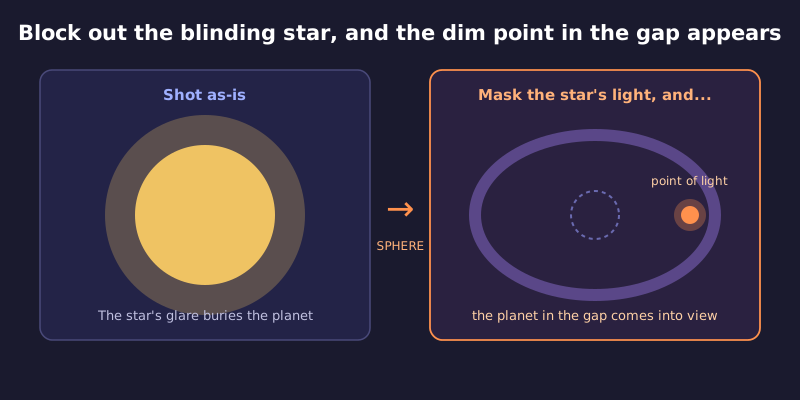
In July 2018, the European Southern Observatory (ESO) announced it had captured a clear image of a newborn planet. The tool was SPHERE, an instrument on the Very Large Telescope (VLT) in Chile, built specifically to cancel out a star’s glare so that faint objects sitting right next to it can finally show up.
What SPHERE picked up was a single point of light, sitting inside the gap in the disk around PDS 70. The research team confirmed it as PDS 70 b, a planet still in the process of forming.
Notice the careful wording there — “clear image,” “confirmed.” Astronomers had spotted planet-like blobs in disks before. So what made this one different?
A “Candidate” Is Not the Same Thing as “Caught in the Act”
Disks around young stars are messy places, full of swirls, rings, and shadows. A bright dot showing up somewhere in that mess doesn’t automatically mean a planet is there — it might just be a quirk in the disk’s structure. For years, astronomers couldn’t tell the two apart with any confidence.
Miriam Keppler, who led the discovery, put the problem plainly: many previous “planet candidates” were probably just disk features after all. In other words, they never made it past the candidate stage.
PDS 70 b was different. The planet was actively pulling in material from its own orbital path, carving a gap into the disk as it went — and the point of light sat exactly where that gap was. The gap itself became the evidence that a planet was really there.
And this wasn’t a one-time observation, either. A separate team went back and re-examined the object’s color and brightness, confirming it behaved like a genuine planet rather than some trick of the disk. Researchers double- and triple-checked before calling it confirmed.
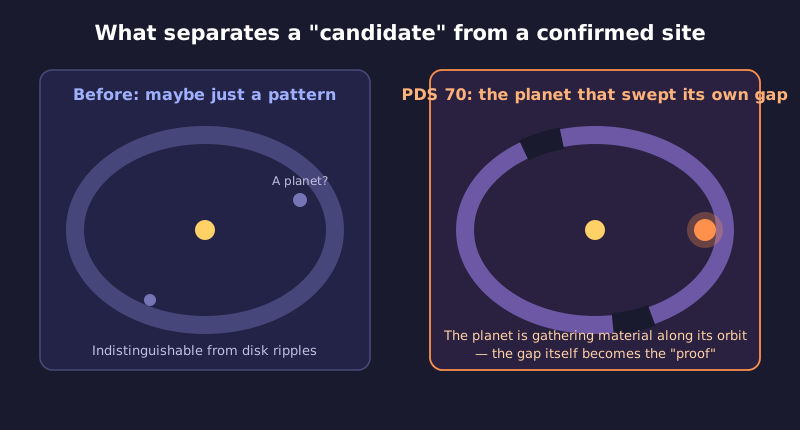
Strange as it sounds, the planet’s own cleanup work is what sealed the deal. Not a dot that might be a pattern, but a construction site actively tidying up its own neighborhood. That distinction matters a lot.
A Baby Planet, Several Jupiters Heavy, Glowing at 1,000°C
So what does this planet actually look like? According to ESO, PDS 70 b is a gas giant several times the mass of Jupiter, with a surface temperature around 1,000°C. Spectral analysis even suggests it has a cloudy atmosphere.
“Newborn” doesn’t mean cold and quiet, though. As surrounding gas and dust fall onto the planet, that infall energy turns straight into heat. The site where material keeps piling up blazes at roughly 1,000°C. In other words, PDS 70 b is bright precisely because it’s still growing. A planet that had already finished forming and cooled down wouldn’t stand out nearly as much.
The distance makes this even more striking. PDS 70 b sits about 3 billion kilometers from its host star — roughly the same distance as Uranus is from our Sun.
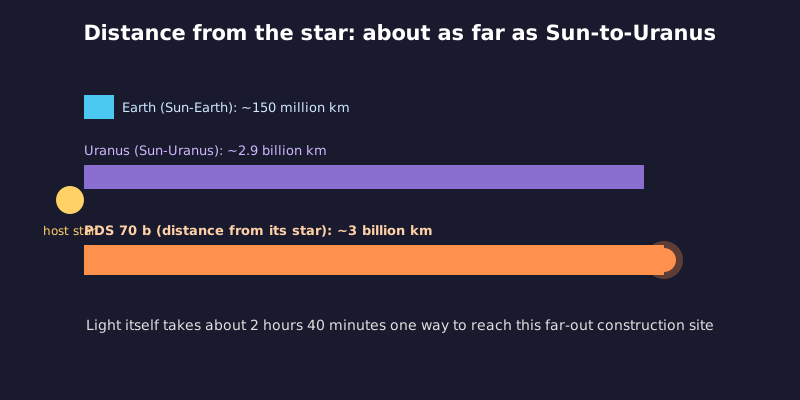
Three billion kilometers doesn’t mean much on its own, so try this: light takes about 2 hours and 40 minutes to cross that gap. Earth only needs 8 minutes to catch sunlight, so this planet sits roughly 20 times farther out than that. Way out in that remote stretch of space, a planet is parked, quietly gathering its own building materials.
Pause here for a second. If you could float next to this planet, you’d likely see a huge, glowing red ball of gas with dust raining down onto it nonstop. This isn’t a finished world — it’s a construction zone, happening in real time.
The Second Planet Was Already Building Moons
Here’s where it gets even more interesting. PDS 70 turned out to have a second planet.
Later observations found a second world, PDS 70 c, sharing the same gap. Then in 2021, ESO announced results from the Atacama Large Millimeter/submillimeter Array (ALMA): a circumplanetary disk — a small disk orbiting the planet itself — showed up clearly around PDS 70 c.
That little disk is roughly the diameter of the distance between the Sun and Earth. And it holds enough material to build as many as three moons the size of our own Moon.
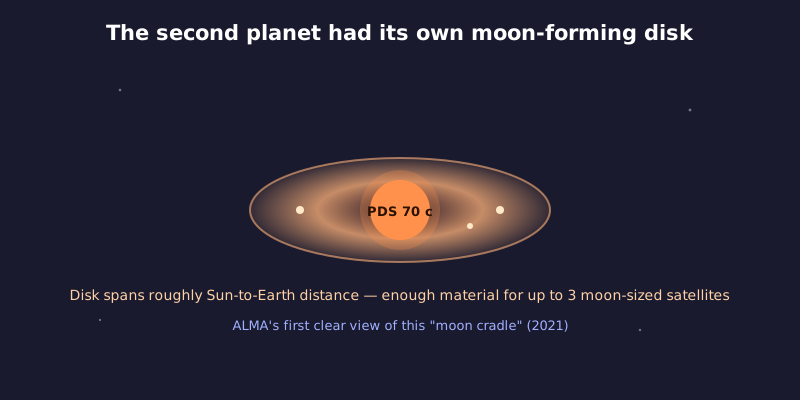
So at a site where a planet is still being born, that very planet is already cradling the raw material for its future moons. The way Jupiter ended up with its Galilean moons — we’re watching an earlier stage of that same process unfold, from the outside.
I’ll admit it: for a long time I assumed planets and moons formed on completely separate timelines. In reality, moon-making material can be swirling around a planet while the planet itself is still growing. Call it a construction site nested inside another construction site.
ALMA’s radio eyes, which can see straight through gas and dust, are what revealed this circumplanetary disk. SPHERE, working in visible light, captured the planet itself as a point of light; ALMA, working in radio wavelengths, mapped the material surrounding it. Layer different wavelengths of light on top of each other, and a single scene suddenly gains depth.
Why Catching a Planet “Mid-Build” Is So Valuable
For a long time, our picture of how planets form came from theory and indirect evidence. Dust clumps together, solidifies, and eventually wraps itself in gas to become a giant planet — that’s the general script, but actual footage of the process in progress has been almost impossible to come by.
What makes PDS 70 valuable is that it shows a stage of that script not as a candidate, but as a confirmed, ongoing event. André Müller, who led the team studying the planet’s properties in detail, put it this way: really understanding how planets form requires seeing one directly, sitting inside the disk of a young star.
Our own solar system is thought to have started the same way, 4.6 billion years ago, from a disk of gas and dust. Earth and Jupiter both must have gone through a phase of gathering material inside their own gaps. That scene vanished long ago here at home — but looking at PDS 70, we’re watching something close to our solar system’s infancy play out right now, in a different household.
If you want something closer to home, think of it like an ultrasound of a baby still in the womb. No number of photos taken after birth can replace that one image of life still forming inside. PDS 70 is, in a sense, the fetal ultrasound of a planet.
One distinction is worth keeping in mind, though. The planet’s presence in the gap, along with its brightness and temperature, are observed facts. How fast material is falling in, and what kind of planet it will eventually become, rely heavily on models the research team built on top of that data. The photograph doesn’t show us the future.
The Light We’re Seeing Now Left Before Japan’s Edo Period Began
One last note on distance. PDS 70 sits about 400 light-years away. The light reaching our telescopes today left that disk roughly 400 years ago — around the time Japan’s Edo period was just getting started, if you want an Earth-side reference point.
So what we’re calling a “planet being born” is really a 400-year-old snapshot. In the time since, PDS 70 b has likely kept gathering material, growing a bit heavier and a bit more planet-like. But the light showing us its current state won’t arrive here for another 400 years.
Somewhere out there tonight, light showing a planet still mid-assembly is already racing toward Earth. Behind the finished-looking night sky, construction is still underway.


