Right now, you’re sitting still. Or so it feels. But the ground beneath your feet at the equator is hurtling eastward at roughly 1,670 km/h — about 460 meters every second, rifle-bullet speed, and you don’t feel a thing.
So why aren’t we flung off into space? And if that spin ever stopped, what exactly would the world lose? Let’s take it apart piece by piece.
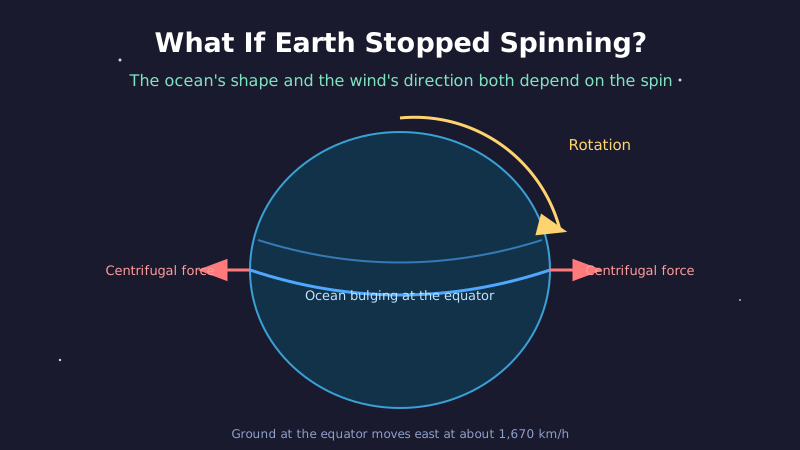
Here’s the headline up front, the tastiest part of the conclusion: if Earth stopped rotating, the oceans couldn’t hold their current shape. Physics suggests the water would slowly retreat from the equator, pool into two enormous seas at the poles, and leave a continuous ring of land wrapped around the equator.
You’re Already Moving East at 1,670 km/h
The first time I saw this number, I assumed it was a typo. But the math is simple. The equator measures about 40,000 km around, and Earth completes one full turn roughly every 24 hours. Divide 40,000 by 24, and you land on about 1,670 km/h.
A commercial jet cruises at around 900 km/h. A bullet train hits roughly 320 km/h. Which means the ground at the equator is outrunning a jetliner, all day, every day. You never feel the wind because the atmosphere, the ocean, and your own body are all spinning along together at the same speed.
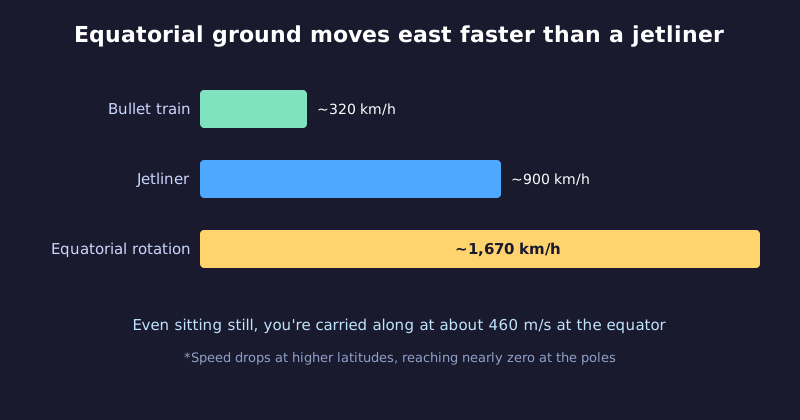
That speed isn’t the same everywhere, though. The closer you get to the poles, the smaller the circle you’re tracing, so the speed drops. Stand directly on the North or South Pole and your radius is essentially zero — you’d just spin in place once a day.
Here’s where it’s worth pausing. If something is spinning this fast, there has to be a force somewhere trying to fling it outward. That force has been quietly reshaping the planet itself.
Why Earth Isn’t Perfectly Round
Anything that spins develops an outward push — the same effect that presses laundry against the drum during a washing machine’s spin cycle. We call it centrifugal force: the apparent outward force that shows up in a rotating frame.
On Earth, that force is strongest right at the equator, because that’s where the ground is moving fastest. The result is a planet that bulges slightly outward around its middle — more “tangerine” than “perfect sphere.”
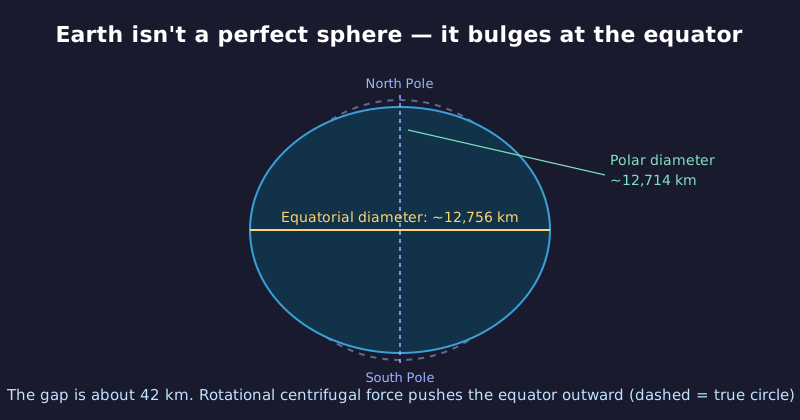
Here are the actual numbers: the diameter through the equator measures about 12,756 km. The diameter from pole to pole is about 12,714 km. That’s a difference of roughly 42 km. On the scale of the whole planet, it’s a subtle bulge — but it’s real, and it’s measurable.
Here’s the interesting part: it’s not just solid ground that bulges. Ocean water does the same thing, piling up slightly toward the equator because centrifugal force is pushing it outward there too.
Which means the shape of today’s sea level is itself evidence that the planet is spinning. So what happens to all that piled-up water the instant the rotation stops?
If It Stopped, the Oceans Would Abandon the Equator
From here on, we’re in thought-experiment territory. Think of this less as a prediction and more as “here’s where the physics logically leads.”
Centrifugal force only exists because of rotation, so the moment the spin stops, it vanishes cleanly. The support that’s been holding water up at the equator disappears with it. Gravity takes over, and water simply flows toward lower ground — which, in this scenario, means toward the poles.
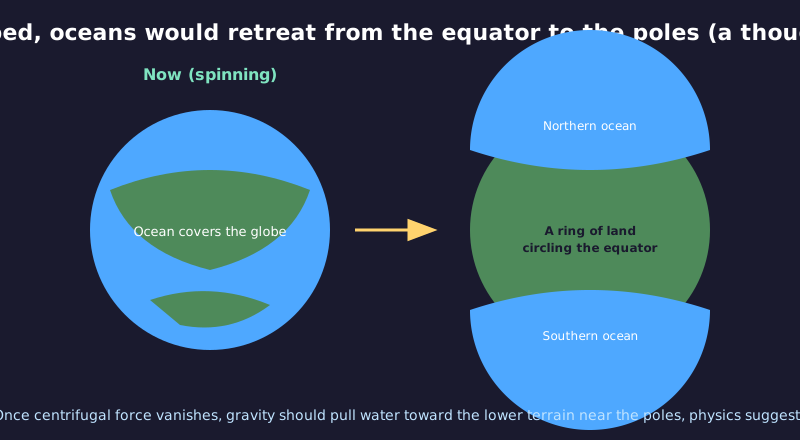
What you’d end up with is an almost unrecognizable planet. One enormous ocean at the north, another at the south. In between, a continuous belt of land wrapping all the way around the equator. Ridges currently hidden under today’s seafloor would surface, while the low points of today’s continents would sink beneath the new water line. The whole map of land and sea would be redrawn from scratch.
If you stood on the equator in that world, you might find yourself somewhere with no ocean visible in any direction, no matter how far the horizon stretched. You could walk for days and never run out of land. The familiar fact that 70 percent of Earth is ocean would simply stop being true the moment the spin stopped.
This migration of water wouldn’t happen overnight. Picture an unfathomably massive body of water spending a very long time slowly finding wherever gravity finally lets it settle. Some coastal cities would dry out; others would sink deep beneath new seas. Every coastline map we use today would become useless in a world that had stopped turning.
It’s a strange thought: the thing holding the ocean in its current position, all along, was an invisible rotational force. So what happens to the sky? Rotation doesn’t just shape the sea — it also decides which way the wind blows.
Rotation Even Decides Which Way Typhoons Spin
You’ve seen typhoon clouds swirling on a weather forecast. That spiral traces straight back to Earth’s own rotation.
Watch anything moving across a spinning surface, and its path appears to curve sideways — to the right in the Northern Hemisphere, to the left in the Southern Hemisphere. This deflection is called the Coriolis effect: the apparent curving of moving objects within a rotating reference frame.
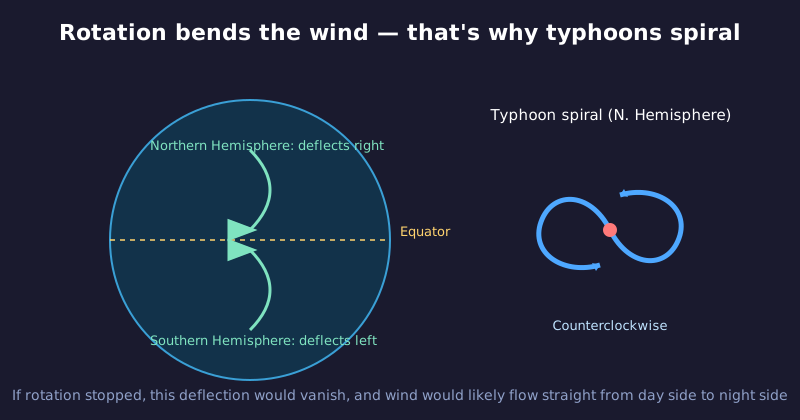
Global wind patterns trace intricate shapes because of this deflection. Air flowing toward the equator gets bent sideways into the trade winds; at mid-latitudes, the jet stream flows west to east. Typhoons and low-pressure systems spin because incoming air gets curved by the Coriolis effect. There’s a real reason Northern Hemisphere typhoons always rotate counterclockwise.
If rotation stopped, that bending force would vanish too. What’s left is just the temperature difference between the side baking in constant sunlight and the side freezing in constant dark. Rather than swirling, wind would likely flow in a much simpler pattern — straight from warm to cold.
A sky with no swirling storm clouds. Somehow that feels a little lonely to imagine. And underneath that sky, the very meaning of “a day” would change completely.
One Day Would Become Six Months of Light, Six Months of Dark
“Rotation stops” means the motion that completes one turn per day disappears. So what happens to day and night?
Let’s walk through it simply. Separate from its rotation, Earth also orbits the Sun once a year. If rotation alone stopped while the orbit continued, the planet would only change its orientation relative to the Sun once per year. That means roughly six months of daylight, followed by roughly six months of night. A single “day” would stretch out to the length of a year.
The side locked in six straight months of sunlight would scorch; the opposite side would freeze through six months of darkness. Sunrise and sunset would each happen only once a year. Measured against that, our current rhythm of day flipping into night every 24 hours suddenly seems frantic — and also, strangely, like something to be grateful for.
If you want a real-world example of a slow-spinning planet, look no further than Venus. According to NASA, Venus takes about 243 Earth days — 5,832 hours — to complete a single rotation. It’s the slowest-spinning planet in the solar system, and its “day” is almost incomprehensibly long.
Imagine Earth braking down to Venus’s pace, and you start to appreciate just how well-tuned a 24-hour spin actually is. Because day and night trade off on such a short cycle, no single spot ever gets to bake or freeze for too long.
Earth Is, Ever So Slightly, Easing Off the Spin
Everything above has been a game of “what if it stopped.” But to close, let’s touch on something that’s actually happening: Earth’s rotation really is slowing down, just by an infinitesimal amount.
The main culprit is tidal friction with the Moon — the back-and-forth of ocean tides, driven by the Moon’s gravity, dragging against the seafloor and coastlines. That friction siphons off a sliver of rotational energy with every cycle. As a result, over almost incomprehensible stretches of time, the length of a day has been gradually stretching.
Don’t worry — day and night won’t turn into six-month stretches within your lifetime. The change amounts to a tiny fraction of a second per century, far too slow for any of us to notice. But far off in the future, Earth really is, very gradually, tapping the brakes.
The height of the horizon you glanced at out your window this morning. The direction that typhoon was spinning on tonight’s news. The ordinary fact that day and night trade off every 24 hours instead of every six months. All of it rests on one single fact: this planet, moving at 1,670 km/h, is still turning, without pause, today.