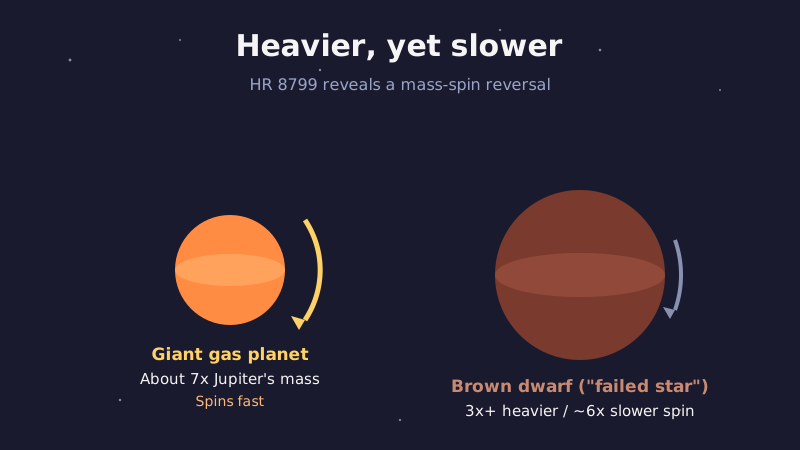
Heavier should mean more dominant, right? Not always. In the HR 8799 system, a giant planet about seven times the mass of Jupiter shares space with a “failed star” more than three times heavier still. And yet the lighter one spins faster — much faster.
Astronomers at the Keck Observatory in Hawaii caught this reversal in the act. The findings appeared in The Astronomical Journal on March 18, 2026, led by Dino Chih-Chun Hsu of Northwestern University and colleagues. Their tool was KPIC, the Keck Planet Imager and Characterizer, which splits a planet’s own faint light apart to read the fingerprint of its spin.
Why would the heavier object be the slow one? To answer that, we first need to understand what a brown dwarf actually is.
What exactly is a “failed star”?
Chances are you’ve never heard the term “brown dwarf” before. Put simply, it’s an object that tried to become a star and came up short.
Stars shine because hydrogen fuses together at their core. But if a cloud of gas doesn’t gather enough mass, the pressure and temperature at its center never climb high enough to ignite that fusion — or the fire never stays lit. Instead, the object just cools, slowly, forever. That’s a brown dwarf: a star that never quite made it.
In terms of mass, brown dwarfs sit squarely between planets and stars. Heavier than a gas giant like Jupiter, but too light to become something like the Sun. They’re stuck in limbo.
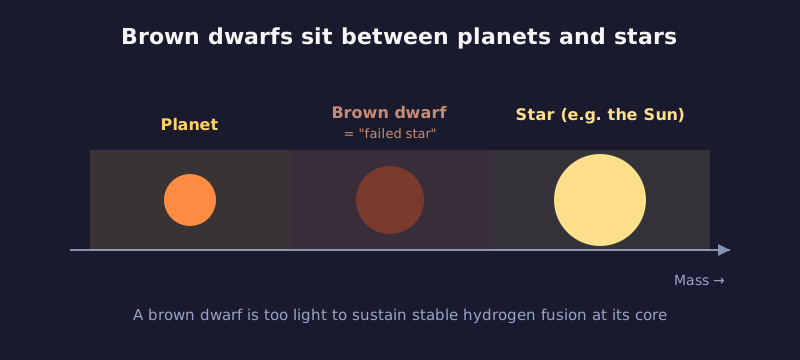
Here’s the tricky part, and it matters for everything that follows: giant gas planets and brown dwarfs look remarkably similar. Both are big balls of gas that don’t shine brightly on their own. Point a telescope at one and you often can’t tell which is which just by looking.
So what’s the giveaway? The research team zeroed in on something less obvious: how fast each object spins.
Reading rotation speed in the smear of light
Imagine two balls, one spinning and one still. From a distance, telling them apart is hard enough — and these targets are faint points of light dozens of light-years away. So how do you even measure a spin rate that far out?
The trick is the Doppler effect — the same phenomenon that makes an ambulance siren sound higher as it approaches and lower as it recedes. When an object rotates, the side spinning toward you compresses its light slightly, while the side spinning away stretches it.
Blend those two effects together, and the distinctive spectral lines in the object’s light smear out sideways, ever so slightly. The faster the spin, the wider the smear. KPIC measures that smear with remarkable precision, then works backward to calculate rotation speed.
To be precise, KPIC isn’t measuring the spin directly — it’s measuring the width of a smudge in the light, and the team infers rotation speed from that. Worth keeping straight: what’s observed is light; what’s calculated is spin.
Pause on that for a second. Pinning down the length of a day on a point of light dozens of light-years away — for both a gas planet and a star-that-wasn’t — is a genuinely impressive feat of observation.
Three times heavier, six times slower
Now for the main event: the reversal itself. The team controlled for mass, size, and age when comparing planets to brown dwarfs. Skip that step, and you risk mistaking “younger objects spin faster” for the real story.
Once those variables were matched, a clear pattern emerged. Giant gas planets consistently spun faster than the heavier brown dwarfs.
HR 8799 makes the case most vividly. Its giant planet weighs in around seven times Jupiter’s mass, while its brown dwarf tips the scales at more than three times that. On mass alone, the brown dwarf wins by a landslide. But measure the spin, and the brown dwarf rotates at roughly one-sixth the speed of its lighter neighbor.
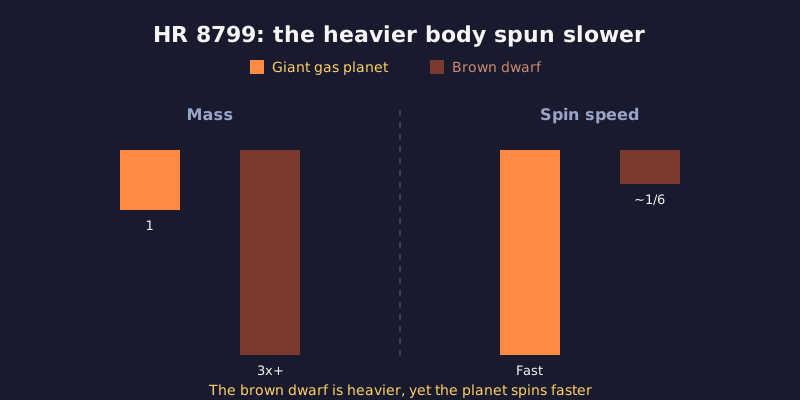
We tend to assume heavier things move with more heft and stability — a very human bias. When it comes to spin, the opposite held true. The researchers themselves seem struck by how consistent the pattern was, rather than a one-off fluke.
Which raises the real question: what’s applying the brakes?
The magnetic brake a newborn planet steps on
When any object forms, gas collapses inward and pulls itself into a sphere. That collapse naturally speeds up rotation — the same physics behind a figure skater spinning faster as she pulls her arms in. Left alone, newborn planets and stars should all spin up dramatically.
But they don’t, not nearly as much as physics alone would predict. Something is applying the brakes, and the leading suspect is magnetism.
Newly formed objects are still surrounded by the leftover gas disk they were born from. If the object generates a magnetic field, those field lines reach out and grip the gas in the disk. The spinning body and its disk end up tethered together by magnetism, like a tug-of-war, bleeding off rotational energy in the process. That’s the proposed mechanism behind the brake.
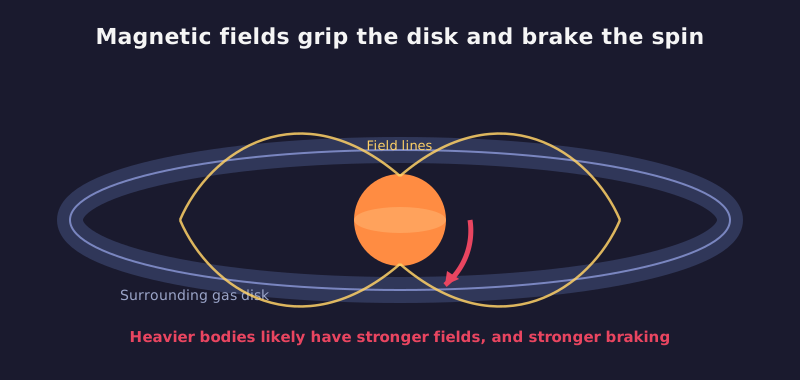
Mass is what makes this interesting. The team believes heavier objects generate stronger magnetic fields, which in turn means a stronger tug-of-war with the disk. So the heavier brown dwarf gets braked harder and ends up spinning slower — that’s the proposed explanation for the reversal.
It’s an interpretation the team built from the observed spin patterns, not a direct measurement of magnetic field strength. Still, the logic holds together nicely: heavier means stronger fields means harder braking.
Jupiter’s ten-hour day — fast, even by solar system standards
We’ve been talking about distant star systems for a while, so let’s bring this back home. “Braking” and “spin rate” are abstract until you have something familiar to compare them to.
Enter Jupiter. The largest planet in our solar system, eleven times Earth’s diameter, somehow completes a full rotation in about ten hours. Earth’s day is 24 hours, so Jupiter spins more than twice as fast — remarkable for something so enormous.
The numbers get more dramatic up close. Jupiter’s equator whips around at roughly 12 kilometers per second thanks to its spin. Compare that to Earth’s equator, which moves at under 0.5 kilometers per second — Jupiter is in an entirely different league. Stand on its cloud tops, if you could, and day would flip to night in a blur, your whole body swept sideways by the motion.
And here’s the twist: even Jupiter is fairly ordinary by giant-planet standards. Some of the exoplanets studied in this research spin faster than Jupiter does. Honestly, that’s the detail that got me most excited writing this piece — Jupiter, our familiar neighbor, belongs to the same fast-spinning club as planets in far-off star systems.
A new dividing line between planets and stars
Giant gas planets and brown dwarfs are notoriously hard to tell apart by sight. Spin rate just gave astronomers a new ruler to separate them — and that’s the biggest takeaway here.
Mass and brightness aren’t the whole story. How an object rotates carries a record of how it was born and raised. The tug-of-war between a young object’s magnetic field and its birth disk seems to leave a mark that survives for billions of years, still readable in today’s spin rate. Rotation might be something like a fossil of an object’s early history.
The team wants to push this technique toward smaller, dimmer targets next. Keck Observatory is set to add a new instrument called HISPEC in 2027, which should reach objects too faint and distant for current methods — including smaller worlds this study couldn’t quite touch. The line separating planets from failed stars is only going to get sharper from here.
Next time you spot Jupiter in the night sky, remember: that point of light is spinning more than twice as fast as Earth does, right now, as you look at it. And somewhere in a distant star system, a heavier “star that never was” turns much more slowly — carrying, in that lazy spin, the story of how it came to be.