Deep within the Milky Way, 39 ancient star clusters drift in orbit. The Hubble Space Telescope has now measured the age and chemical makeup of each one with unprecedented precision. The clusters sorted themselves into three distinct family lines — and one of those families didn’t originate in our galaxy at all.
In other words, clusters born in a completely different galaxy have been hiding inside the Milky Way all along.
Big galaxies didn’t start out big
I’ll admit it: for a long time, I pictured galaxies as things that simply appeared in their current form and then quietly aged. That picture is almost entirely wrong.
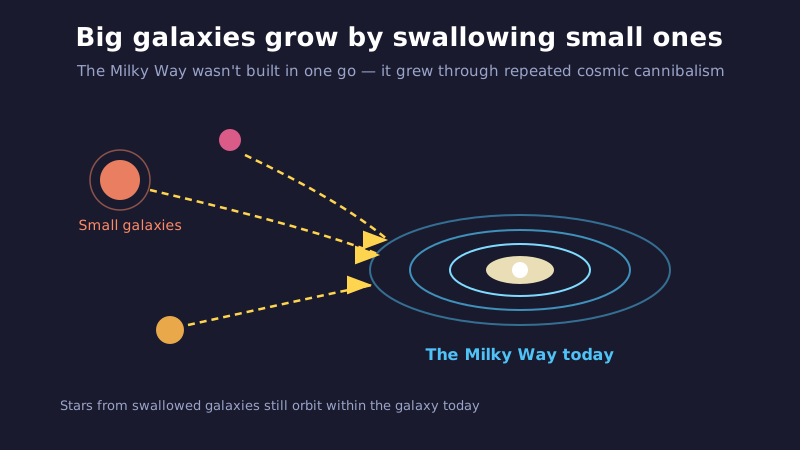
What we actually know is that the biggest galaxies got that way by swallowing smaller ones, over and over. Clumps of stars collide, mix, and merge into a single system — astronomers call this a “merger.”
Think of it like a metropolis that grew by repeatedly annexing the towns and villages around it. A core settlement absorbs its neighbors bit by bit until it becomes a sprawling city. Galaxies grow the same way, starting as small clumps that gradually gathered into something enormous.
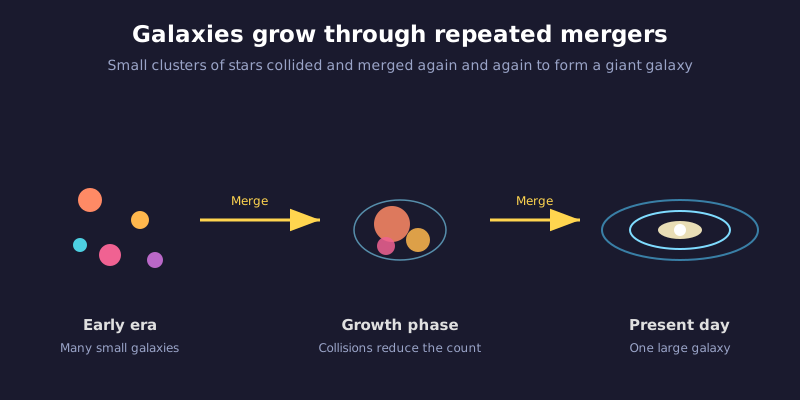
The Milky Way is no exception — and it happens to be the best-studied case of galactic cannibalism we have, precisely because we live inside it. We can’t step outside and view the whole structure at once, but we can get remarkably close to the leftovers of everything it has eaten.
So how do we figure out what our galaxy swallowed hundreds of millions, even billions, of years ago?
Swallowed galaxies survive as star clusters
Here’s the puzzle. Billions of years after a merger, you’d expect the absorbed galaxy to have completely unraveled — its stars scattered and blended so thoroughly into the Milky Way that no trace of “foreign origin” would remain.
But one thing doesn’t dissolve: globular clusters.
A globular cluster is an extremely old, tightly packed ball of anywhere from hundreds of thousands to millions of stars, bound together so strongly by gravity that even when the parent galaxy gets torn apart, the cluster itself survives intact. It’s essentially a keepsake left behind by a devoured galaxy. Globular clusters rank among the oldest objects in the universe — many of them were already full of stars before their host galaxies had even finished taking shape.
Here’s where it gets interesting: each cluster carries a kind of birth certificate stamped into it.
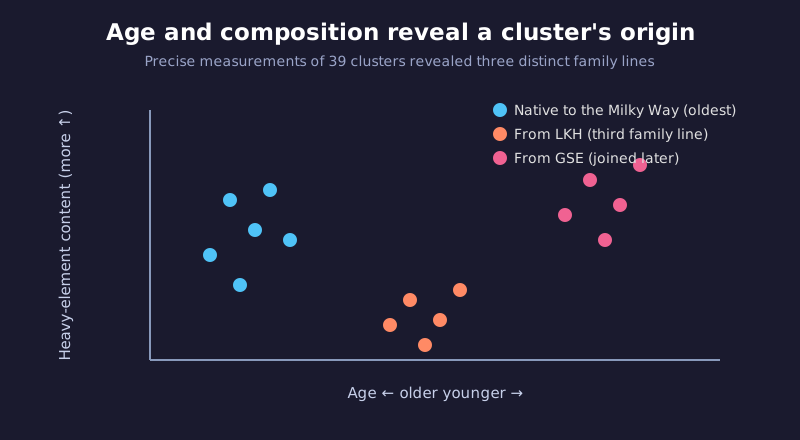
The first clue is age. The second is chemical composition — specifically, how much of the cluster is made up of elements heavier than hydrogen and helium, which astronomers lump together and call “metals.” Stars form from the raw gas available at a given place and time, so clusters born in the same place and era tend to share very similar ages and metal content. And because heavier elements accumulate in the universe generation after generation, as each wave of stars lives out its life and dies, later-born stars typically contain more metals than earlier ones. Measure these two properties precisely enough, and you can trace a cluster back to its birthplace.
39 clusters, three family lines
Researchers focused on 39 globular clusters within about 20,000 light-years of the Milky Way’s center — roughly the innermost fifth of the galaxy’s full 100,000-light-year span.
The Hubble Space Telescope measured each cluster’s age and metal content, while the European Space Agency’s Gaia satellite supplied precise positions and motions. Gaia’s job is to relentlessly track the position and movement of stars, which lets researchers spot clusters that share similar orbits — a telltale sign they arrived together from the same source galaxy.
The result: the 39 clusters split cleanly into three groups. One is the oldest, born within the Milky Way itself. The other two arrived later, carried in by mergers.
The team apparently didn’t recognize that third family right away. By age, its members are older than clusters known to come from the previously identified merger event called Gaia-Sausage-Enceladus (GSE), but younger than the Milky Way’s own native clusters — a group sitting squarely in between, unaccounted for.
The team named this third family “LKH,” short for Low-energy-Kraken-Heracles, stitching together names from earlier papers that had separately proposed the existence of such a galaxy. A long-unidentified culprit in the Milky Way’s merger history finally had a face, thanks to the age and composition of its orphaned star clusters.
LKH: the first big bite, roughly 11.8 billion years ago
The team’s best estimate puts the Milky Way’s absorption of LKH at around 11.8 billion years ago — when the universe itself was only about 2 billion years old.
I double-checked that figure, assuming it was a typo. But no: barely 2 billion years after the Big Bang, in what amounts to the very infancy of the universe, the Milky Way had already taken a serious bite out of a neighboring galaxy.
That’s hard to picture, so try this: compress the universe’s entire 13.8-billion-year history into a single calendar year. The Big Bang happens at midnight on January 1st, and right now it’s New Year’s Eve. On that scale, the LKH merger — “roughly 11.8 billion years ago” — falls in late February. The Milky Way was already cannibalizing its neighbors within its first two months of existence.
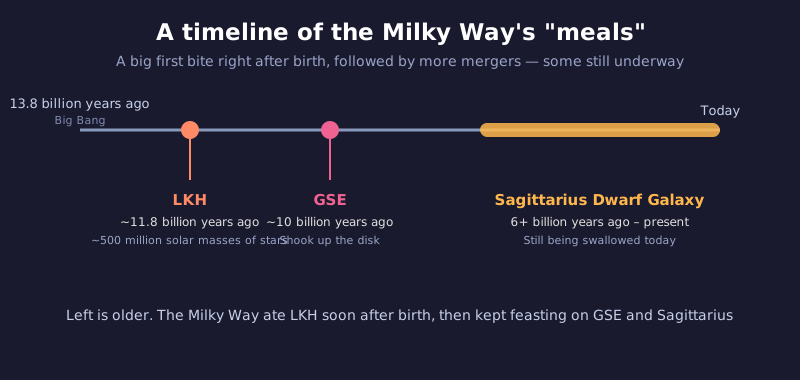
How big was LKH? Its stars added up to roughly 500 million solar masses — a serious mouthful for a Milky Way that was itself still young and comparatively small at the time. That single meal became part of the skeleton of the galaxy we see today.
And the menu didn’t stop there. Around 10 billion years ago, the Milky Way absorbed GSE, an event thought to have violently shaken up the galactic disk. More recently still, it has been steadily consuming the Sagittarius Dwarf Galaxy — a small galaxy in the direction of the constellation Sagittarius — for more than 6 billion years and counting.
A team of researchers in Bologna published these findings in the journal Nature Astronomy in August 2026. The 39 clusters analyzed so far are just a starting point; as more clusters get measured, the Milky Way’s full menu should come into sharper focus.
The feast isn’t over
Everything above might read like ancient history, but the Milky Way’s meal is still in progress. The absorption of the Sagittarius Dwarf Galaxy is happening right now.
As a small galaxy gets torn apart, its stars stretch into a thin, long ribbon that wraps around the host galaxy — what astronomers call a “stellar stream.” It’s the last visible trace a swallowed galaxy leaves behind, a thread slowly unraveling in space.
If you could stand somewhere out in the dim outskirts of the Milky Way and scan the sky, you might see a sparse band of stars stretching overhead. That band would be the remains of a once-independent galaxy, its stars strung out in a line as gravity pulls it apart — a single, coherent group of stars unspooling across the sky.
By tracing these stellar streams and the scattered motions of old, metal-varied stars one by one, astronomers can slowly reconstruct the full menu of what the Milky Way has consumed over its lifetime. Read the traces left by the eaten to learn the history of the eater — it sounds backward, but that’s exactly how galactic archaeology works.
Foreign galaxies are hiding in the summer sky
Big things are usually built out of accumulated small things — companies, cities, and galaxies alike. The vast spiral we call the Milky Way wasn’t there from the start in its current form; it became what it is today by swallowing one small galaxy after another.
On a summer night, look up at the faint band of the Milky Way arching across the sky. Within that pale light, stars that have always belonged to our galaxy and stars swallowed from elsewhere spin together, utterly indistinguishable from one another.
The next time you look up at that band of light, don’t picture a single house built all at once. Picture instead an old neighborhood that’s been expanded and renovated again and again — every wall stamped, somewhere, with the name of a small galaxy that didn’t survive the meal.