The last human footprint landed on the Moon in 1972. Half a century later, before anyone sets foot there again, a fleet of uncrewed landers is going to touch down first — over and over.
Not people. Machines. Carrying dozens of instruments, making the trip again and again.
Think of it as the prologue to a crewed Moon base: a long robotic run-up designed to make sure humans never have to land somewhere they can’t afford to fail.
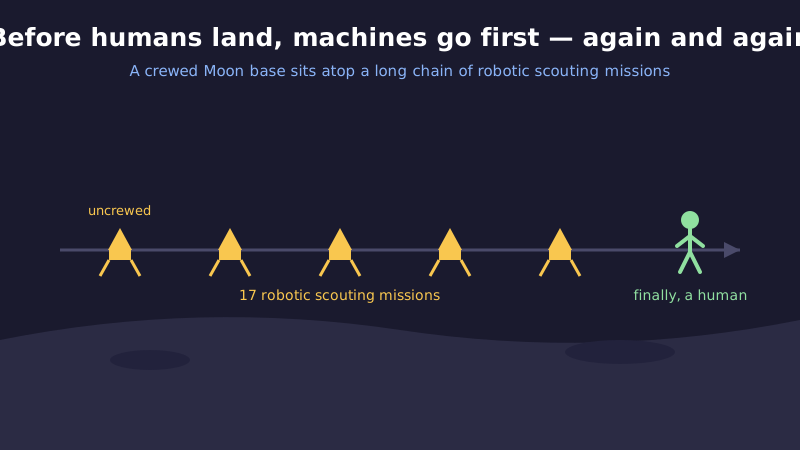
17 robotic trips before a single human sets foot
NASA runs a program called CLPS — Commercial Lunar Payload Services. In plain terms, it’s a system for hiring private companies to haul cargo to the Moon.
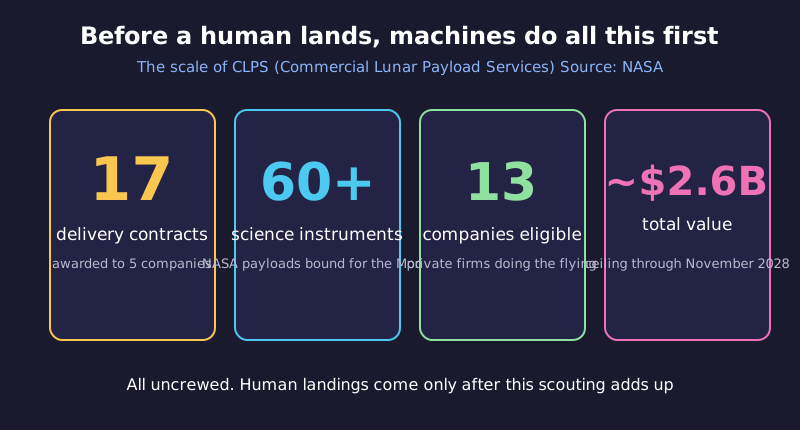
According to NASA’s own numbers, the agency has awarded 17 delivery contracts to five companies so far. Those flights are carrying more than 60 NASA science instruments. Thirteen companies are eligible to bid on the work, and the total contract ceiling runs to roughly $2.6 billion through November 2028.
The first time I saw that number — 17 — it struck me as excessive. Seventeen robotic trips just to scout a landing before a single crewed mission?
But trace the logic step by step, and the sheer number starts to make sense. NASA frames these missions as part of Artemis, the program meant to return astronauts to the Moon, with a base planned near the lunar south pole. Before people ever set foot there, robotic eyes need to check the ground — repeatedly. That’s the real purpose of this long run-up.
Landing on the Moon still fails — a lot
I’ll admit it: I used to assume Moon landings were a solved problem, something Apollo-era engineers figured out decades ago. Surely nothing that old could still be hard.
I was wrong.
In recent years, private landers headed for the Moon have had a mixed record — some touched down safely, others tipped over on landing or missed the mark entirely. The Moon has no atmosphere, so parachutes are useless. A lander has only its engines to fire in reverse, easing itself down onto a surface littered with boulders and craters, with nothing to catch it if it stumbles.
And the difficulty doesn’t stop there. Unlike Earth, the Moon has nothing like GPS to tell a spacecraft where it is. Landers have to rely on preloaded maps and onboard cameras matching the terrain in real time as they descend. Near the south pole, the target zone, the sun sits so low on the horizon that shadows stretch out for meters, making it hard to tell a boulder from a pit.
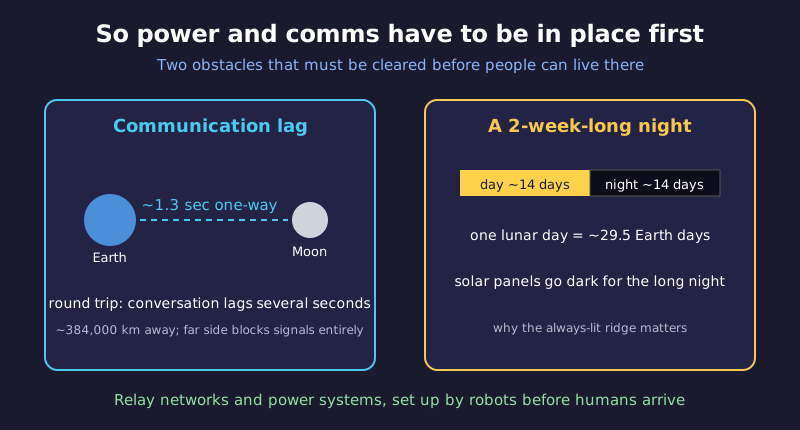
Then there’s the communication lag: about 1.3 seconds one way. That’s how long it takes radio signals, traveling at the speed of light, to cross the roughly 384,000 kilometers between Earth and the Moon. A landing sequence unfolds in seconds — too fast for a human controller on Earth to steer in real time. The spacecraft has to make its own calls.
It’s worth pausing on why machines are asked to shoulder all this risk. If a crewed lander tips over on touchdown, that’s not a mishap you walk away from — it’s a catastrophe. So uncrewed landers go first, proving again and again that a spacecraft can reach a chosen spot, land safely, and stay upright. Proving landing accuracy is itself one of the main goals of this scouting phase.
Why the south pole — and specifically, the rim of a crater?
So where exactly is NASA aiming? The lunar south pole. And the reason comes down to water ice.
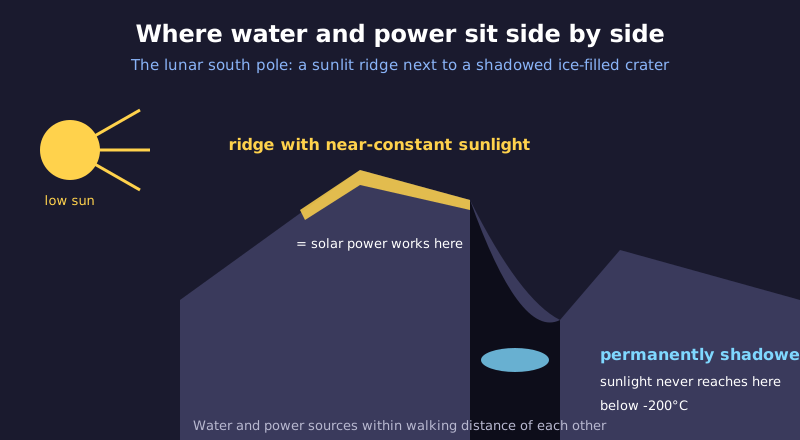
Scattered across the south pole are craters where sunlight has never reached — “permanently shadowed regions.” Because the Moon’s axis is barely tilted, the floors of these deep craters have sat in darkness for billions of years, some of the coldest spots in the solar system, dropping below -200°C. Scientists believe water ice has survived down there, frozen in that cold, permanent dark.
Here’s where it gets interesting.
Right next to those icy pits sit ridges that almost never lose the sun. Near the south pole, the sun skims low along the horizon, circling rather than rising and setting, so certain high ground stays lit for extended stretches. On one side: a crater floor that has never seen daylight. Just steps away: a ridge that’s almost always bright. For a future base, that pairing is remarkably convenient.
Honestly, this juxtaposition might be my favorite detail in the whole story. Imagine standing on that ridge — behind you, a sun that refuses to set for days; in front of you, a crater whose floor has never known a sunrise. A reliable source of water (ice in the shadows) and a reliable source of power (sunlight on the ridge) sit close enough to walk between.
Ice you can only trust after you’ve dug for it
But there’s a real gap between “ice is probably there” and “ice is there and usable.”
So far, most evidence of that ice has come from orbiters circling overhead. Orbital data, though, can’t tell you exactly where on the ground the ice sits, what form it takes, or how much of it there is. Is it solid ice, or icy soil? There’s no way to know for certain without digging in and checking directly.
That’s why NASA is sending landers equipped to actually dig. One experiment, called PRIME-1, drills into the lunar surface and analyzes the excavated soil on the spot, checking directly for water rather than guessing from orbit.
It’s worth pausing here. If people are going to live on the Moon, they’ll want their drinking water, oxygen, and even rocket fuel-grade hydrogen to come from local ice rather than shipped from Earth — hauling water up from Earth’s gravity well is absurdly expensive, even by the liter. Think of it like backcountry camping: carrying every drop of water yourself versus finding a spring nearby changes everything about how long you can stay. Whether local water is actually usable determines whether a base is viable at all — which is exactly the question robots are digging to answer before anyone arrives.
Wiring up power and communications, ahead of time
Even once ice is confirmed, that alone doesn’t make a place livable. A base needs the basics of daily life: power and communications.
A lunar day lasts about 29.5 Earth days — roughly two weeks of daylight followed by roughly two weeks of night. In most locations, that long lunar night leaves solar panels useless for half the month. That’s part of why the “always-lit ridge” near the south pole is so attractive: it’s not just close to the ice, it’s a rare spot that can keep generating power straight through that long dark stretch.
Communications face a similar challenge. That 1.3-second one-way delay is nothing like the mild lag you sometimes notice on a video call — round-trip, every exchange runs several seconds behind. And in certain valleys and on the far side near the south pole, the horizon itself can block a direct signal to Earth. So NASA has laid out plans for relay networks and power infrastructure to be installed by robots, well before any astronaut sets foot on the surface.
This groundwork for lunar living isn’t theoretical anymore, either. Even questions like how equipment brought from Earth might contaminate the lunar environment — say, by carrying Earth microbes along for the ride — are now things researchers check before anything or anyone arrives.
A long run-up to a place where failure isn’t an option
Lay it all out like this, and the number 17 suddenly makes sense. Landing accuracy. The location of ice. Reliable power and communications. Get any one of those wrong with people already on the ground, and there’s no taking it back. So the work goes to machines first — dozens of instruments, sent repeatedly, ahead of any crew.
The Moon is the closest object in Earth’s sky, hanging there most nights if you look up. It’s also, right now, an active research site. NASA’s lunar orbiters have even captured fresh craters gouged by rocket stages that crashed into the surface.
So when a human finally stands on that south pole ridge, it won’t be untouched, unknown ground. Which patches are firm, where the ice sleeps, where it’s safe to land — robots will have mapped it all, one mission at a time, before any footprint gets added to that map.
Right now, on that familiar bright edge of a familiar bright world, dozens of machines are quietly digging holes, sniffing out ice, and testing their footing — all on humanity’s behalf. The next giant step only gets taken once that pile of robotic reconnaissance is finally tall enough to stand on.