Picture a patch of sky about one-tenth the size of the full moon — pitch black, apparently empty. The Hubble Space Telescope pointed at that exact spot and kept its shutter open for a combined total of more than eleven days. What emerged was roughly 10,000 galaxies.
Why spend that much time on a patch of “nothing”? The universe is full of brighter, flashier things to photograph.
Follow that question far enough, and you run into a strange constraint built into the very nature of telescopes.
Why stare at “nothing” for eleven days?
That patch of sky wasn’t actually empty. It just held galaxies so faint and so distant that neither the naked eye nor an ordinary snapshot could pick them up.
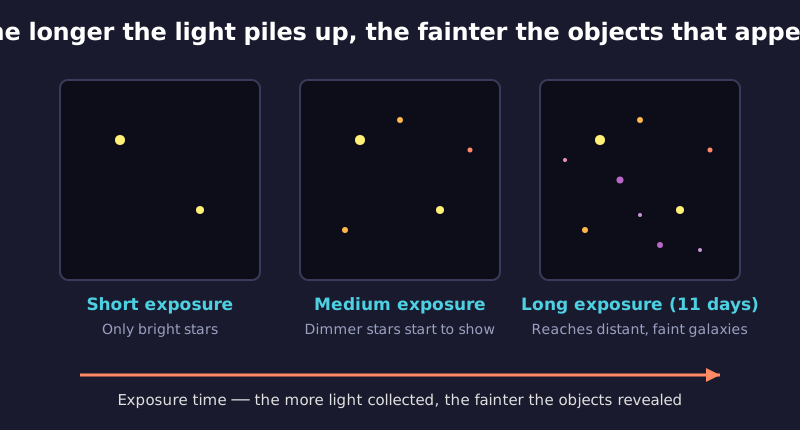
Think of a telescope as a bucket for catching light. A distant, faint object sends only a trickle of photons toward Earth. Snap a quick picture, and too few of those photons land in the bucket — nothing shows up. But keep the shutter aimed at the same spot for days on end, and the light slowly accumulates. Faint galaxies gradually rise out of the darkness.
It’s the same principle behind taking a photo on your phone in a dark room: the shutter stays open longer, and your hand starts to shake. When there isn’t enough light, waiting is the only option.
This is what astronomers call the Hubble Ultra Deep Field. According to ESA and NASA records, between September 2003 and January 2004, Hubble accumulated 11.3 days of total exposure time across 800 separate exposures, all pointed at a single patch just 3.1 by 3.1 arcminutes — about one-tenth the apparent diameter of the full moon. Out of that sliver of sky came nearly 10,000 galaxies.
Honestly, when I first learned this number, it took a while to sink in. A patch of darkness you could cover with a fingertip, and it held 10,000 galaxies — each one a collection of hundreds of billions of stars.
So if staring long enough reveals that much, why not just photograph the entire sky at this same depth?
The constraint: you can’t see everything at once
Here’s the catch — and it’s the crux of this whole story.
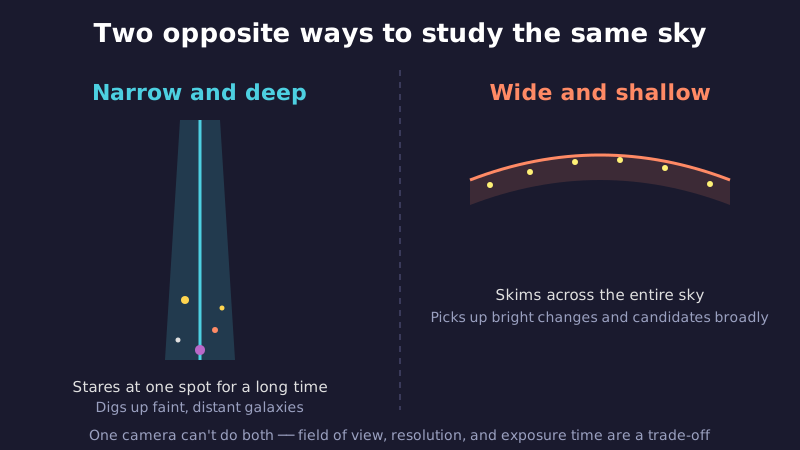
Every telescope juggles three properties that can’t all be maximized at the same time: field of view (how much sky it captures in one shot), resolution (how finely it can distinguish detail), and exposure time. Chasing something faint and small means narrowing the field of view, zooming in, and letting light accumulate for a long stretch.
It works the same way as zooming in with your phone’s camera — the frame shrinks as the zoom increases. The deeper and sharper you look, the smaller the patch of sky you can cover. That’s exactly why Hubble’s eleven-day exposure only covered a patch smaller than a postage stamp — one-tenth the size of the full moon.
So what happens if you try to photograph the entire sky at that same depth?
The whole sky works out to roughly 15 million patches of that size. If each one took eleven days, the math comes out to hundreds of thousands of years. Start the exposure before humans invented agriculture, and you still wouldn’t be finished.
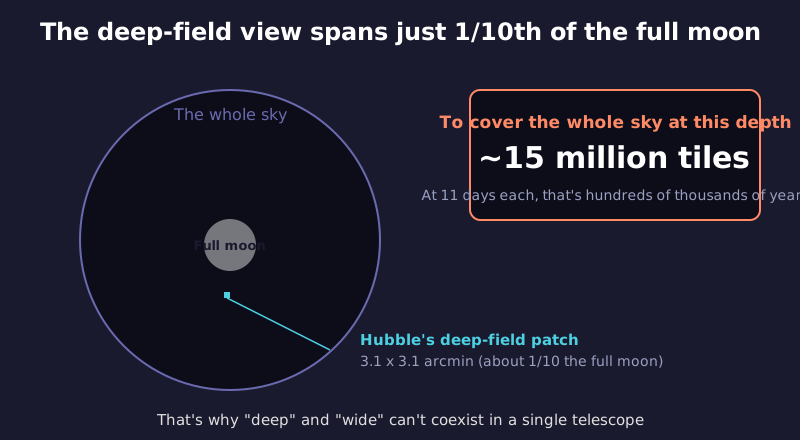
In other words, a telescope built for depth gives up the ability to see broadly. It digs deep into one tiny point of the sky while learning nothing about the rest.
Which raises an obvious question: shouldn’t there be a telescope built the opposite way — one that trades depth for breadth?
Wide and shallow: the telescopes that sweep the sky
That’s exactly the role filled by survey telescopes — instruments designed to scan wide swaths of sky.
According to NASA, TESS, which hunts for exoplanets (planets orbiting stars other than the sun), was designed as an all-sky survey mission, using four wide-field cameras to cover the entire sky. Its goal isn’t depth — it’s breadth, achieved by repeatedly sweeping across the whole sky, again and again.
Each individual image isn’t a deep exposure meant to dig up faint galaxies. It’s a light pass designed to catch subtle changes in bright stars. When a planet crosses in front of its star, the star dims ever so slightly. TESS’s job is to catch that momentary flicker, anywhere in the sky.
You might wonder what good a shallow sweep really does. But here’s the key point: without knowing where to look, a deep-staring telescope has nowhere to point. A wide-field image functions like a map of the cosmos — a catalog pointing the way.
Survey telescopes have another advantage too: they can revisit the same patch of sky again and again. While a deep-field telescope spends days locked onto a single point, a survey telescope can patrol the entire sky repeatedly. A star that brightened overnight. A point of light that wasn’t there yesterday but is glowing today. These kinds of changes — things that happen over time — fall completely outside the view of an instrument locked onto one narrow spot. Some cosmic changes are only visible to the wide, shallow eye.
I’ll admit it — for a long time, I misread this division of labor as a hierarchy of performance. I assumed the wide, shallow telescopes were just watered-down versions of the deep ones. I couldn’t have been more wrong. They aren’t competitors. They’re teammates with completely different jobs.
The finder and the confirmer
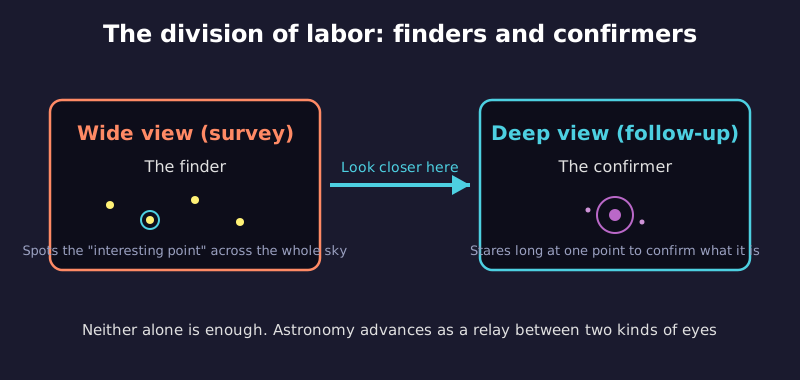
Studying the sky splits roughly into two jobs: scanning broadly to find candidates, and staring deeply at one spot to confirm what’s actually there.
The Kepler Space Telescope, for instance, fixed its gaze on one patch of the constellation Cygnus and monitored about 150,000 stars continuously, watching for the faint dip in brightness caused by a planet passing in front. According to NASA, this vigil turned up more than 2,600 confirmed exoplanets. It’s a textbook example of the “finder” role — reeling in a massive haul of candidates.
But a candidate on its own only means “probably a planet.” A star’s brightness can flicker for reasons other than a transiting planet — the star itself might be pulsating, or another object might have drifted into the frame by coincidence. Among the huge pile of candidates a survey reels in, some inevitably turn out, on closer inspection, not to be planets at all.
That’s where the confirmer steps in. Hubble, for instance, was the first telescope to directly capture the atmosphere of an exoplanet. It settles in on a single point and works out what’s really there, sorting through the pile of candidates the finder generated, one by one, in painstaking detail.
The upcoming Nancy Grace Roman Space Telescope is expected to straddle both roles. NASA anticipates it will combine microlensing (where a foreground star’s gravity bends light from a background star) with the transit method to discover thousands of exoplanets — an attempt to pack both wide-scanning power and sensitivity to faint signals into a single instrument.
What’s striking is that astronomy isn’t converging on a single “ultimate” telescope that does everything. The sky is simply too vast, and too dim, for that to make sense. Dividing the labor is faster. Astronomy moves forward as a relay race between two fundamentally different kinds of eyes.
What it really means to “study the sky”
By now, the phrase “studying the sky” probably means something a little different than it did at the start of this article.
The sky is too vast, and too dark, to grasp all at once. Every telescope has to settle somewhere on the seesaw between field of view, resolution, and exposure time. Choose breadth, and you sacrifice depth. Choose depth, and you sacrifice breadth. A telescope that does it all simply can’t exist, by design — which is exactly why we need instruments built in opposite directions.
Next time you look up at the night sky, spare a thought for the darkness between the stars. It isn’t empty. Hubble pointed at a patch of “nothing” small enough to hide behind a fingertip and, over eleven days of collected light, pulled 10,000 galaxies out of it.
But sweeping that darkness broadly and digging into it deeply can’t happen through the same set of eyes at once. Those 10,000 galaxies, buried in a darkness one-tenth the size of the full moon, only came into view because one instrument scanned widely and pointed a finger at “this spot right here” — and another stared at it, unblinking, for eleven straight days.