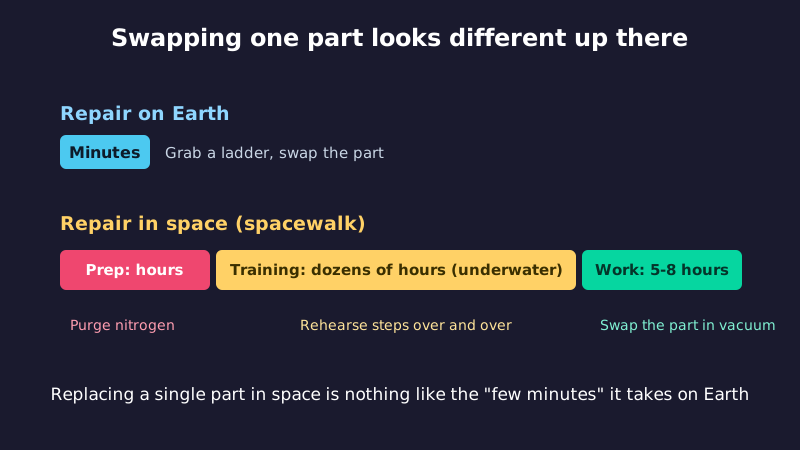
When your home antenna breaks, you grab a ladder and swap it out in a few minutes. In space, the very same job — replacing a single part — starts with an astronaut purging nitrogen from their own bloodstream. Just getting through the hatch takes hours.
On space stations, astronauts have gone outside the vehicle to replace aging antennas, pumps, and batteries for decades. This work outside the spacecraft is called a spacewalk, or EVA (extravehicular activity). A job that would take a toolbox and a few minutes on Earth becomes an entirely different undertaking in vacuum and weightlessness.
Let’s trace exactly how different it is, starting from the preparation.
Before the hatch opens, nitrogen has to leave the body
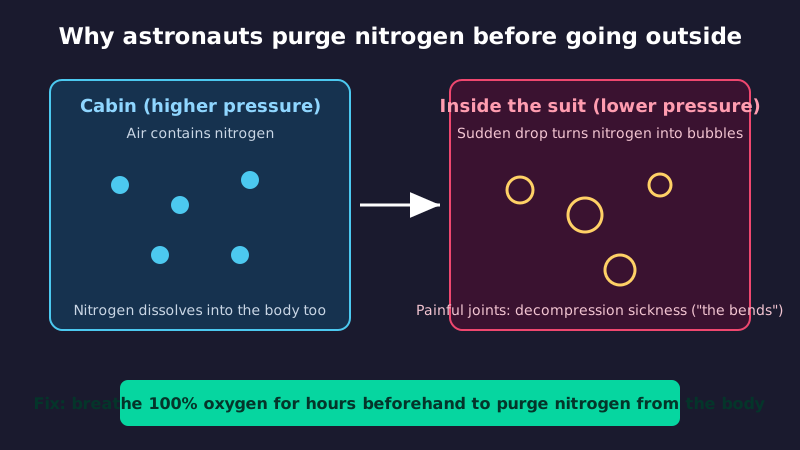
We don’t need to prepare before opening our front door. Astronauts, though, spend hours breathing pure oxygen before heading outside. The goal: flush every trace of nitrogen out of their system.
Why bother? The air inside a spacecraft cabin contains nitrogen, just like the air we breathe every day. That nitrogen dissolves into blood and body tissue. But the inside of a spacesuit is kept at a much lower pressure than the cabin.
Drop the pressure suddenly, and dissolved nitrogen turns into bubbles — the same way a soda fizzes up the instant you pop the cap. When those bubbles expand in joints and blood vessels, they cause intense pain. Divers know this condition well: decompression sickness, or “the bends.”
So the act of stepping outside actually begins long before the hatch opens. Breathing oxygen through a mask, astronauts quietly rebuild their body chemistry from the inside. Skip this groundwork, and the body could start screaming the moment they step out.
Confession: I misunderstood this for a long time. I assumed a spacesuit was just a balloon that pumped in air. In reality, there’s a delicate sequence of conditioning the body goes through before anyone even opens the door.
Seven hours of pool training for every hour outside
Purging nitrogen doesn’t mean the real thing is about to start. A spacewalk itself is a long affair. According to NASA, a typical spacewalk today runs 5 to 8 hours — the length depends on the task, but it’s essentially a half-day job.
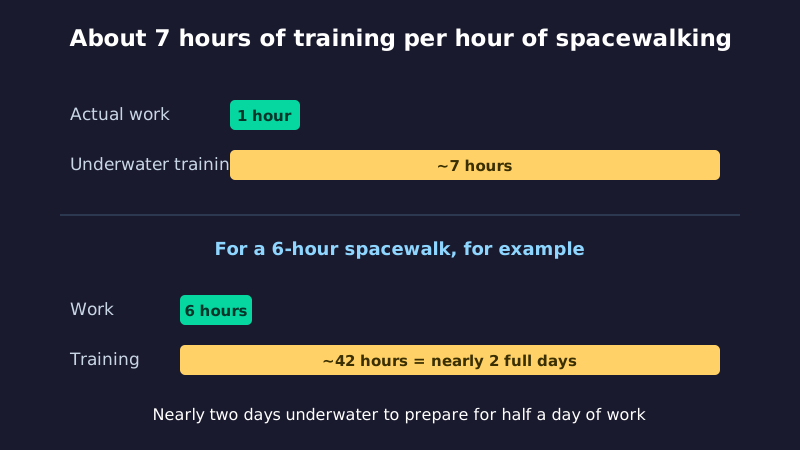
And every single hour of that work comes with a staggering amount of preparation. Astronauts train roughly 7 hours for every hour they’ll spend on an actual spacewalk. That training happens in a giant pool, at the bottom of which sits full-scale replica hardware — the Neutral Buoyancy Laboratory.
Submerged in water, the body floats in a state close to weightlessness. With divers standing by, astronauts run through handrail positions, tool sequences, and body orientation again and again — steps that would take minutes on Earth. Where to grip, which way to face, what comes next: all of it gets drilled into muscle memory.
I double-checked this number, thinking I’d made a math error. For a 6-hour spacewalk, training adds up to roughly 42 hours — nearly two full days spent underwater to prepare for half a day of actual work.
Out there, there’s no do-over. That’s exactly why the training phase is designed to eliminate hesitation before it ever matters. Every moment of uncertainty in space eats directly into oxygen and stamina. Hours outside the vehicle are a finite budget — oxygen and focus both spent down to the last drop.
One glove, standing between -157C and a bullet
Why does it take that much practice? Because a body in a spacesuit operates under conditions nothing like Earth.
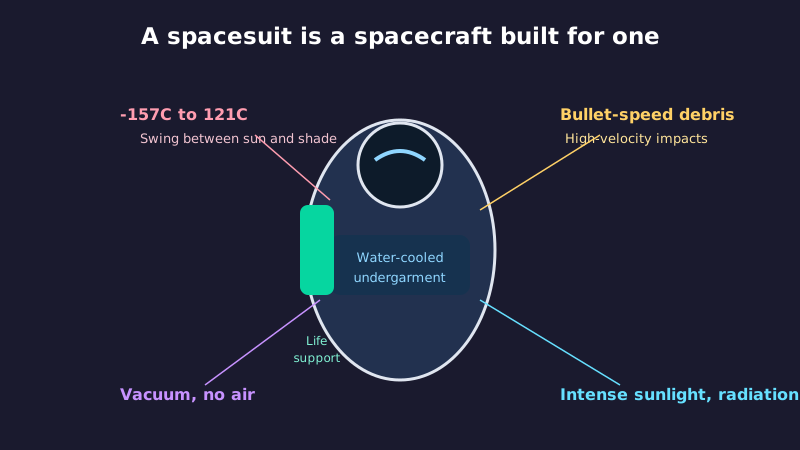
Temperature swings are extreme. In orbit, the difference between sunlight and shadow can span roughly -157C to 121C. To hold body temperature steady through that swing, astronauts wear an undergarment threaded with water-cooled tubing — the Liquid Cooling and Ventilation Garment. Sweat heavily and heat builds up; drift into shadow and the cold hits fast. Water circulating through that undergarment balances both extremes.
Drifting debris is another threat. Tiny particles floating in space travel at bullet-like speeds. The suit shields the body from that debris as well as from intense sunlight and radiation. On the astronaut’s back rides a life-support pack that feeds oxygen in and scrubs exhaled carbon dioxide out. A spacesuit, in effect, is a spacecraft built for one.
Here’s the twist: all that protection makes the work itself harder. Turning a tiny screw with fingertips buried inside thick gloves takes real effort. Even opening and closing a hand demands more force than it would on Earth. Keep that up for hours, and forearms fatigue fast.
Turn the screw, and you’re the one who spins
Weightlessness creates another headache: nothing holds the body still.
On Earth, you can turn a screw because your feet are planted on the ground and your own weight anchors you. In space, apply force to turn a screw, and the reaction sends your own body spinning instead. Newton’s third law — every action has an equal and opposite reaction — plays out with zero mercy here.
So astronauts secure themselves first. They lock their boots into foot restraints, or grip a handrail with one hand, using it as a stand-in for the ground. Only then can the other hand operate a tool. Let a foot slip loose, and the moment force is applied, the whole body spins.
Tools don’t just drop and stay put when released, either. They drift, quietly escaping. That’s why every tool is tethered with a short cord. A screwdriver that would simply clatter to the floor on Earth becomes an unrecoverable stray in space.
Miss your grip, and there’s no coming back
If tools need tethers, people need them even more. Astronauts themselves stay connected to the spacecraft with a safety tether — a literal lifeline that keeps them from drifting into space the instant they let go.
Picture it: you open the hatch, grab a handrail, and step outside. There’s no ground beneath your feet. Just Earth, turning slowly, far below. And because Earth completes an orbit roughly every 90 minutes, a few hours outside means cycling through multiple sunrises and sunsets.
Even though everything looks calm and still, the body is moving at a staggering speed. The space station circles Earth at roughly 8 kilometers per second — about 28,000 kilometers per hour. That’s fast enough to cross the distance between Tokyo and Osaka in under a minute. And through all of it, an astronaut is gently turning a small screw.
If a hand slipped off the rail and there was no tether, there’d be nothing to push against — no wall, no floor to brace on. As a last resort, astronauts also wear a jet-propelled backpack called SAFER. If someone does drift free, it’s the one card left to play for getting back to the ship under their own power.
Personally, this is the part that chills me most. What would just be “falling” on Earth turns into “never coming back” out there.
And still, people go outside
The first person to step outside a spacecraft did so on March 18, 1965. Alexei Leonov of the Soviet Union exposed himself to space for just 10 minutes. That June, American astronaut Ed White completed a 23-minute spacewalk. From 10 minutes to today’s 5-to-8-hour excursions — the time humans can spend in vacuum has stretched enormously over half a century.
Robotic arms exist. So why send a person at all? Because when something unexpected happens, only a human can judge the situation on the spot and check it by hand. A screw that’s stuck tighter than expected, a part oriented differently than planned — reading those small snags and working around them, in real time, is still something only human hands can do.
So astronauts purge nitrogen from their blood, rehearse for dozens of hours underwater, and step into vacuum tethered by a single line — all to replace just one part, and get it right.
Next time you casually open your own front door, spare it a thought. The same act of “going outside,” 400 kilometers overhead, only happens after hours of preparation and nearly two full days of training.