Picture the candles on a birthday cake. The flame always tapers upward into that familiar teardrop. We’ve come to think of that shape as simply what fire looks like.
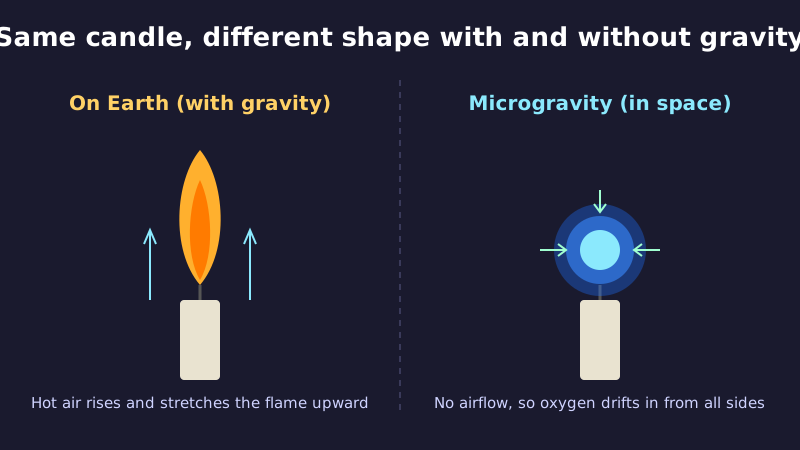
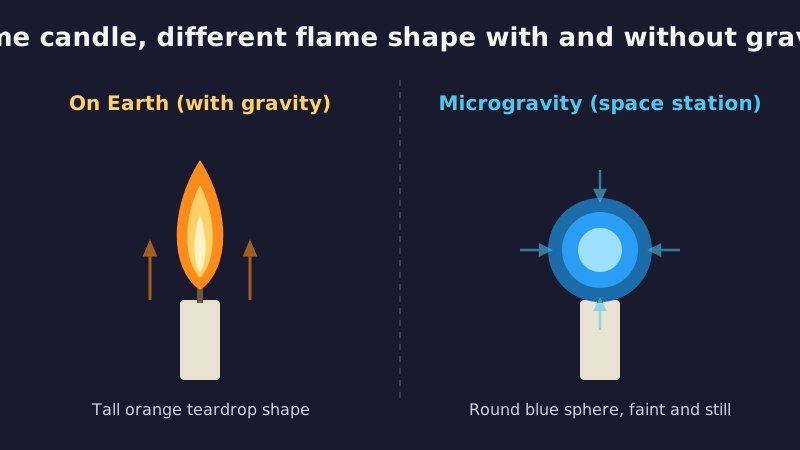
But light a candle on a space station, and the flame doesn’t stretch upward at all. Instead it becomes a small, round, blue sphere—glowing quietly, suspended like a tiny light bulb floating in midair.
Honestly, when I first read about this, I assumed it was some kind of joke. It isn’t. The teardrop shape we take for granted was never created by the fire itself. It was created by gravity.
The Flame’s Shape Was Never About the Fire—It Was About Moving Air
A flame reaching upward seems obvious enough that we rarely question it. Ask why it points up, though, and the answer isn’t as easy as it sounds.
The explanation has nothing to do with the fire itself—it’s about the air surrounding it. A flame heats the air nearby. That warmed air becomes lighter and rises away, and cooler air rushes in from below and the sides to fill the gap it leaves behind.
This upward motion is called buoyant convection: air that’s grown lighter from heat simply drifts upward on its own. The flame rides along on that current, stretching skyward while constantly pulling in fresh oxygen from underneath.
It’s the same principle that lifts a hot-air balloon or sends steam curling off a cup of tea. Warm things rise. That ordinary bit of physics has been quietly shaping every flame you’ve ever seen.
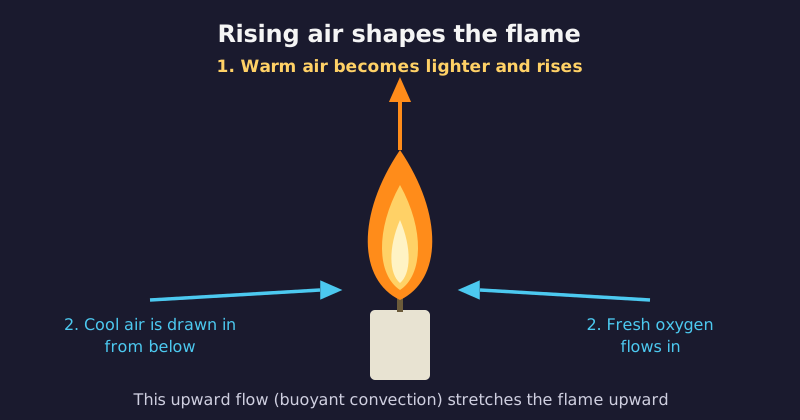
In other words, that iconic candle-flame shape is really just a record of moving air. The fire isn’t trying to climb. It’s being carried upward by air that’s already decided to rise.
So here’s a question worth sitting with: what happens to that upward current once gravity disappears?
Remove Gravity, and the Flame Becomes a Blue Sphere
The answer turns out to be simple. Without gravity, there’s no such thing as “lighter” or “heavier” air. Warm air has no reason to rise, and cool air has no reason to sink in and replace it. Buoyant convection simply doesn’t happen.
In a world with no up or down, a flame has no direction to favor. Every side of the fuel is equally exposed. So the flame naturally settles into the most even shape available—a sphere.
NASA has watched this play out firsthand aboard the International Space Station. In very still air, a small flame ignites and burns as a blue, nearly perfect sphere from the start. This isn’t some exotic movie-style fire—it’s the same fuel you’d find on Earth, simply behaving differently once gravity is taken out of the equation.
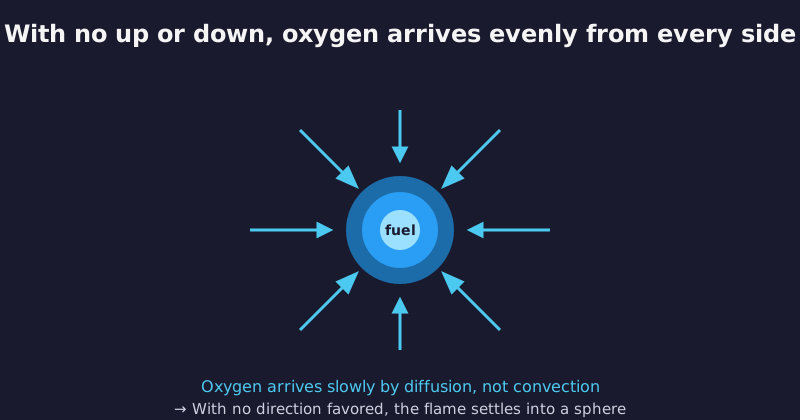
If you were standing in front of that experiment rig on the ISS, watching this sphere ignite right in front of you, you’d probably be speechless. It looks less like fire and more like a glowing blue soap bubble, just hovering there. It’s a form of fire that doesn’t exist anywhere on the ground.
What’s more, this sphere doesn’t flicker. The restless dance of an Earthbound flame comes entirely from air constantly rushing upward past it. Take that current away, and the flame goes still, as if it’s holding its breath—something closer to a lighter’s flame frozen in midair than anything we’d normally call “burning.”
That stillness comes at a cost, though. The sphere is weak. It simply can’t pull in oxygen the way a flame on Earth can.
Why It’s Weak—and Why It’s Blue
A flame on Earth has its own built-in ventilation fan: buoyant convection. Fresh oxygen keeps getting fed in from below, letting the fire burn with real intensity.
In microgravity, that fan shuts off. Oxygen no longer travels by convection—it has to creep toward the flame through diffusion, the slow spread of molecules through still air. That supply trickles in at a crawl. The result is a flame that’s small, weak, and sluggish.
Then there’s the color. A candle’s warm yellow-orange glow on Earth isn’t really the fire’s own light—it’s the glow of leftover, unburned fuel.
When a flame doesn’t get enough oxygen, some of the fuel’s carbon never fully combusts. It turns into tiny particles—soot. Heated to high temperatures, that soot glows white-hot, which we perceive as yellow. That cozy, familiar color is essentially the light of incomplete combustion.
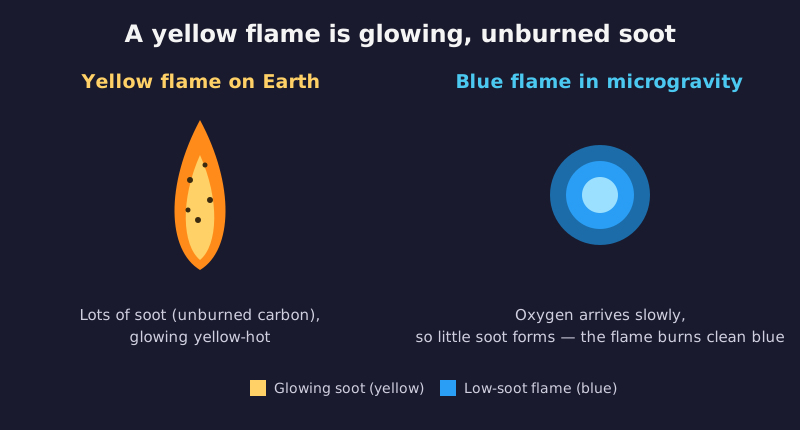
A microgravity flame burns slowly enough that fuel and oxygen mix much more thoroughly, so far less soot forms in the first place. Strip away that yellow soot glow, and what’s left is the flame’s own inherent blue light.
It’s a similar principle to why a gas stove burner burns blue—gas and air get pre-mixed thoroughly before combustion, so soot barely forms and the flame stays blue. A flame in microgravity achieves the same clean burn, just through slow diffusion instead of deliberate mixing.
I’ll admit that before I understood this, I assumed a blue flame meant weaker, less complete combustion. It’s actually the opposite. Blue is a sign of burning efficiently, without waste.
Weak Fire, Bigger Danger
You might assume that a faint, quiet flame would be less of a threat. For astronauts, it’s actually the reverse.
On Earth, a fire climbs upward and sends hot smoke straight toward the ceiling. That gives you clues—you can trace smoke to find the source, and you know to duck low to escape. Fire’s behavior comes with a built-in sense of direction: up.
In microgravity, that clue disappears. Smoke doesn’t rise—it just drifts, hanging in place. The flame itself stays an inconspicuous little sphere, burning quietly. Because it’s small and weak, it can spread unnoticed for far longer than anyone would expect.
Even ventilation works against astronauts here. Spacecraft run fans constantly to keep air circulating and prevent it from going stale. That artificial airflow can feed oxygen to a flame that diffusion alone couldn’t sustain, pushing fire in directions nobody anticipated. The instincts that work on Earth simply don’t apply up there.
Worse still, a fire that looks extinguished can keep smoldering out of sight. Inside a sealed spacecraft with nowhere to vent and nowhere to run, fire becomes one of the most frightening threats a crew can face.
That’s exactly why NASA keeps running experiments on the ISS—including investigations like SoFIE-MIST—to study how spacecraft materials ignite, spread fire, and can be extinguished. The goal isn’t to admire pretty flames. It’s to keep crews alive.
Why Bother Lighting Fires in Space at All
So why take the risk of igniting anything up there in the first place? The answer, strangely enough, comes back down to Earth.
Down here, buoyant convection constantly disturbs every flame we study. The air around a fire is always moving, flickering, reshaping itself. That makes it genuinely hard to observe combustion in its purest form.
Take gravity out of the picture, and that noise disappears. The flame settles into a simple, motionless sphere, letting researchers watch exactly how oxygen reaches it, how soot forms, and where combustion completes. It’s essentially a chance to study fire with almost nothing getting in the way.
The ISS hosts a dedicated combustion research facility called the Combustion Integrated Rack (CIR), launched aboard the space shuttle in November 2008—the station’s only rack built specifically for combustion science. It includes a 100-liter combustion chamber and has supported research into the structure of spherical flames, along with a series of experiments (including the Advanced Combustion via Microgravity Experiments, or ACME) aimed at burning fuel cleaner, with less soot.
Researchers have also studied how tiny liquid fuel droplets burn. On Earth, air disturbances around a droplet make clean observation nearly impossible, but in microgravity a droplet can hang suspended in one spot while scientists watch flame engulf it from start to finish. It’s about the clearest possible view of how fuel actually burns inside an engine.
Scientists hope these findings will eventually translate into more efficient car engines and power generation here on Earth, along with lower soot and emissions. A blue sphere floating in orbit, in other words, eventually connects back to how far your car gets on a tank of gas, and how clean the air around you stays.
Gravity, Written Into Every Candle Flame
Next time you happen to see a candle burning, take a second to remember this. That flickering teardrop shape wasn’t drawn by the fire. It was drawn by Earth’s gravity, lifting warmed air out of the way.
The flame on a family altar, the crackle of a campfire, the blue ring on a kitchen stove—all of it rests on that same invisible mechanism. In a sense, every time we look at fire, we’re actually looking at gravity at work.
Take that very same candle into space, though, and the flame loses its sense of direction entirely, unraveling into a quiet blue sphere. Something as familiar as fire—something we never thought to question—turns out to be entirely at gravity’s mercy. The flickering tip of every flame you’ve ever seen is really just proof that Earth is standing right there behind it.