Picture the faucet in your bathroom. Red marks the hot tap, blue marks the cold one. It’s a habit baked so deep into us we never question it.
Look up at the night sky, though, and that habit gets turned inside out. Red stars are the “cool” ones. Blue-white stars are the ones burning hottest.
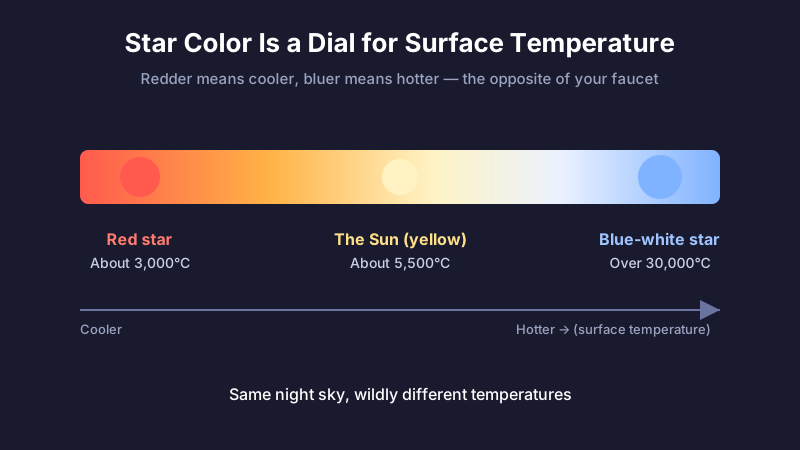
And it’s not a matter of taste or drama, either. A star’s color is an honest readout of its surface temperature — nothing more, nothing less.
Red stars run cool, blue stars run blazing hot
Look closely at the night sky and you’ll notice the stars aren’t all the same color. Some glow orange, others flash a sharp blue-white.
Orion makes the point better than almost anything else in the winter sky. Betelgeuse, marking the hunter’s right shoulder, glows distinctly red. Rigel, down at his left foot, burns blue-white. Side by side, the color difference is obvious to the naked eye.
Here’s the part that fights your instincts: Betelgeuse, the red one, is actually cooler. Rigel, the blue-white one, runs far hotter.
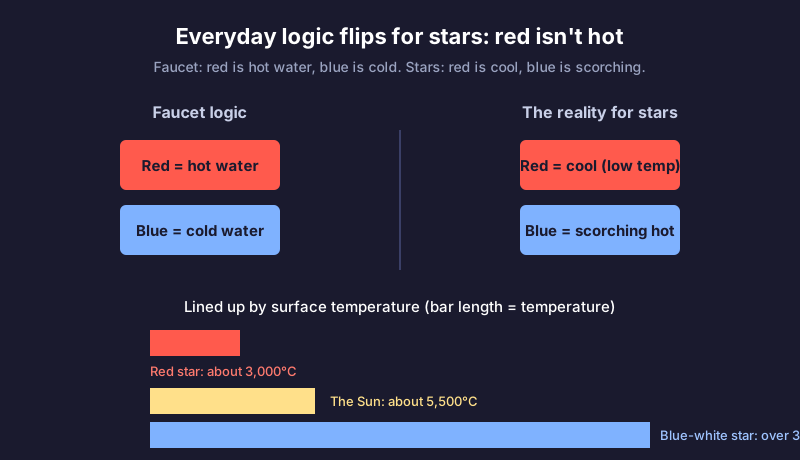
In round numbers, a red star’s surface sits around 3,000°C. A blue-white star can top 30,000°C. That’s a tenfold difference.
I’ll admit it took me a while to unlearn the assumption that “red equals roaring hot,” since flames trained me to think that way. The truth runs the other direction: red is the low end of the dial.
So why does temperature show up as color in the first place?
How color becomes a thermometer
Think of a blacksmith heating a piece of iron. It starts out dark, then as the temperature climbs it turns a dull red, then a brighter red, then orange, and eventually it glows almost white.
The glowing coil on an electric stove or in a toaster works the same way. Heat something enough, and it emits light in a color tied directly to its temperature.
Stars are no different. Each one is an enormous ball of hot gas, glowing in whatever color matches its surface temperature. Read the color, and you’ve read the temperature.
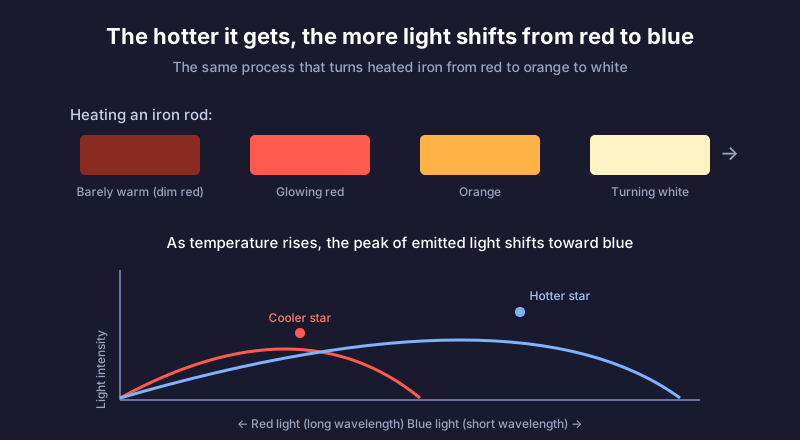
Here’s a detail worth pausing on. You might only ever have seen heated iron go from red to white. Push the temperature even higher, though, and the light keeps shifting — past white, and on toward blue.
The hotter something gets, the more its peak light output shifts from longer, redder wavelengths toward shorter, bluer ones. Physicists call this precise relationship Wien’s displacement law, and it ties temperature to color with no wiggle room.
That’s why cool stars look red and hot stars look blue. Star color isn’t an impression or a vibe — it’s locked to a single number: surface temperature.
Your light bulbs run on the exact same scale
This temperature-to-color relationship shows up somewhere you’ve probably never connected to astronomy: the LED bulb aisle.
You’ve likely seen labels like “warm white,” “neutral white,” or “daylight” on bulb packaging. Those describe a range running from a cozy orange glow to a crisp blue-white light. And tucked in the corner of the box, in small print, you’ll usually find a number — something like 2700K, 5000K, or 6500K.
That K stands for Kelvin, a unit of temperature. Warm orange bulbs sit around 2,700 Kelvin; crisp daylight bulbs sit near 6,500 Kelvin. The higher the number, meaning the hotter, the bluer the light.
Oddly enough, lighting manufacturers are using the exact same scale astronomers use to sort stars. That cozy “warm white” bulb you picked for your bedroom is, color-wise, standing in for a cool, reddish star. The “daylight” bulb over your desk mimics a hot, blue-white one.
The stars overhead and the desk lamp in front of you are both calibrated on the same hidden thermometer. Once you notice that, it’s hard to look at either one the same way again.
The Sun sits right in the middle, as a yellow star
So where does our own Sun fall on this scale?
The Sun is a yellow star — not red, not blue, but squarely in between. According to NASA, the surface of the Sun (its photosphere) runs at roughly 5,500°C. Astronomers classify it as a “yellow dwarf,” technically a G2-type star, which is about as common a stellar type as there is.
A number like 5,500°C doesn’t mean much on its own, so here’s a comparison: iron melts at a little over 1,500°C. The Sun’s surface runs more than three times hotter than that.
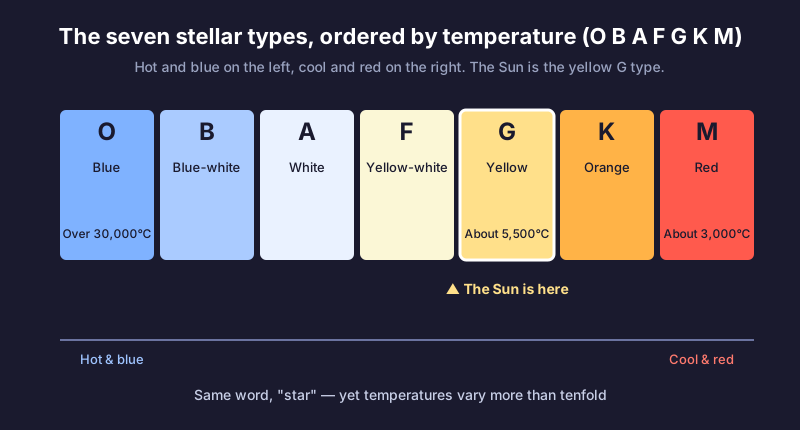
Here’s the interesting part: blue-white stars run more than five times hotter than the Sun. If our Sun had turned out to be one of those blue-white blazers instead of a mellow yellow one, Earth’s environment would look nothing like it does today.
One caveat: the Sun looks yellowish from the ground partly because of Earth’s atmosphere. Seen from space, it reads closer to white. Either way, its position as “neither red nor blue” doesn’t change.
Every morning, the star that rises over your head turns out to be a thoroughly average, middling-temperature yellow star, at least by the standards of the stellar catalog. There’s something quietly amusing about that.
Sorting stars by temperature: O, B, A, F, G, K, M
Astronomers group stars into seven classes based on this color-temperature relationship, running from hottest and bluest to coolest and reddest: O, B, A, F, G, K, and M.
O-type stars, at one end, are the hottest and bluest. M-type stars, at the other end, are the coolest and reddest. The Sun sits roughly in the middle, in the G class. Think of it as a rainbow reshuffled by temperature.
NASA notes an interesting wrinkle: so-called “red dwarfs” don’t actually look fire-engine red. They tend to appear more orange — closer to the warm glow of a lamp than to a burning flame.
What makes this classification so useful is that measuring color alone tells you a surprising amount about a star. Color reveals temperature. Temperature, in turn, hints at the star’s mass and even how quickly it’s racing through its own lifespan.
Nobody can fly out to a distant star and stick a thermometer into it. But just by analyzing the color of the light that reaches us, astronomers can pin down the surface temperature of stars thousands of light-years away. Light, in that sense, is a star’s own temperature report, mailed across the galaxy.
A star’s color changes over the course of its life
So far we’ve treated “star color equals temperature” as a fixed fact. But that color isn’t static — it shifts as a star ages.
Stars are born inside clouds of gas and shine by fusing hydrogen into helium in their cores. This steady fusion phase is by far the longest stretch of a star’s life. The Sun is currently sitting roughly at the midpoint of this stage.
Eventually, as fuel runs low, a star swells up and turns into a reddish giant. According to NASA, the Sun itself will someday puff away its outer layers this way, leaving behind an Earth-sized ember called a white dwarf.
Oddly, the heaviest stars live the shortest, flashiest lives. A massive blue-white star burns through its fuel so fast that it lives only a few million years before exploding. A dim, cool red star, by contrast, sips its fuel so slowly it can keep glowing for trillions of years.
Mass alone can stretch or shrink a star’s lifespan by tens of thousands of times. And color quietly tells you which kind of star you’re looking at — heavy or light, and roughly where it stands in its own life story.
In short: a blue-white star overhead is living fast and dying young. Red stars are a mixed bag — some are quietly aging stars nearing the ends of their long lives, puffed up into giants; others are simply small, patient stars that will keep glowing for ages. Color works as both a thermometer and a biography.
The night sky is a field of scattered thermometers
Next clear night, look up. The sky should stop looking like a random scatter of light.
Spot a reddish point of light, and you’re looking at a relatively mild star, around 3,000°C at its surface. Spot a sharp blue-white one, and that’s a scorcher past 30,000°C. The yellowish ones in between are the Sun’s cousins.
In winter, Orion makes this easiest to see. Compare red Betelgeuse with blue-white Rigel, and you’re reading off the temperature difference between two stars many light-years apart, using nothing but your own eyes.
A star’s color was never random decoration. It’s the number each star holds up for us to read — its own temperature, broadcast across space. The night sky, seen this way, is really one enormous panel of scattered thermometers.