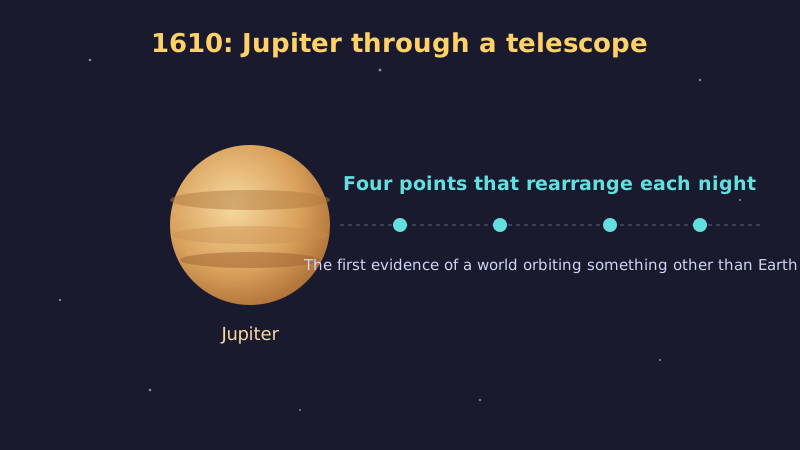
In the winter of 1610, a man pointed his homemade telescope at Jupiter. Right next to it sat three tiny points of light, lined up in a neat row.
The man was Galileo Galilei, and when he looked again the following night, the arrangement had changed. By the next night, there were four points instead of three.
Stars weren’t supposed to move like that. A few weeks of notes scribbled down by one stubborn observer would go on to dismantle a model of the cosmos that had stood for two thousand years.
The Lineup Changes Every Single Night
What Galileo saw was a handful of small points of light sitting right beside Jupiter. At first, he assumed they were just distant stars that happened to be in the neighborhood.
But the longer he watched, the stranger things got. Jupiter itself crept slowly across the sky night after night, yet these points never left its side — they just kept swapping places from left to right, over and over.
Distant stars don’t behave that way. They’re fixed against the background sky, and it’s Jupiter that should be the one drifting past them. Instead, these points refused to let go of Jupiter at all.
Picture yourself watching the same patch of sky for four nights running. What would you make of it?
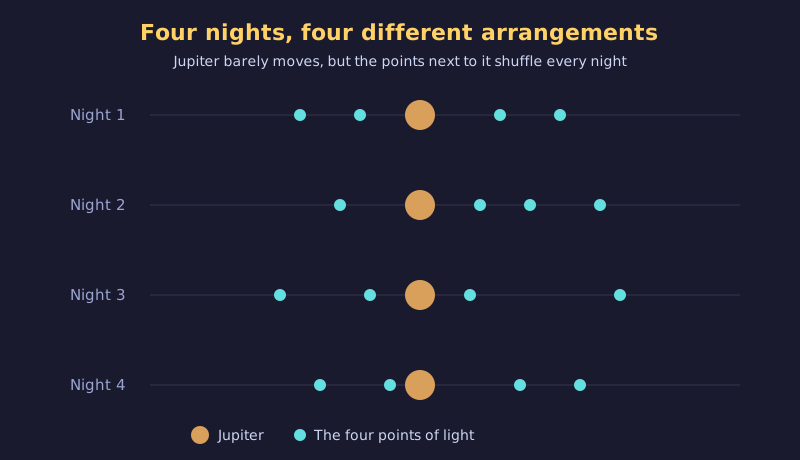
The points drifted back and forth near Jupiter — now closer to one side, now the other, occasionally vanishing behind the planet and dropping the count. It looked almost like they were ticking back and forth on some kind of schedule.
What made Galileo remarkable was that he didn’t stop watching. Night after night, he sketched the positions of Jupiter and its companions in small diagrams: three points to the right tonight, one left and two right the next evening, and so on.
Any single sketch just looks like a random scatter of dots. But stack enough of them together, and a rhythm emerges — the points swinging slowly back and forth around Jupiter. That’s not the kind of pattern coincidence produces. It smells like a rule.
The Moment It Clicked: “They’re Orbiting Jupiter”
Eventually Galileo figured out what the back-and-forth motion really meant. The points weren’t swinging in front of and behind Jupiter — they were circling it.
Watch a circular orbit edge-on, and it looks exactly like side-to-side motion: the object appears to swing right, then left, depending on whether it’s closer to you or farther away. It’s the same illusion as watching a Ferris wheel from the side — the gondolas seem to move left and right instead of up and down.
When a point swung around behind Jupiter, it would disappear from view entirely. That explained perfectly why the count dropped to three on some nights — one of the four was simply hiding behind the planet.
In other words, these four points of light were satellites, circling Jupiter the way our own Moon circles Earth. Jupiter had moons of its own.
I’ll admit that when I first learned this story, I didn’t immediately grasp why it mattered. On the surface, it just sounded like “Jupiter has moons” — interesting, sure, but not exactly earth-shattering.
To people living in 1610, though, this was a seismic event. To understand why, you have to look at the 2,000-year-old assumption it broke.
Why Four Little Dots Shattered an Entire Worldview
In Galileo’s era, people believed the universe worked like this: everything revolved around Earth.
The sun, the moon, every star in the sky — all of it circled a motionless Earth sitting at the very center of creation. This was geocentrism, a model inherited from ancient Greece and formalized by the astronomer Ptolemy in the second century.
The whole framework rested on one core assumption: Earth was the only center of rotation in the universe. Everything orbited Earth, and that was precisely what made Earth special — the hub around which the cosmos turned.
But the four points Galileo observed weren’t circling Earth at all. They were circling Jupiter. Centers of orbital motion existed somewhere other than Earth, and his telescope showed it plainly.
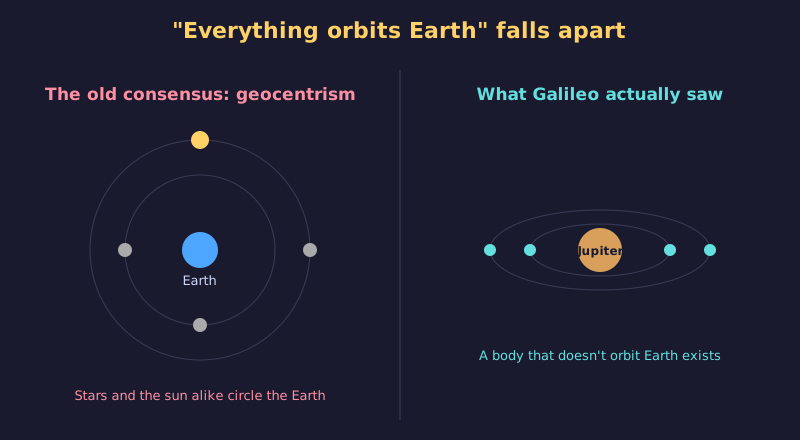
On its own, that might sound like a shrug-worthy footnote. But once you pull out the “Earth is the only center” assumption, the whole geocentric structure loses a load-bearing pillar.
Not long before, Nicolaus Copernicus had proposed that the sun — not Earth — sat at the center, with Earth doing the moving. At the time it was still a minority view, but Galileo’s Jovian moons became hard observational evidence in its favor.
If Earth really is moving, its own moon doesn’t get left behind — it keeps pace right alongside it. The four points circling Jupiter, itself a body in motion, were demonstrating exactly that principle in real time, right there in the eyepiece.
Invisible to the Naked Eye: What the Telescope Unlocked
A natural question follows: why didn’t anyone notice these four points before Galileo?
The answer is simple — you can’t see them with the naked eye. Jupiter’s four moons are too faint, washed out entirely by the glare of the planet itself. What finally revealed them was a device that had only just appeared on the scene: the telescope.
By modern standards, Galileo’s telescope was almost a toy, magnifying objects by maybe 20 times at best. And yet that modest boost beyond the limits of human eyesight was enough to rewrite humanity’s entire picture of the cosmos.
This next point is a little abstract, but skip it and the rest won’t quite land. The real significance of this discovery wasn’t “a new object was found.” It was proof that a tool could change how we see the universe itself.
Swap a lens in for your eye, and suddenly a world that no one had ever glimpsed snaps into view. From that point on, astronomy would advance hand in hand with better instruments — one development feeding the other. The four points next to Jupiter were the first step down that road.
Here’s the fun part: you can still see those exact same four points today. On a clear night when Jupiter is visible, mount a decent pair of binoculars on a tripod and aim them at the planet. You’ll spot a handful of small points lined up right beside it.
It’s almost exactly the view Galileo had in 1610. Even a cheap pair of binoculars lets you relive the moment humanity’s whole picture of the universe shifted. If the sky is clear some night, it’s worth trying.
What Those Four Points Turned Out to Be
The four points of light eventually got names: Io, Europa, Ganymede, and Callisto. Collectively, they’re known as the Galilean moons, after the man who found them. NASA credits Galileo with being the first to observe all four, back in 1610.
Four hundred years later, we know these worlds in startling detail. Look at each one individually, and what used to be a single indistinguishable dot turns out to be four wildly different places.
Io, the innermost of the four, is the most volcanically active body anywhere in the solar system, with sulfurous plumes constantly erupting from its surface. Europa, next in line, is roughly 90 percent the size of our Moon and is thought to hide a liquid ocean beneath its icy crust — a place scientists suspect might have the right ingredients for life.
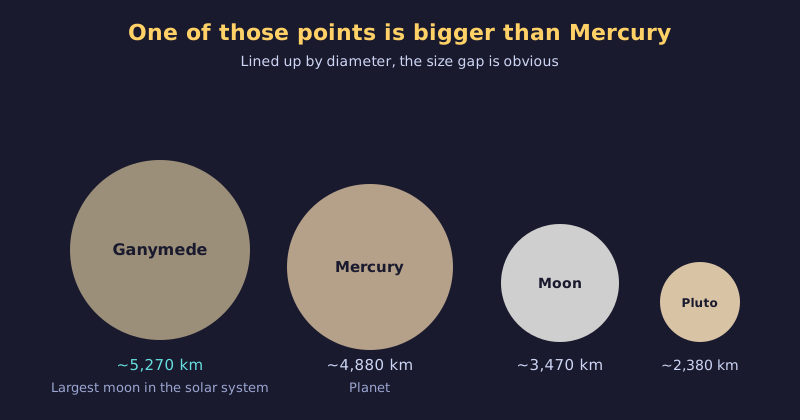
Then there’s Ganymede — the largest moon in the entire solar system, bigger even than the planet Mercury, and naturally bigger than Pluto too. One of those original “points of light” turned out to be a world on the scale of a planet.
The outermost of the four, Callisto, is famous for being covered in countless craters, one of the oldest-looking surfaces in the solar system. Four moons of the same planet, and yet one is a volcanic furnace, another conceals an icy ocean, and a third is scarred from one end to the other — wildly different personalities sharing the same orbit.
According to NASA, Jupiter now has 115 moons officially recognized by the International Astronomical Union. Galileo’s original four turned out to be just a sliver of an enormous family.
To investigate whether Europa’s ocean might actually harbor life, NASA launched the Europa Clipper spacecraft on October 14, 2024. A world Galileo once recorded as nothing more than a point of light is now being visited by a spacecraft built to study it up close.
What Weeks of Watching One Spot Left Behind
What Galileo did wasn’t some flashy invention or a feat of advanced mathematics. He simply looked at a few faint points near Jupiter, night after night, without giving up, and wrote down where they were.
That unglamorous record was enough to put a hole straight through a 2,000-year-old assumption: that everything in the universe revolves around Earth. The motion of those points quietly announced that Earth wasn’t the only center after all.
Worldviews don’t always crumble because of some grand invention. Sometimes all it takes is paying real attention to one small, overlooked thing. It wasn’t a famous scholar’s proclamation that moved the needle — it was a stack of modest nightly sketches.
Next time Jupiter is easy to spot in the sky, try pointing a pair of binoculars at it. One of those tiny points lined up beside the planet is an icy world bigger than a planet; another has volcanoes that never stop erupting. And four hundred years ago, that same lineup of dots is what pulled Earth down from the center of the universe.