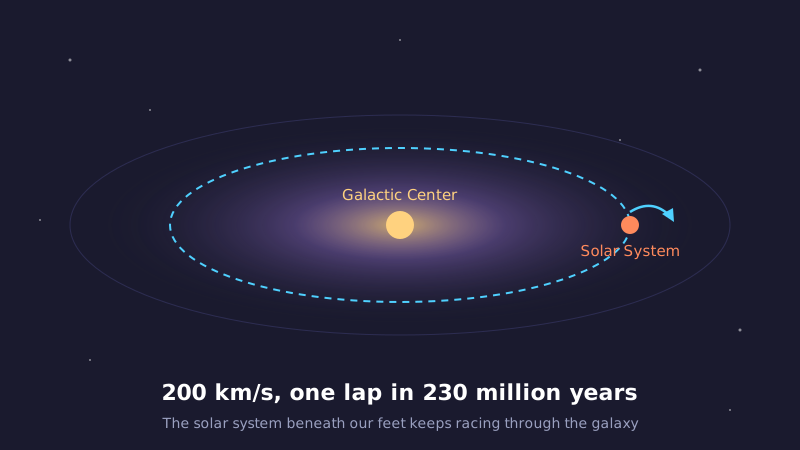
Right now, the chair you’re sitting in is moving at 200 kilometers per second. That’s 720,000 km/h. It’s hard to believe, since there’s no sound, no vibration, nothing you can actually feel — but the entire solar system is barreling through the Milky Way at exactly that speed.
The ground feels still. The water in your glass doesn’t ripple. And yet we’re hurtling through space thousands of times faster than a bullet train. Let’s unpack that contradiction, one layer at a time.
Standing Still, Yet Moving in Three Layers at Once
Our motion turns out to be nested, like a set of carousels stacked inside each other.
First, Earth spins on its axis. Stand on the equator and that rotation alone carries you eastward at roughly 1,700 km/h — faster than the speed of sound, though obviously nobody feels the wind.
Then Earth orbits the Sun, at about 30 km/s, completing one full circuit every year. That part you probably remember from school.
Here’s where it gets bigger. The Sun itself is orbiting the center of the Milky Way. According to NASA, the solar system travels through the galaxy at 720,000 km/h — around 200 km/s — roughly seven times faster than Earth’s trip around the Sun.
So you’re riding a spinning planet, which is riding around the Sun, which is itself riding around the galaxy. Three carousels, stacked inside one another, and we’re standing on the outermost ring.
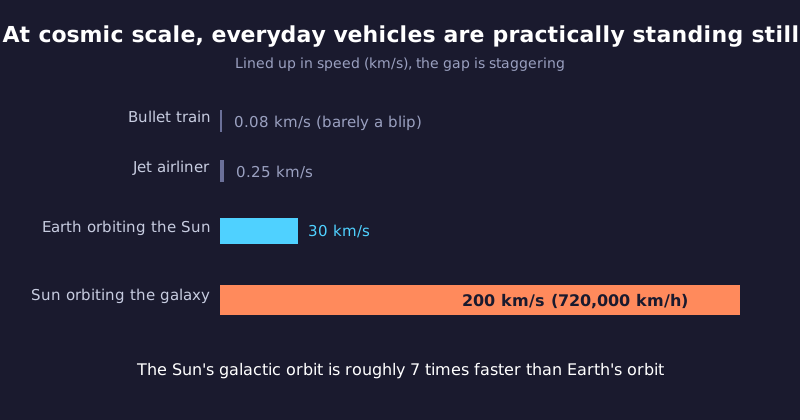
To get a feel for 200 km/s, picture it against a familiar distance. Tokyo to Osaka is about 400 km — at this speed, you’d cover it in two seconds flat. A full lap around Earth’s circumference would take barely three minutes.
So if the solar system is circling the galaxy at that speed, how long does one complete lap actually take?
230 Million Years for a Single Lap
Here’s where it’s worth pausing. Keep moving at 200 km/s, and how long does it take to circle the galaxy once? NASA puts the number at roughly 230 million years.
That figure is so large it barely registers. So let’s measure it against something more familiar: the history of Earth itself.
The dinosaurs went extinct about 66 million years ago. Since that mass extinction, the Sun has covered less than a third of a single lap around the galaxy. Put another way, the Sun still hasn’t finished even one-third of an orbit since the dinosaurs disappeared.
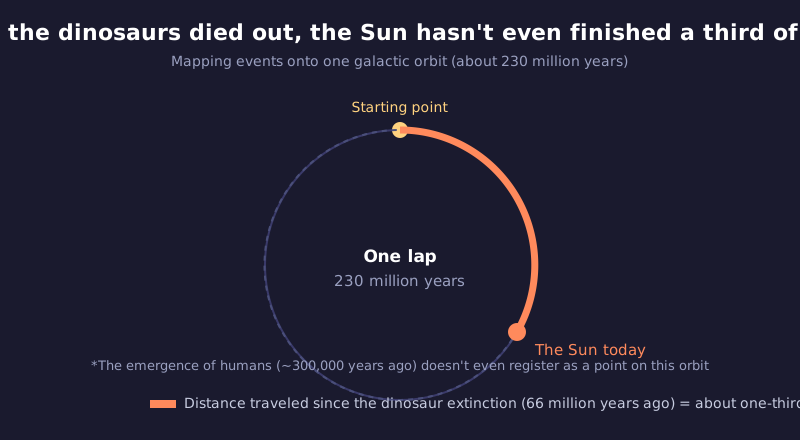
Bring human history into the picture and the scale gets even more extreme. Homo sapiens showed up roughly 300,000 years ago — on a 230-million-year orbit, that’s not even enough distance to mark a dot. The entire span of civilization barely registers as the width of a single tick mark.
Meanwhile, the Sun itself is about 4.6 billion years old. Divide that by 230 million, and you get roughly 20. In other words, the Sun has circled the galaxy about 20 times since it was born. Every single lap, life on Earth has reshuffled itself, and even the continents have changed shape.
Astronomers sometimes call the time it takes the Sun to complete one galactic orbit a “galactic year.” If a year on Earth is one trip around the Sun, then a year for the solar system is this 230-million-year lap. By that measure, the Sun is still barely in its twenties.
A lap that long obviously means the orbit itself is enormous. So just how big is it?
An Orbital Radius of 26,000 Light-Years
If you could look down on the Milky Way from directly above, you’d see a massive spiral disk. NASA’s figures put its diameter at about 100,000 light-years — wide enough that even light takes 100,000 years to cross it.
Where does the Sun sit on that disk? Not at the center. It sits well out toward the edge, about 8 kiloparsecs from the galactic core — roughly 26,000 light-years out.
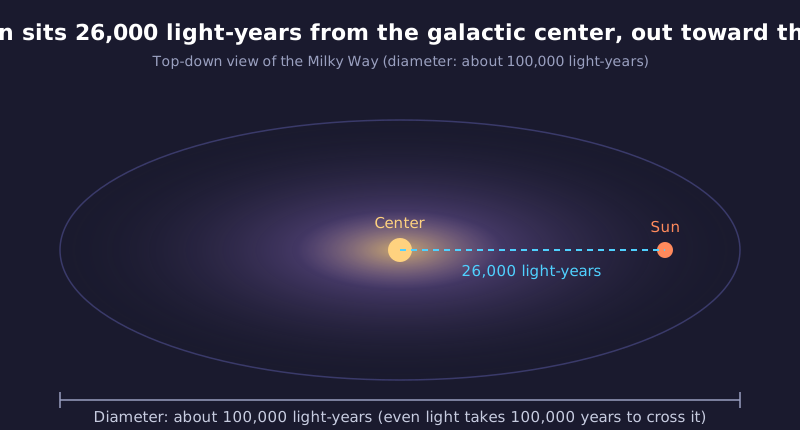
One light-year is about 9.5 trillion km. Multiply that by 26,000 to get the radius of the Sun’s orbit, then circle it at 200 km/s — and you end up with a lap of more than 200 million years. The speed is extreme, but the track is so vast that the time adds up anyway.
Here’s another way to look at it, from time’s side rather than distance’s. Say a human lifetime is 80 years — in that span, the Sun covers only about one three-millionth of a full lap. On the scale of the orbit, that’s barely a blink. But convert that “blink” back into real distance, and it comes out to more than 500 billion km. Over the course of one lifetime, we — along with the entire Sun — get silently carried across that much space.
Throwing numbers at it like this can actually make the scale feel more distant, not less. But the short version is this: we’re sitting in a seat far out from the center of a spinning disk, taking a slow, enormous ride around the rim.
The Sun’s Address Is on a Spiral Arm
That “seat” has a more specific address, as it turns out.
According to NASA, the Sun sits in what’s called the Orion Arm — one of several spiral arms that make up the Milky Way’s structure. Think of it less like living downtown and more like having a house on a quiet street out in the suburbs.
That’s not just a quirky detail about geography. Stars are packed far more densely near the galactic center. Had the Sun ended up there instead, the night sky would be crowded with countless bright stars, and intense radiation from close neighbors might have made Earth a much harder place to live. Out here on our quiet street, the sky stays comfortably sparse.
I’ll admit that, before this “address” clicked for me, I’d pictured the galaxy as one smooth, flat disk of light. In reality, it’s a three-dimensional city of bright arms and dark gaps, and the Sun keeps flowing through one particular block of it, at a fixed and steady pace.
Given how violently everything is moving, why don’t we feel so much as a tremor?
Why We Never Notice We’re Moving
The answer isn’t about speed itself — it’s about the fact that the speed never changes.
What your body actually registers is acceleration: speeding up, slowing down, turning. A train lurching forward sends the hanging straps swinging backward; a sharp curve throws your body sideways. But cruise along in a straight line at constant speed, and you feel nothing at all.
Think about flying in an airplane. Even at 900 km/h, once you’re in level flight, you can pour a cup of coffee without spilling a drop. That’s because the seats around you, the air inside the cabin — everything is moving at exactly the same speed you are.
The solar system’s trip around the galaxy works the same way. Earth, the air, you — all of it rides along as a passenger of the solar system, moving at the exact same speed. There’s no stationary reference point nearby to measure against, so the motion disappears from view entirely. It’s the same principle Galileo first identified, and it holds just as true at a galactic scale.
Try imagining this: if you could pin a marker — just a pencil-tip-sized point — at some fixed spot in space, then one second after you touched it, that marker would already be 200 km behind you. You don’t feel it, but in the few seconds it took to read this sentence, you’ve already traveled nearly 1,000 km through the galaxy.
The Next Lap on This Carousel
The Sun won’t return to the exact spot it’s in right now for another 230 million years.
Will Earth still be spinning then? Will humans still be around? The last time the Sun passed through this stretch of the orbit, the earliest ancestors of the dinosaurs had barely appeared on land. Whatever looks up at the sky next time around — nobody can say what it will be.
Astronomers have also found that the Sun’s orbit isn’t a clean, flat circle. It drifts gently up and down as it travels, like a carousel that doesn’t sit quite level. Even this most basic motion beneath our feet is still, in some sense, a work in progress for science to measure.
So tonight, if you look up and the stars seem frozen in place, remember: they’re not standing still. You and every star up there are riding the same enormous disk, drifting silently in the same direction. The only thing that’s ever truly still is the observer doing the looking.