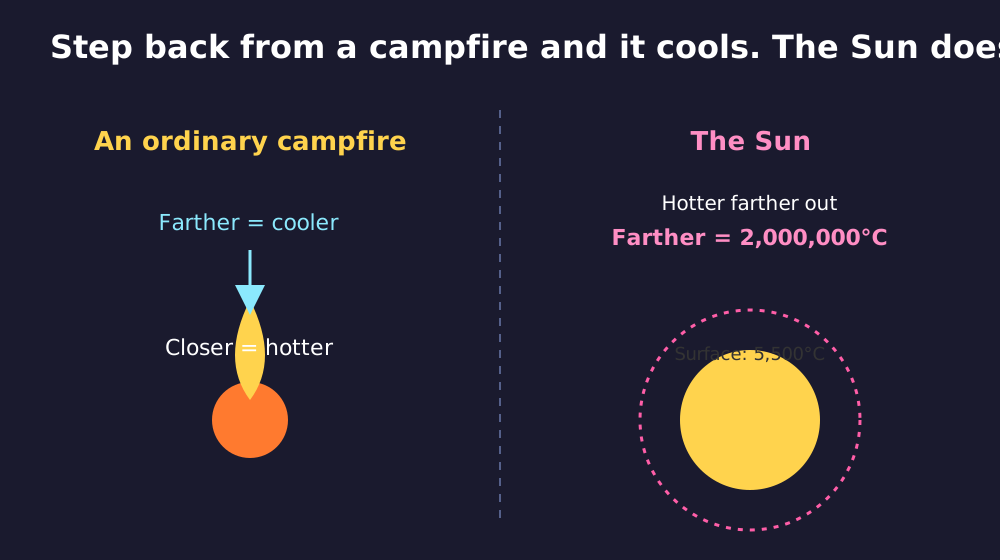
Picture a campfire. Stand close and you feel the heat; step back a few feet and it’s cooler. Keep walking away, and the warmth keeps fading. That’s just how fire works.
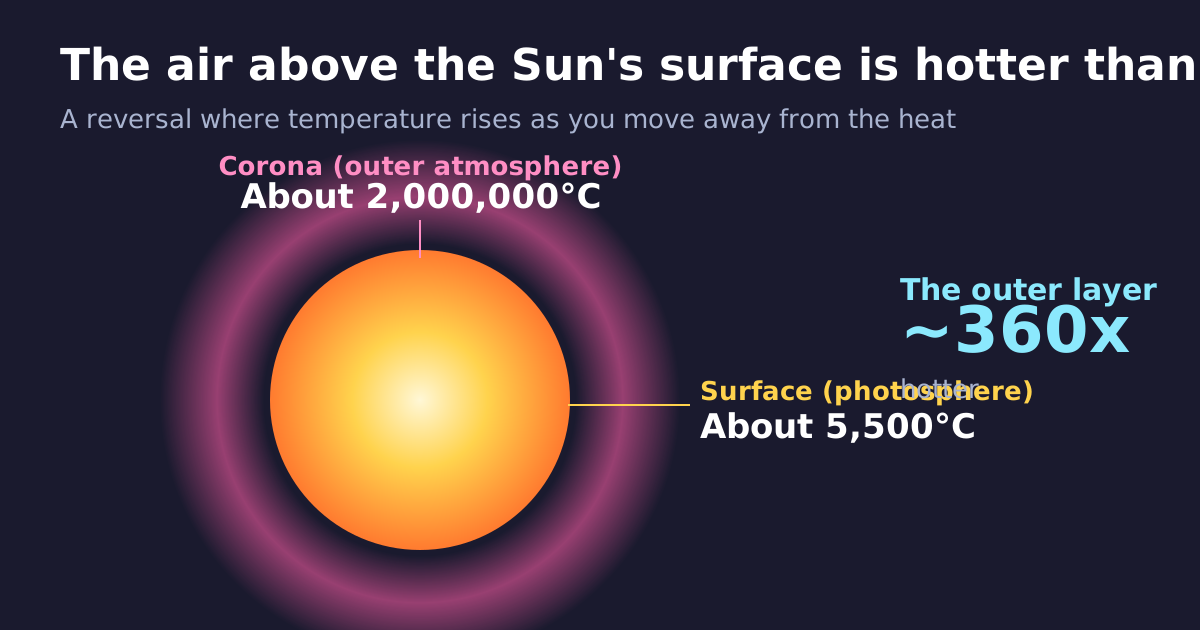
The Sun breaks that rule outright. Its surface runs about 5,500°C. But the thin atmosphere wrapped around it, the corona, sits at roughly 2,000,000°C.
The air farther from the fire is about 360 times hotter than the fire itself.
A Surface at 5,500°C, an Atmosphere at 2 Million
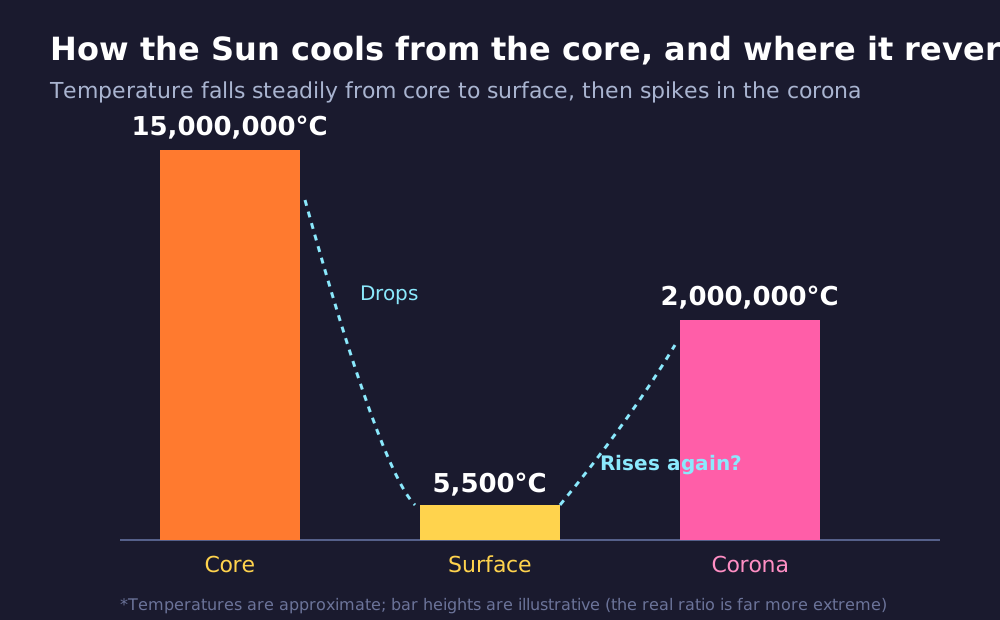
Let’s lay out the numbers first. According to NASA’s basic data on the Sun, the photosphere, the bright, visible layer we call the Sun’s “surface,” sits at around 5,500°C. The core at the center runs far hotter, about 15,000,000°C.
So far, this tracks with intuition. The heat source sits at the center, and things cool down as you move outward. From the core’s 15 million degrees to the surface’s 5,500, the temperature drops in a clean, sensible line.
Here’s where it gets strange. Just beyond the surface, visible to the naked eye only during a total solar eclipse, floats a pearly halo of gas called the corona. The same data pegs its peak temperature at about 2,000,000°C.
A temperature that had just finished dropping to 5,500°C suddenly rockets back up, hundreds of times over, the moment you step away from the heat. I’ll admit it: the first time I learned the order of these numbers, I double-checked whether I was reading the diagram upside down.
Why This Breaks the Rules
Before going further, it’s worth pausing on why this is such a big deal.
Heat flows from hot to cold, never the reverse. Leave a hot cup of coffee alone and it cools down. A cold room doesn’t spontaneously heat itself up. This is one of the more unbending rules in physics, and everyday experience never contradicts it.
For the Sun, the energy source is the core, where nuclear fusion generates heat that then travels outward. By that logic, temperature should drop steadily the farther you get from the center. No exceptions.
Yet the corona, which sits beyond the surface, runs hotter than the surface itself. The farther you are from the heat source, the hotter it gets. Step away from a campfire and you cool off. Step away from the Sun’s surface and the temperature spikes.
On the surface, it looks as if heat is flowing backward, from cold to hot. No actual law of physics is being violated, of course. The surface’s heat isn’t simply radiating outward to warm the corona directly. Instead, energy travels to the corona through some other channel and gets released there all at once. That’s the only way to make sense of the reversal.
So how does that energy leap over the relatively cool 5,500°C surface and heat only the layer beyond it, up to 2,000,000°C? This puzzle, known as the coronal heating problem, has stumped astronomers for close to a hundred years.
The Prime Suspect: Magnetic Fields
There’s one clue nearly everyone agrees on: the culprit is the Sun’s magnetic field.
The Sun is a ball of gas, but inside it, electrically charged gas is constantly on the move, generating an intense magnetic field. Sunspots and prominences (those flame-like arcs of gas that leap off the surface) are both magnetic phenomena. That same magnetic field appears to be the channel carrying energy from the surface outward.
The real question is how that transported energy turns into heat once it reaches the corona, and here, two major theories compete.
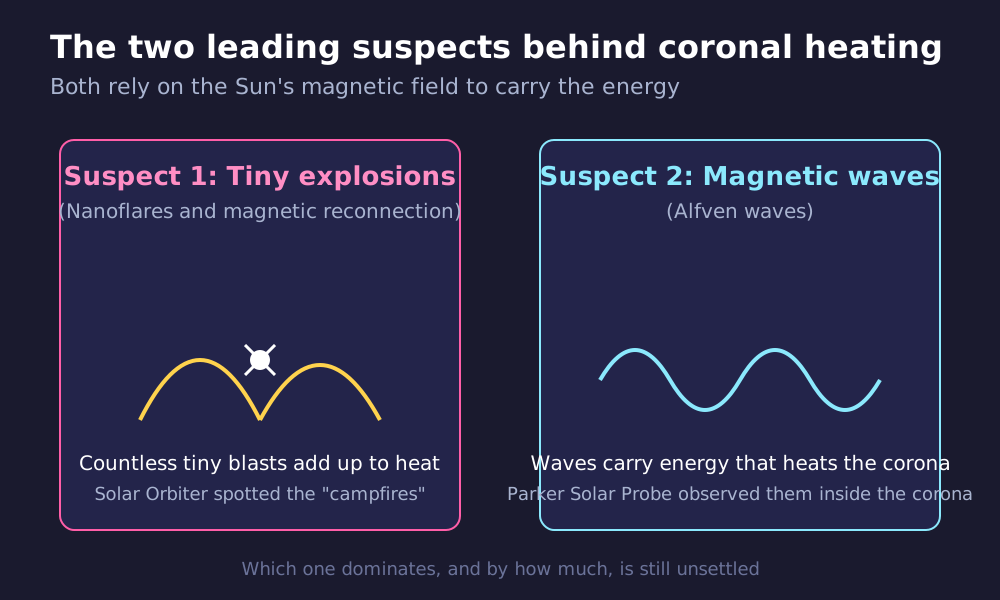
The first says countless tiny explosions are going off constantly. Magnetic field lines twist, snap, and reconnect, releasing bursts of energy each time. These micro-explosions are called nanoflares. Individually, each one is tiny, but if they’re firing nonstop across the entire surface of the Sun, their combined output could be enough to heat the whole corona.
The second theory points to waves traveling along the magnetic field. Field lines vibrate like guitar strings, and those oscillations, known as Alfvén waves, propagate outward into the corona and dump their energy there.
What makes this interesting is that these two explanations aren’t mutually exclusive. Most researchers suspect both mechanisms are at work, trading off depending on location and conditions.
The Trouble With Studying Something You Can’t See
There are suspects, so why isn’t this case closed? Part of the answer is that the corona is brutally hard to observe.
The corona is thin and faint. Just inside it, the Sun’s surface blazes with light. It’s like trying to spot a firework next to a searchlight: the overwhelming brightness of the surface drowns out the corona almost entirely under normal conditions.
From Earth, the corona only becomes visible for a few minutes during a total solar eclipse, when the Moon blocks the Sun’s disk. For earlier generations of astronomers, those brief eclipse windows were the only chance to study it properly, period.
To get around that glare, scientists invented the coronagraph. The device places a small disk inside a telescope to deliberately block out the Sun’s body, artificially recreating an eclipse so the faint corona around it can stand out.
One of NASA’s highlighted 2025 space station research results involves a new coronagraph called CODEX, mounted on the International Space Station, which has begun capturing images of the Sun’s outer atmosphere. According to NASA, CODEX goes beyond measuring the corona’s density, which is what older instruments mostly tracked, and can also measure the temperature and speed of the solar wind streaming off it. The goal is to watch, in the same location at the same time, what’s heating the corona and what’s accelerating the solar wind.
Flying Into the Fire to Find Out
If you can’t see something clearly from a distance, the next move is to get closer. Over the past few years, the most direct strategy has been sending spacecraft right up to the corona, or straight through it.
NASA’s Parker Solar Probe was built for exactly this mission. It’s the closest any spacecraft has ever flown to the Sun, and it’s designed to probe how the corona gets heated and how the solar wind gets accelerated, from the inside. Its heat shield is engineered to withstand temperatures of about 1,377°C.
That it survives at all, despite the corona itself reaching 2,000,000°C, comes down to one detail: the corona is so thin that it carries very little heat even at that extreme temperature. High temperature and large heat transfer aren’t the same thing, which is basically the difference between a sauna and boiling water. You can sit comfortably in a 90°C sauna, but you can’t put your hand in 90°C water. Think of the corona as an almost impossibly hot, almost impossibly thin sauna.
ESA’s (European Space Agency’s) Solar Orbiter approached the problem from a different angle. In 2020, during its first close pass of the Sun, it captured images riddled with tiny flashes of light across the surface. The research team nicknamed them “campfires.” Whether they’re miniature flares or something driven by a different mechanism is still an open question.
Still, one researcher involved in the ESA findings suggested that, added up across the entire Sun, these campfires could be a major contributor to coronal heating. It was the first time observations put a concrete face on the “countless tiny explosions” theory.
CODEX, Parker Solar Probe, and Solar Orbiter are three different sets of eyes circling the same mystery. Even so, no single culprit has been pinned down yet.
This Reversal Reaches Earth’s Sky, Too
This might sound like a story confined to a distant star, but the corona is tied directly to the sky above us.
Gas heated to 2,000,000°C is too energetic for the Sun’s gravity to hold onto, so it streams outward into space. That outflow is the solar wind, a constant stream of charged particles leaving the Sun. It reaches Earth, lights up the aurora at the poles, and occasionally, when it surges, disrupts communications and power grids.
So the next time you look up at the aurora, you’re watching the ripple effects of a question that still hasn’t been fully answered: why is the Sun’s atmosphere hotter than its surface?
If you could somehow float just above the Sun’s surface and look up, you’d find yourself standing in a genuinely strange place, one where the thin air overhead is hundreds of times hotter than the ground beneath your feet. Right now, spacecraft flying straight into that fire are writing down the answer, one line at a time.