Four hundred and fifty million light-years away, a star fell into a black hole and burned, briefly, with startling brilliance. That flash may have finally revealed something astronomers have hunted for decades: a black hole of “medium” size. We’ve long known black holes come in small and large. The range in between has been almost entirely missing.
Light and heavy black holes exist. The middle is nearly empty
Mention black holes, and most people picture one of two kinds.
The first forms when a massive star collapses under its own weight at the end of its life. These stellar-mass black holes top out below 100 solar masses, and our own Milky Way alone is thought to hold millions of them.
The second is the supermassive kind that sits at the center of a galaxy, weighing in at anywhere from a few million to a few billion times the mass of the Sun. A completely different league.
The trouble is everything in between.
Black holes weighing hundreds to hundreds of thousands of solar masses, squarely in the middle, have barely turned up anywhere. This tier, known as intermediate-mass black holes (IMBHs), should exist according to the physics. Yet observations kept coming up empty.
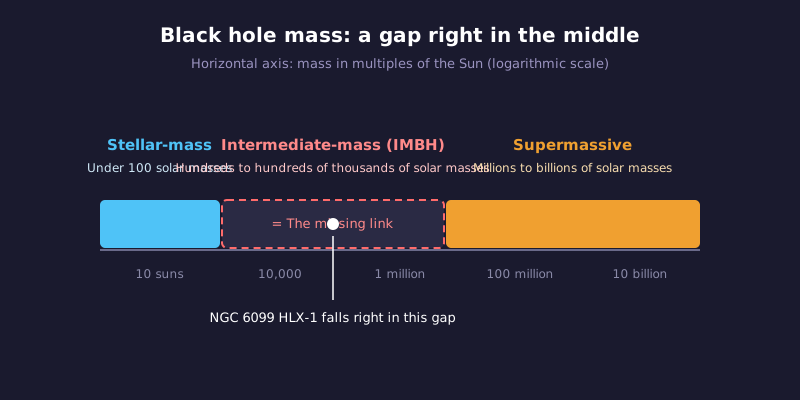
Small ones exist. Huge ones exist. The middle doesn’t show up. It’s a bit like seeing newborn puppies and full-grown dogs everywhere, but never a single adolescent one. That strange absence is why this mass range earned the nickname “the missing link.”
How do you even spot a black hole in the first place?
Here’s an obvious question: how do you find something that not even light can escape?
The trick is to watch what’s around it, not the thing itself. Gas falling toward a black hole spirals inward at tremendous speed before it crosses the point of no return, heating up and blazing with light, especially X-rays. Telescopes catch that light.
Supermassive black holes are relatively easy to spot because they’re usually surrounded by plenty of gas and stars, feeding more or less constantly. They glow brightly while they eat. What we actually see isn’t the black hole itself, but the scream of light from everything plunging toward it.
Intermediate-mass black holes, though, don’t eat nearly as aggressively.
With little material nearby to swallow, they stay dark almost all the time, sitting quietly in the black. Researchers now think this is the main reason the middle tier has been so hard to find.
I’ll admit, I used to assume mid-sized black holes were simply rare. Turns out they’re not necessarily rare at all. They just don’t shine, so we never notice them.
It swallowed an entire star
So how did something invisible finally get caught?
The story starts with a strange X-ray source NASA’s Chandra X-ray Observatory picked up in 2009. The location: NGC 6099, a giant elliptical galaxy in the direction of the constellation Hercules, roughly 450 million light-years from Earth.
This wasn’t just a steady glow.
After that 2009 detection, the source kept brightening until it peaked in 2012, shining about 100 times brighter than it had been. From there it faded, and kept fading, all the way through 2023.
A brief swell, then a long decline.
That exact pattern turned out to be the giveaway. A star that strayed too close to a black hole gets ripped apart by overwhelming gravitational tides and consumed as gas, an event astronomers call a tidal disruption event, or TDE. A normally dim object lit up briefly because it had just eaten an enormous meal: an entire star.
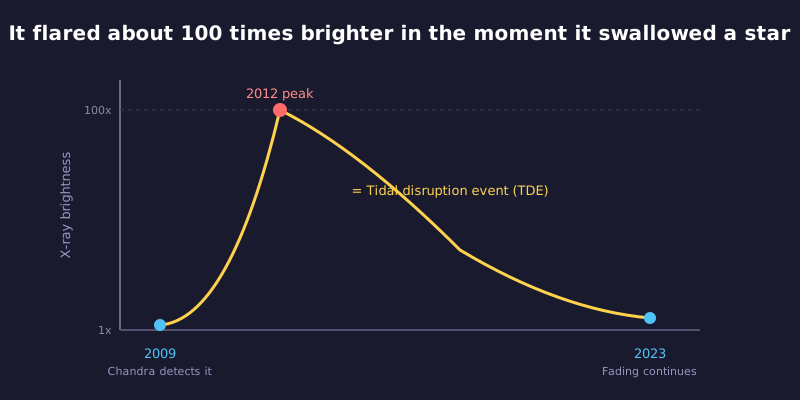
The swallowed gas reached temperatures of about 3 million degrees Celsius, roughly 500 times hotter than the Sun’s surface, which sits around 6,000 degrees. And here’s the interesting part: the exact way the brightness rose and fell lines up precisely with what you’d expect from an intermediate-mass black hole.
Not at the galaxy’s center, but out in an orphaned star cluster
This object has another quirk worth noting.
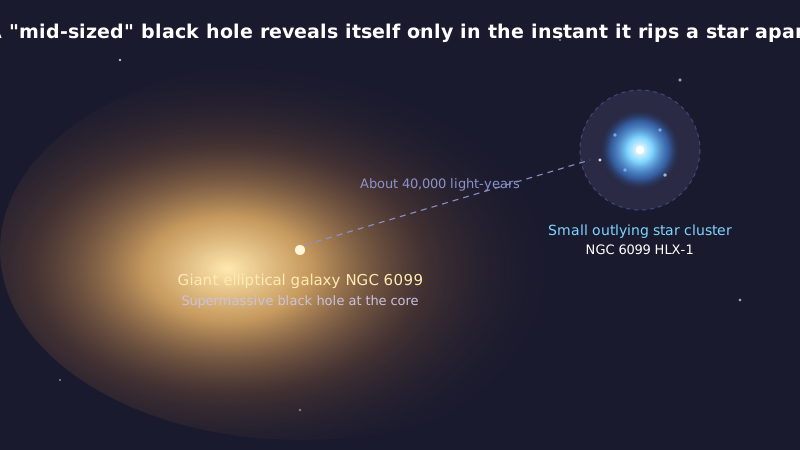
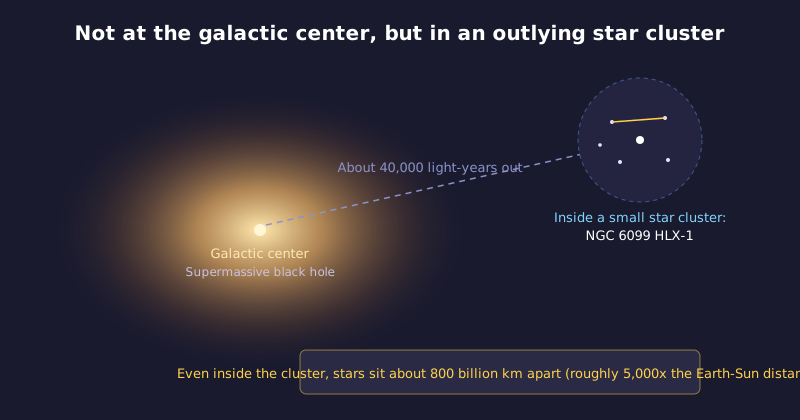
Big black holes usually sit right at a galaxy’s center. But this one, NGC 6099 HLX-1, was found roughly 40,000 light-years out from the galactic core, way out on the edge.
That 40,000-light-year figure might not mean much on its own.
Our own Milky Way spans roughly 100,000 light-years edge to edge, and the Sun sits about 26,000 light-years from the galactic center. In other words, HLX-1 isn’t living downtown. It’s out in the suburbs. Black holes offset from a galaxy’s center have turned up elsewhere too, but one of this intermediate size is unusual.
When astronomers pointed the Hubble Space Telescope at the area, they found a small, compact star cluster there. The black hole was sitting inside it.
You’d expect stars in a cluster to be packed tight. They are, relatively speaking, but even here, neighboring stars are still several light-months apart, roughly 800 billion kilometers.
Try picturing yourself standing at the center of that cluster.
Eight hundred billion kilometers is about 5,000 times the distance from Earth to the Sun. Your nearest neighboring star would technically be close by cosmic standards, yet still impossibly far. The sky would look sparse, and right beneath your feet, something utterly dark and silent would be lurking.
Researchers are intrigued by this unusual address, the outlying star cluster. One idea is that the cluster is the leftover core of a once-independent dwarf galaxy, swallowed long ago by its larger neighbor and left stranded on the outskirts. If that’s right, the term “missing link” takes on a sharper meaning. A mid-sized black hole that grew up at the heart of a small galaxy could be the surviving intermediate stage on its way toward eventually merging into a full supermassive black hole. We’ve already found other evidence pointing this way, including black holes suspiciously overmassive for the dwarf galaxies that host them.
Still just a strong candidate, not a confirmed case
At this point you might think the case is closed.
But the research team is careful to call this only a strong candidate for an intermediate-mass black hole, not a confirmed one.
Part of the reason is timing.
The X-ray brightness was tracked at different times than when Hubble imaged the star cluster in visible light. Stitching together snapshots taken years apart leaves some gaps that can’t be fully explained by a single clean narrative. Caution here is entirely reasonable.
On the X-ray side, both NASA’s Chandra and the European Space Agency’s XMM-Newton tracked how this object changed over time.
Catching a brief flare like this requires watching wide swaths of sky, repeatedly, over long stretches of time. That’s exactly the kind of survey the upcoming Vera C. Rubin Observatory is built for. Researchers expect that telescopes like it will catch star-shredding events happening hundreds of millions of light-years away, one after another, and finally confirm that mid-sized black holes are real. Find one, and it could be a fluke. Find dozens, and you’ve got a population.
Invisible, except for the instant it breaks something
We rarely think about the power grid until the lights go out.
Intermediate-mass black holes are a bit like that. Most of the time, they swallow nothing, emit no light, and sit in total silence somewhere in the universe. They can exist without ever giving us a way to check.
Except for one moment: when a star happened to wander close enough to get torn apart.
The flash left 450 million years ago has finally reached telescopes on Earth, carrying a simple message: I was here. In exchange for the death of a single star, a black hole that had been missing for a very long time briefly showed its outline.
Somewhere out there, in the dark patch of sky toward the constellation Hercules, invisible to the naked eye, a black hole has wiped its mouth and gone quiet again.