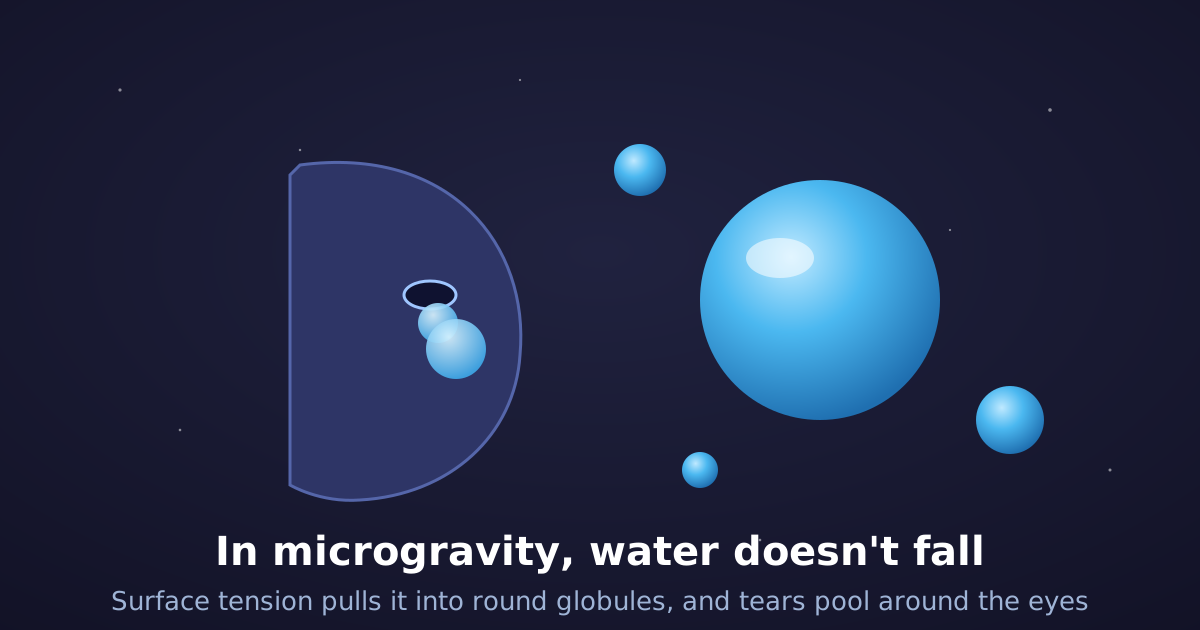
Say someone cries aboard the International Space Station. The tears won’t roll down their cheeks. Instead they pool around the eyes, slowly swelling into a bigger and bigger bead of water that clings to the face and wobbles there.
They never spill over. There’s nowhere for them to fall to.
On Earth, “water falls down” is such an obvious fact that nobody ever questions it. The moment gravity disappears, though, that whole assumption stops working. Tears, drinking water, wash water: all of it behaves differently.
A world where water stops “falling”
Tip a cup on Earth and the water pours out. That’s gravity pulling it downward. In microgravity, that pull barely exists.
So something else takes over: surface tension, the mutual attraction between water molecules that pulls the liquid into whatever shape has the smallest possible surface area, a sphere.
On Earth, gravity crushes this effect into irrelevance. In space, it becomes the main character. Water balls up and drifts. Pour it into a cup and it won’t settle at the bottom, it’ll bulge up over the rim and float away.
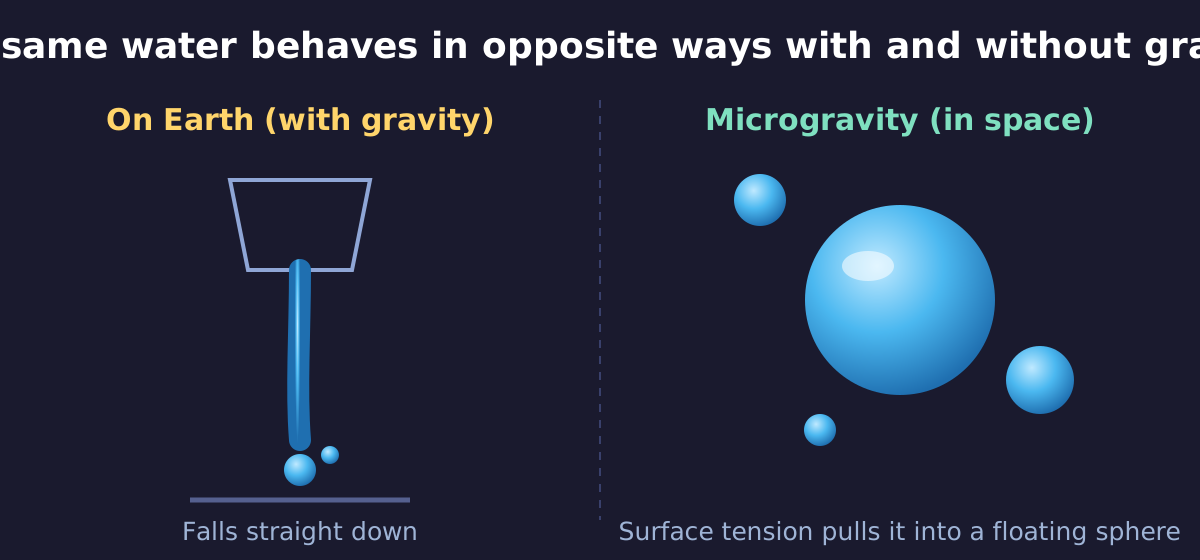
NASA astronauts describe rinse water this way: it forms into a ball, and surface tension actually helps it stick to your skin. The water clings rather than running off.
Strange as it sounds, surface tension, a nuisance on Earth, becomes a trusted partner in orbit. Keep that in mind, because it ties together everything else about drinking, washing, and crying up there.
You can’t pour yourself a glass of water
Drinking starts out different. Pour water into a cup and it just balls up and floats away, never reaching your mouth. So in space, water goes into sealed pouches and gets sipped through a straw.
Most drinks start as powder. According to NASA, beverage powders are packed into containers fitted with one-way valves, and crew members inject water directly into the pouch while in orbit. Tang, the orange-flavored powdered drink famous since the Apollo era, is apparently still being consumed on the space station today.
Picture this for a second.
If you accidentally squeeze too hard on the straw, a small bead of water drifts out in front of your face. The astronaut has to chase it down with their mouth and catch it. What would just mean wiping the floor on Earth becomes a small treasure hunt up there.
There’s no shower. The whole body gets wiped with less than a cup
So how do astronauts actually wash? Short answer: there’s no shower on the space station. Water doesn’t rain down, so a shower simply couldn’t function.
Instead, crew members do what amounts to a sponge bath. Per NASA’s explanation, they fill a mylar-like pouch from the Potable Water Dispenser, then wipe down with a soap-soaked towel. Rinsing means spritzing water in small bursts, letting it ball up, and wiping it away with a towel.
What’s startling is how little water that actually takes. Washing the entire body uses roughly 150 to 200 milliliters.
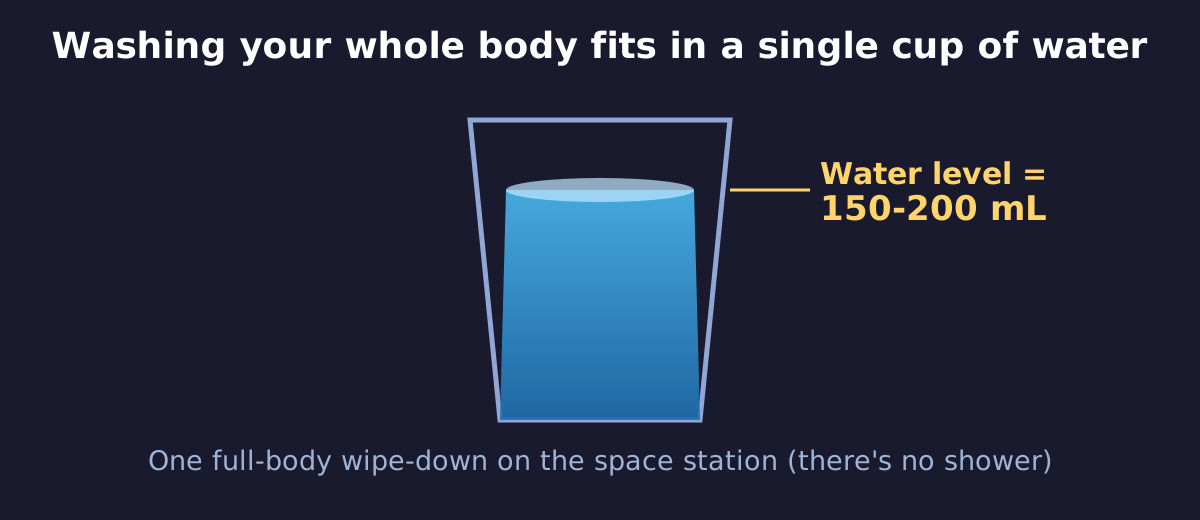
One cup, for your whole body. A shower on Earth would blow through that much water in a matter of seconds. If you want something closer to a warm shower, apparently you warm the water pouch in a food warmer first.
Brushing teeth is its own ordeal. There’s no sink, so you spit your toothpaste into a towel, then hang the towel to dry so the moisture can be recovered later. Swallowing a little toothpaste now and then is fine, NASA notes, but doing it constantly isn’t recommended.
I’ll admit it: before reading this, I assumed brushing your teeth in space was basically a non-issue. I was wrong.
Hand-washing works the same way, wet wipes, or a dab of soap squeezed from a pouch. And the toiletries allowed on board are tightly restricted. NASA says anything containing substances the water recovery system can’t process, alcohol, for instance, is banned; only products on an approved list make the cut. Even the water you wipe your face with is chosen with its eventual return to the recycling system in mind.
Towels get swapped roughly every five days. Razors are replaced daily, since blades can’t be kept sanitary otherwise. Toothbrushes arrive fresh every 21 days. In a world where you can’t just rinse things clean, you swap out the gear instead.
When tears pool on your face, it’s an event
Which brings us back to the tears. If wash water balls up and clings to the skin, of course tears behave the same way.
On Earth, gravity pulls tears down your cheeks, which is why we even have the phrase “tears rolling down.” In microgravity, there’s nowhere for them to fall. They collect around the eyes instead, surface tension drawing them together into a large bead that just sits on the face.
This isn’t some change in how the body works. Water simply stops doing the one thing it always used to do, fall.
Astronauts describe the sensation of water pooling in the eyes as something like the feeling of swim goggles filling up and not being able to drain them, on Earth. Crying doesn’t bring any relief. The tears have nowhere left to go. Once the pooled bead grows large enough, surface tension finally loses its grip, and it trembles free from the face to drift off on its own.
So what happens to this water with nowhere to go? This, honestly, is my favorite part of the whole story. On the space station, nothing gets wasted, not the tears left on someone’s face, not even the moisture in every breath exhaled into the air.
Urine, sweat, even the moisture in your breath, all recycled into drinking water
The International Space Station runs a water recovery system (part of ECLSS, the Environmental Control and Life Support System). This is where humanity’s relationship with water in space gets genuinely astonishing.
In June 2023, NASA announced that this system had reached a milestone: recovering 98% of all water aboard the station. And the sources it draws from are remarkable, urine, sweat, and even the humidity breathed out into the cabin air.
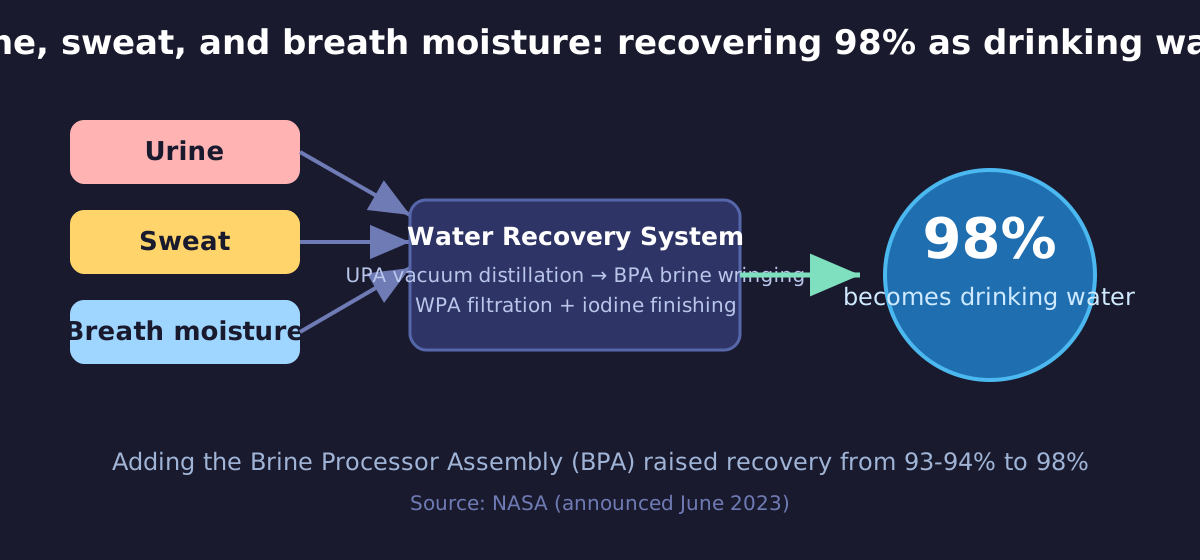
Here’s how it works. Urine goes through the Urine Processor Assembly (UPA), which uses vacuum distillation to extract water. What’s left behind, a concentrated brine, still has moisture in it, so the Brine Processor Assembly (BPA) uses warm, dry air to wring out what remains. That extra step is what pushed the recovery rate from 93-94% up to 98%.
Moisture in the cabin air, crew sweat and exhaled breath, gets pulled out by high-performance dehumidifiers. All of this recovered water then flows into the Water Processor Assembly (WPA), where it’s filtered to remove contaminants and finally dosed with iodine before storage.
You might wonder whether anyone hesitates to drink it. But think about it this way: tap water on Earth also started out as somebody’s wastewater, cycling through rivers and treatment plants before reaching your glass. In space, that same cycle is just compressed into a machine.
A NASA official put it simply: in orbit, there’s no room to waste water. So every last tear, every bit of moisture in every breath, gets reclaimed wherever possible.
The luxury of water that falls when you turn on the tap
With all that in mind, your bathroom sink starts to look a little different.
Turn the tap and water falls. Pour it into a cup and it settles at the bottom. Wash your face and the water runs down the drain. Cry and your tears slide down your cheeks. Every one of these moments rests on a single, invisible assumption: that water falls down.
Gravity has been quietly holding that assumption in place the whole time. It’s so ordinary that we never even notice it’s being supported at all.
Astronauts live wiping their entire bodies with a single cup of water, chasing floating beads with a straw, letting tears collect around their eyes because there’s nowhere else for them to go. And the sweat and tears they shed today come back to them tomorrow, as drinking water.
Tonight, when you brush your teeth and rinse your mouth, take a second to watch the water disappear down the drain. That stream you throw away without a second thought would, 400 kilometers up, become somebody’s water for tomorrow, down to the very last drop.
On a related note, I wrote about how microgravity reshapes the body itself in Live in Space Long Enough and Your Body Gets a Custom Rebuild.