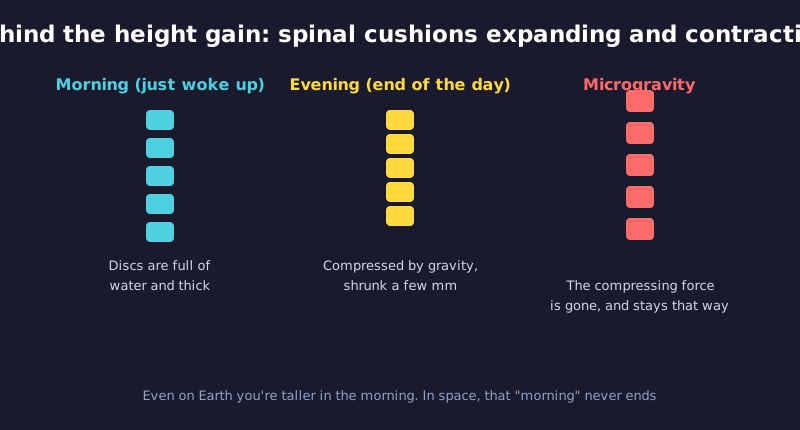
Right now, this morning, you’re a few millimeters taller than you were last night. Through the day, gravity presses down on the cushions between your vertebrae, and they compress. Sleep resets them, and by tomorrow morning you’re back to full height.
In space, though, that “morning height” never resets. It just keeps climbing.
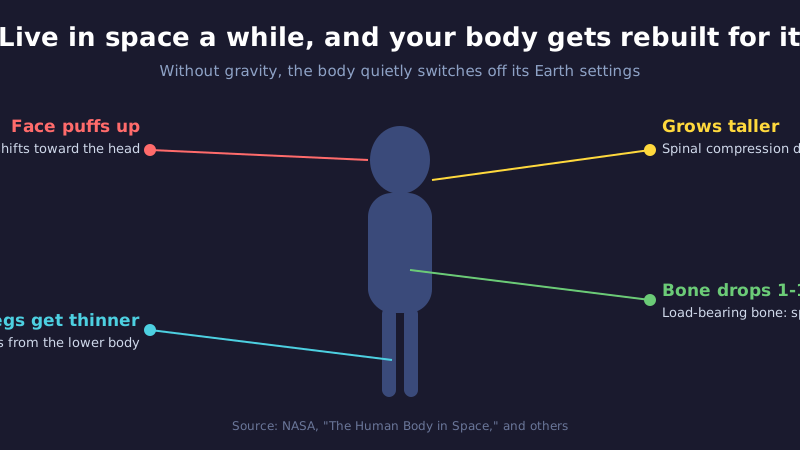
And that’s only the start. Your face puffs up. Your legs shrink. Your bones shed mass by the month. It’s as if your body notices there’s no gravity anymore and starts unplugging every setting it built for Earth.
First, all your body’s fluid rushes toward your head
The moment gravity disappears, the first thing that happens is a mass migration of fluid.
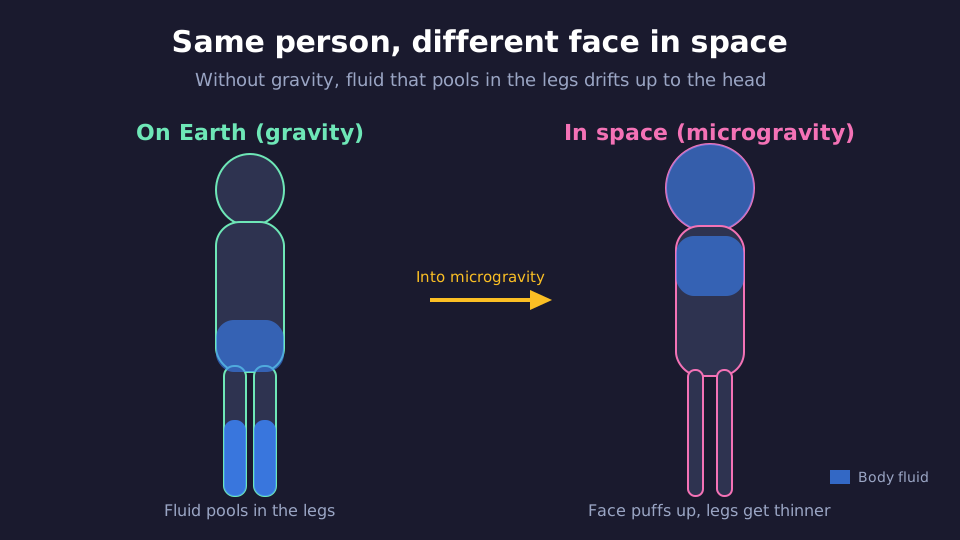
On Earth, blood and other fluids get pulled downward, pooling in your legs and lower body, and your heart spends all day pumping them back up. In orbit, that downward pull just vanishes — so the fluid that used to sit in your legs surges upward toward your chest and head instead. NASA describes this as a “fluid shift” toward the upper body in microgravity.
This isn’t a slow drift that happens over weeks. It starts the instant gravity is gone, and within a few days your face looks noticeably different.
The result: astronauts’ faces swell up. Their legs, meanwhile, lose fluid and get so thin that crews have nicknamed the look “bird legs.” Pants get baggy. Even shoes loosen.
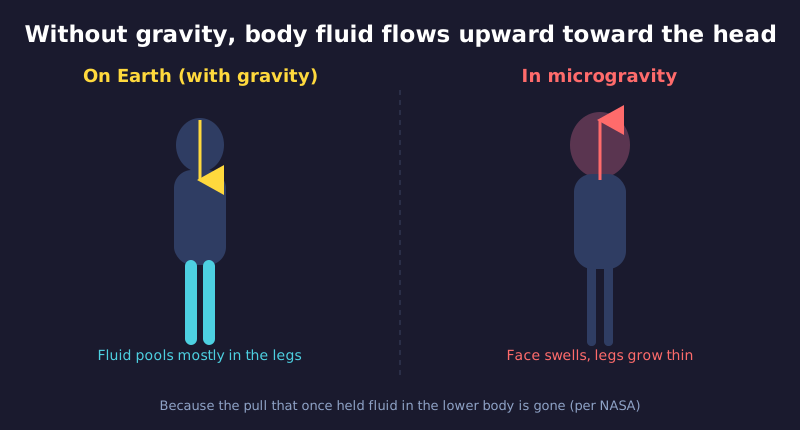
Think about waking up with puffy eyelids after a night lying flat — that’s fluid pooling in your face while you sleep. For astronauts, that puffiness never goes away, waking or sleeping. Some report stuffy noses and a dulled sense of taste, too.
Picture it: six months straight with a swollen face, a blocked nose, and legs like sticks in the mirror. It would take a while to feel normal again.
The heart changes shape — and starts cutting corners
Once fluid piles up near the head, the heart is next to feel it.
Here’s the interesting part: once the heart realizes it no longer needs to pump uphill, it simply adapts. According to NASA, the heart’s shape itself changes in microgravity — from an oblong shape, like a water balloon, to something rounder, like a balloon full of air.
Total blood volume drops, too. And the muscles that once tightened and relaxed blood vessels to control circulation weaken from disuse. In short, both the heart and the vessels optimize themselves for an environment that no longer demands much of them.
“Slacking organs” sounds bad, but this isn’t laziness — it’s efficiency. Keeping up extra effort in an easy environment would actually be the strange choice for a living thing.
None of this causes much trouble while you’re still in orbit. The trouble starts when you come back to Earth — more on that at the end.
Bones decide they don’t need to hold you up anymore, so they start dissolving
Everything so far has been about fluid. The real challenge is bone.
On Earth, your bones — especially the spine and hips — spend all day supporting your body weight. They sense that load and respond by stockpiling calcium and other minerals to stay strong.
So what happens when that job disappears?
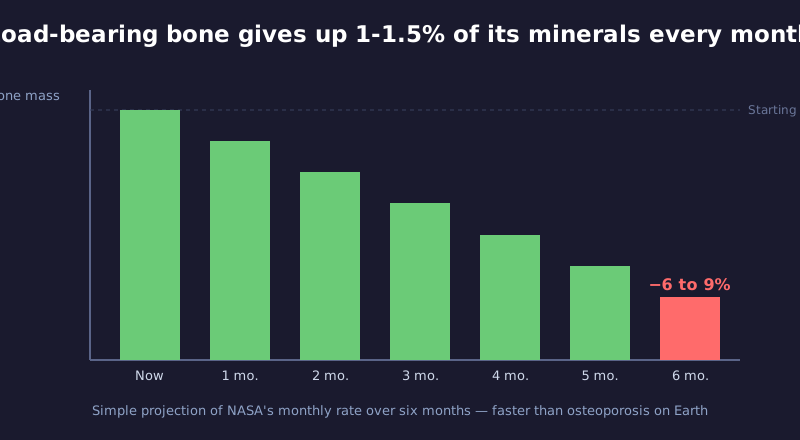
Bone turns out to be brutally honest: if it doesn’t need to hold anything up, it decides it doesn’t need the material either. NASA reports that weight-bearing bone loses an average of 1-1.5% of its mineral density every month during spaceflight, with the spine and hips hit hardest.
The first time I saw that number, I assumed it was a typo. One percent a month works out to 6-9% over a six-month mission — a rate that outpaces even osteoporosis, the bone-thinning disease that usually progresses far more slowly on Earth. Astronauts manage it in a matter of months.
And that dissolved mineral doesn’t just vanish — it flows into the bloodstream and gets filtered out through the kidneys, which is thought to raise the risk of kidney stones. Losing bone density turns out to be more than a bone problem.
Muscle suffers for the same reason: without gravity forcing you to move against resistance, muscle mass drops too. NASA notes that astronauts lose muscle faster than they would on Earth unless they keep up a strict diet and exercise routine. Bone and muscle both slack off the moment the reward of physical load disappears. The human body, it turns out, is a remarkably efficient machine — maybe too efficient.
You get taller — and your eyesight can blur, too
While bone mineral drops, the spine itself does the opposite: it lengthens. Worth separating these two effects clearly.
What shrinks is the mineral content inside the bone. What lengthens is the cushioning between the bones — the intervertebral discs. On Earth, those discs get compressed from above and below by your body weight, staying thin. In microgravity, with that compressing force gone, the discs swell, and the whole spine grows longer.
Remember the “taller in the morning” effect from the opening? The same thing happens in orbit, except it never resets. It’s like living inside one long, six-month-long “morning.” That’s why astronauts can gain several centimeters of height.
I’ll admit, for a long time I thought of this height gain as a neat little bonus. It’s not that simple, though — a spine that stretches quickly can irritate nerves, sometimes causing back and hip pain.
And the fluid that piled up near the head affects the eyes, too. NASA explains that fluid shifted toward the head can put pressure on the eyes and cause vision problems. Some astronauts genuinely see the world differently while they’re up there. So much for the idea that microgravity is just floating around in comfort.
That’s why astronauts exercise, relentlessly, every single day
If bones and muscles slack off without a load, there’s only one countermeasure: manufacture a load that shouldn’t exist.
The exercise equipment lined up on the space station isn’t there for fitness fun — it’s a lifeline that tricks bone into thinking, “there’s still work to do here,” so it won’t discard its materials. NASA states plainly that exercise is essential for limiting bone density loss and preserving muscle strength during flight.
It’s a strange bargain: a body that could finally take it easy in space instead has to work as hard as it would on Earth, just to avoid falling apart. You sweat more up there, floating, than you would down here, walking around.
Even exercise alone can’t fully stop the bone loss. NASA notes that researchers are also studying medications — bisphosphonates, a class of drugs normally used to treat osteoporosis — as a way to slow the decline. Exercise, the low-tech solution, gets backup from pharmaceuticals. Keeping the human body tethered to its Earth settings turns out to be genuinely hard work.
Coming home means rebuilding your body for gravity all over again
So what happens when a body optimized for space lands back on solid ground?
The most obvious symptom is lightheadedness. Blood volume is down, and the heart and vessels have been coasting for months — then gravity suddenly reasserts itself. Blood tries to sink back toward the legs, but the systems that once fought that pull have gone soft. NASA explains that reduced blood volume and a weakened cardiovascular system make it harder for the body to regulate blood pressure. That’s why astronauts fresh off a landing sometimes struggle just to stand on their own.
Lost bone and a lengthened spine don’t snap back overnight, either. Slow, careful rehabilitation gradually pulls the body back toward its Earth settings. Coming down turns out to be harder than going up. The dramatic fire of launch gets all the attention, while the quiet grind of post-flight recovery rarely makes the news — but for the astronauts themselves, that’s where the real test begins.
Worth pausing on this: nothing that happens to the body in space is a malfunction or an illness. It’s simply the body adapting, with total logic, to the environment it’s handed. No gravity, no need for dense bone. No need to pump blood uphill, so the heart eases off. Every bit of it makes sense.
Flip that around, and it says something about us: every bone, every heartbeat in your body was designed on the assumption that Earth’s gravity would always be there.
The fact that you were a few millimeters taller this morning than last night, and that you’ll shrink back down by evening, is proof that blueprint is still quietly doing its job. The astronaut’s transformed body is really just a mirror — showing us, from the other side, the gravity we get for free every single day down here.