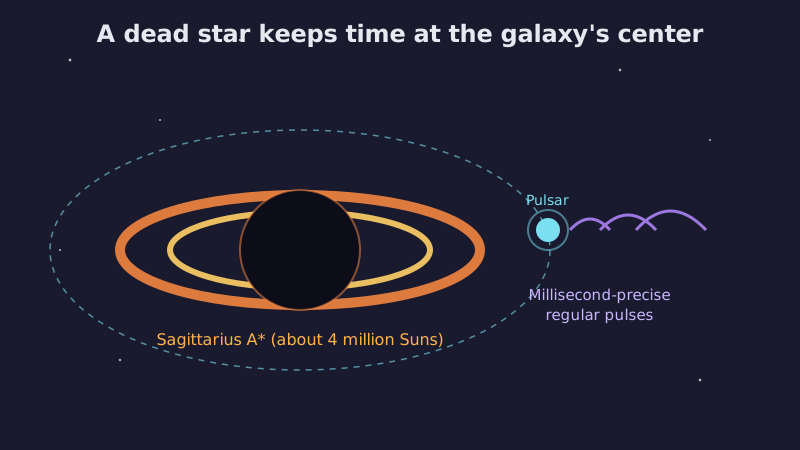
At the center of the Milky Way sits a black hole with the mass of 4 million Suns crammed into a single point. Its name is Sagittarius A*. Now imagine a “dead star” orbiting right next to it, blinking on and off with millisecond precision. If that star is really there, humanity is about to get an extraordinary new instrument.
That “dead star” is a neutron star — the crushed, leftover core of a star that exploded at the end of its life. When one of these objects flashes on a steady rhythm, we call it a pulsar.
Honestly, the first time I learned this, I gasped a little. The most accurate clock in the universe might not be an atomic clock or a radio-controlled watch. It might be the wreckage of a star that burned out long ago.
Why a dead star makes such a good clock
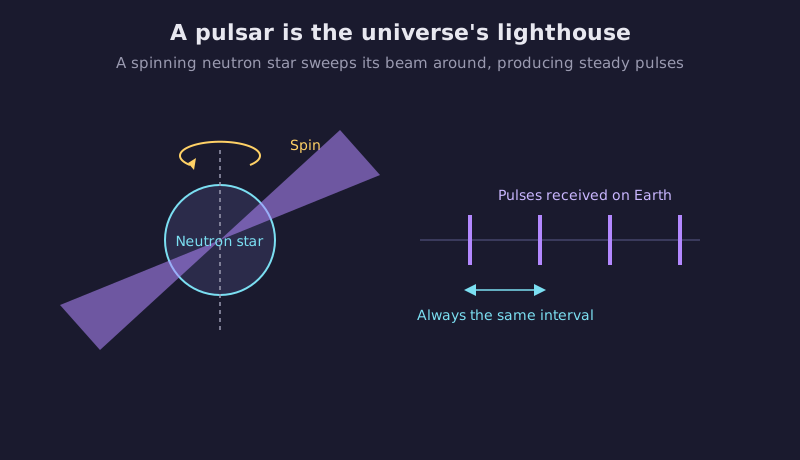
A pulsar is the corpse of an exploded star — a neutron star — spinning at incredible speed. NASA describes it as a cosmic lighthouse: as it rotates, it sweeps a narrow beam of radiation around, and every time that beam sweeps past Earth, we catch a flash of light.
The remarkable part is just how regular that flashing is. According to NASA, pulses arrive anywhere from milliseconds to seconds apart, and the rhythm barely wavers. A pulsar with a millisecond period is spinning hundreds of times every single second.
Why is it so precise? Because a neutron star is an absurdly heavy, absurdly rigid top. Once it starts spinning fast, almost nothing can throw it off rhythm. That’s what keeps the flashing as steady as a ticking second hand.
And we’re not talking about a small object here — this is a mountain-sized mass, actually more than a mountain, spinning at tremendous speed. Something that heavy, rotating that fast, shrugs off small outside nudges without missing a beat. There’s no air resistance in space to slow it down, either, so once a neutron star starts spinning, it just keeps going, barely losing speed at all.
Researchers think this stability rivals that of atomic clocks. It’s as if the universe has scattered precision timepieces across the sky, each one ticking away entirely on its own.
So what happens if you park one of these clocks right next to the monster sitting at the center of our galaxy?
The 4-million-solar-mass monster at the galactic core
Sagittarius A* is the supermassive black hole that sits dead center in the Milky Way. According to the European Southern Observatory (ESO), it weighs about 4 million times as much as the Sun and sits roughly 26,000 light-years from Earth.
A distance of 26,000 light-years is hard to picture, so here’s one way to think about it: light takes 26,000 years to make that trip. The light we’re receiving from the galactic center right now left its source back when woolly mammoths still roamed an Earth locked in an ice age.
At the far end of that unimaginable distance, the mass of 4 million Suns is packed into a single point. The space around it is warped to a degree that’s almost impossible to picture.
Here’s the strange part: something that massive doesn’t just bend space — it changes the flow of time itself. Near strong gravity, clocks run slow.
So if you put a pulsar’s clock in that neighborhood, how would its ticking appear to us?
Strong gravity slows clocks down
A clock sitting inside strong gravity appears to run slow when you watch it from far away. This is a prediction of Einstein’s general relativity — a theory that ties gravity directly to the warping of space and time — and the effect is known as gravitational time dilation.
You’ve actually relied on this effect today, probably without realizing it. GPS satellites orbit high above Earth, where gravity is weaker, so their onboard clocks run slightly faster than clocks on the ground. The mismatch comes out to about 38 millionths of a second per day. That sounds tiny, but without correcting for it, your GPS position would drift by several kilometers. The reason your car’s navigation system can pinpoint the right intersection is that engineers cancel out this timing drift, every single day.
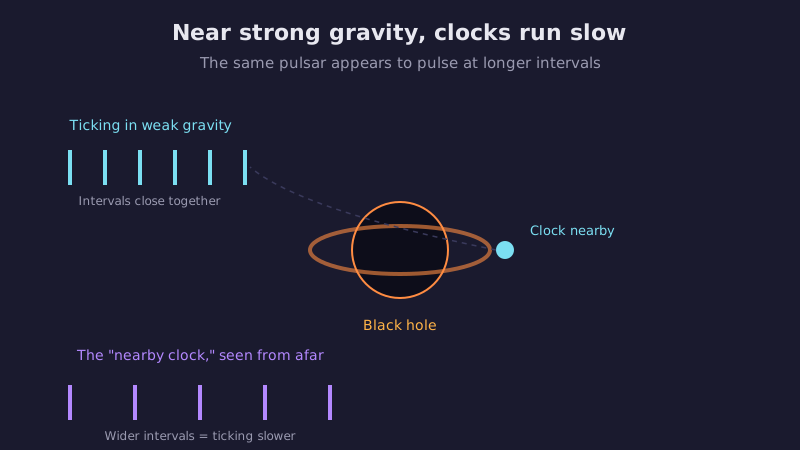
If gravity has that much effect just 20,000 kilometers up, imagine what it does right next to a black hole weighing 4 million Suns — the time dilation there would be dramatically larger. A pulsar orbiting that close would have its flashes arrive on Earth stretched out, spaced farther apart than they really are.
Here’s the part worth pausing on. The pulsar itself keeps perfect time. But as its pulses climb out of the black hole’s gravitational well on their way to us, a delay gets baked in. The clock isn’t broken — the signal we receive just gets stretched.
If we can measure that stretching with enough precision, we can work backward and read off the exact warp of spacetime around the black hole. A single clock, placed in the right spot, turns an invisible distortion into a hard number.
A single star has already given us a preview
Astronomers have already found evidence that Sagittarius A*‘s gravity warps spacetime — and they found it by watching a star’s motion.
According to ESO, a star called S2 completes one full orbit around Sagittarius A* roughly every 16 years. At its closest approach, S2 comes within 20 billion kilometers — about 120 times the distance between Earth and the Sun — and reaches nearly 3% of the speed of light. Astronomers tracked this star for 27 years using instruments including GRAVITY, which combines the light from four 8-meter telescopes into a single beam, achieving the resolving power of a telescope 130 meters across.
The result: S2’s orbit doesn’t trace the same ellipse twice. Instead, it slowly rotates, tracing out a shape like overlapping rose petals. This is exactly the effect general relativity predicts, known as Schwarzschild precession.
In April 2020, the international GRAVITY collaboration announced that this observation confirmed Einstein’s theory. All of that came from tracking the motion of a single star.
Here’s where it gets interesting. If a star’s motion alone can reveal this much, then a pulsar — an object that is itself a precision clock — could potentially deliver accuracy on a completely different level.
A pulsar could measure spacetime with far greater precision
Watching a star tells you where it is in the sky and how fast it’s moving — position and velocity. A pulsar, on the other hand, broadcasts something much more direct: an actual, precise timestamp, riding on a radio signal.
Measuring position and reading a timestamp are worlds apart in precision. It’s the difference between tracking a distant figure by eye and listening to that same person read out the time, second by second. If even a single genuine pulsar turns up near Sagittarius A*, everything changes. Researchers expect that the delays and rhythm shifts in its pulses could reveal the black hole’s mass and spin with unprecedented accuracy.
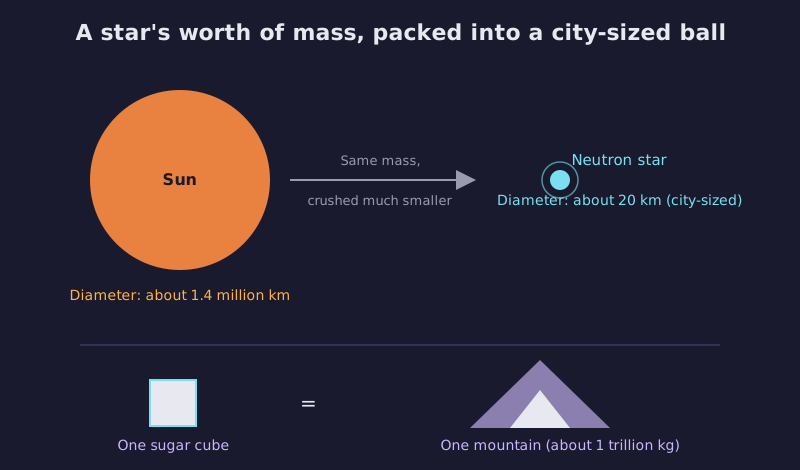
It’s worth pausing to appreciate just how extreme this clock actually is. According to NASA, a neutron star packs 1 to 3 times the mass of the Sun into a sphere only about 20 kilometers across — small enough to fit inside a single city. A sugar cube’s worth of that material would weigh about a trillion kilograms on Earth — roughly the same as an entire mountain.
And yet this monstrous object keeps time with total regularity. If you could somehow stand on its surface, the ground beneath your feet would spin hundreds of times every second, while overhead, the darkness of 4 million Suns would loom in the sky.
So why hasn’t a definitive example of this ideal clock turned up yet? Because the galactic center is thick with gas and dust that scatter radio waves. Unlike starlight, radio waves have long wavelengths, and pushing through that dense fog blurs their rhythm. That’s exactly why, when researchers reported a candidate object near Sagittarius A* spinning with a period of roughly a millisecond, so many scientists took notice. Whether it turns out to be a genuine pulsar is something future observations will have to confirm.
Your GPS and a clock 26,000 light-years away
Strong gravity slows clocks down. That single piece of physics is quietly keeping your phone’s GPS accurate right now — and 26,000 light-years away, it could become the key to unlocking the true nature of a black hole. The scales couldn’t be more different, but it’s the exact same underlying rule at work.
If the pulsar near the galactic center turns out to be real, the implications are huge. Humanity would gain a way to test Einstein’s theory under the most extreme gravity we know of. The black hole’s mass and spin rate would emerge, quietly, from nothing more than the timing of its flickers.
At the edge of a darkness weighing 4 million Suns, a dead star no bigger than a city keeps blinking, precisely, every millisecond. That tiny flicker might just become the most accurate ruler the universe has ever offered us.