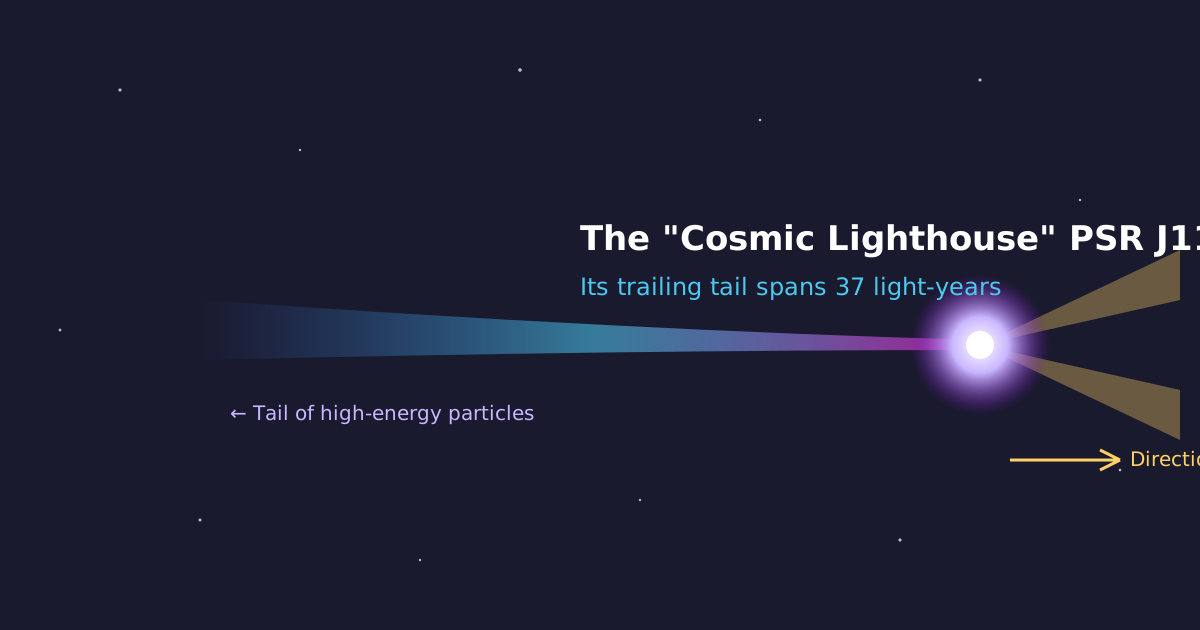
Twenty-one thousand light-years away, the corpse of a star is racing through the galaxy at breakneck speed. Behind it trails a stream of glowing particles that stretches for 37 light-years — roughly nine times the distance from the Sun to the nearest star.
Because it looks so much like a rotating beacon, astronomers have nicknamed this object the “Lighthouse Nebula.” At its heart sits a pulsar, the compressed remnant of a dead star. In 2026, a NASA X-ray telescope measured the direction of that lighthouse’s magnetic field directly for the first time in history.
Honestly, the first time I saw this image, the scale of it briefly broke my brain. Let’s unpack it piece by piece.
What exactly is this “lighthouse”?
The star at the center of the story is a pulsar named PSR J1101-6101. The name is a mouthful, but the object itself is a neutron star — what’s left after a star heavier than the Sun collapses at the end of its life.
A neutron star crams more mass than the Sun into a sphere roughly 20 kilometers across, small enough to fit inside a single city. All that compression sends the density and magnetic field off the charts. A sugar-cube-sized scoop of neutron star material would outweigh a mountain on Earth — that should give you a sense of just how extreme these objects are.
A “pulsar” is simply a neutron star that spins rapidly while shooting beams of light from its magnetic poles. Every time a beam sweeps past Earth, we see a flash — the same basic mechanism as a lighthouse sweeping its beam across the sea at regular intervals.
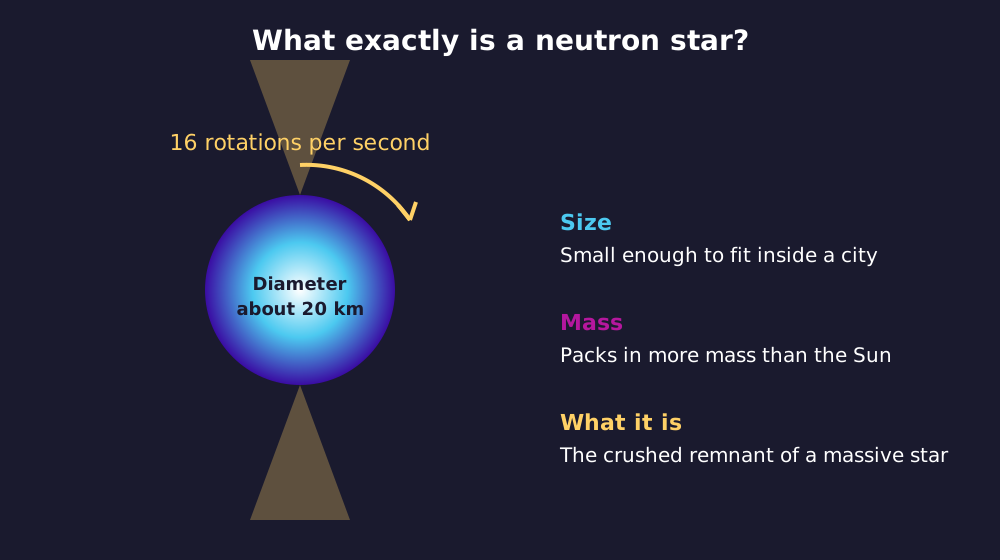
This particular pulsar spins 16 times per second. Picture something the size of a city rotating so fast you couldn’t even track it with your eyes. Each rotation sweeps its beam across the sky, which is exactly why astronomers reach for the lighthouse metaphor.
So why does it drag such a long tail behind it? That’s where things get interesting.
Translating “37 light-years” into something you can actually picture
This pulsar is barreling through interstellar space, still carrying the momentum from the explosion that created it. As it plows forward, it sheds high-energy particles that pile up behind it into a long, thin tail.
The tail glows because accelerated particles spiral around magnetic field lines and radiate energy as they go. In other words, this isn’t a simple trail of smoke — it’s a live battlefield where particles and magnetic fields are locked in a constant tug-of-war.
Its length: 37 light-years. That number alone doesn’t mean much, so let’s translate it into something familiar.
Proxima Centauri, the closest star to the Sun, sits about 4.2 light-years away. This tail is roughly nine of those distances laid end to end — and all of it belongs to a single, unbroken streak of light.

According to NASA and the Chandra team, this is the longest tail — or jet — ever found trailing a single object anywhere in the Milky Way. A lone dying star dragging a wake this immense is already remarkable on its own.
And the whole thing sits about 21,000 light-years from Earth, roughly the distance toward the center of our galaxy. So how did we manage to “see” the tail of a city-sized stellar corpse from that far away?
Four wavelengths, one picture
The trick wasn’t a single telescope — it was stacking observations from several telescopes, each tuned to a different type of light. Point different instruments at the same object, and you get wildly different faces staring back.
The composite image behind this story layers four separate observations into one. Here’s what each color represents:
- Purple: X-rays captured by NASA’s Chandra X-ray Observatory
- Blue: X-rays captured by NASA’s IXPE
- Green: Radio waves captured by Australia’s ATCA radio telescope
- Background stars: Visible and infrared light captured by 2MASS
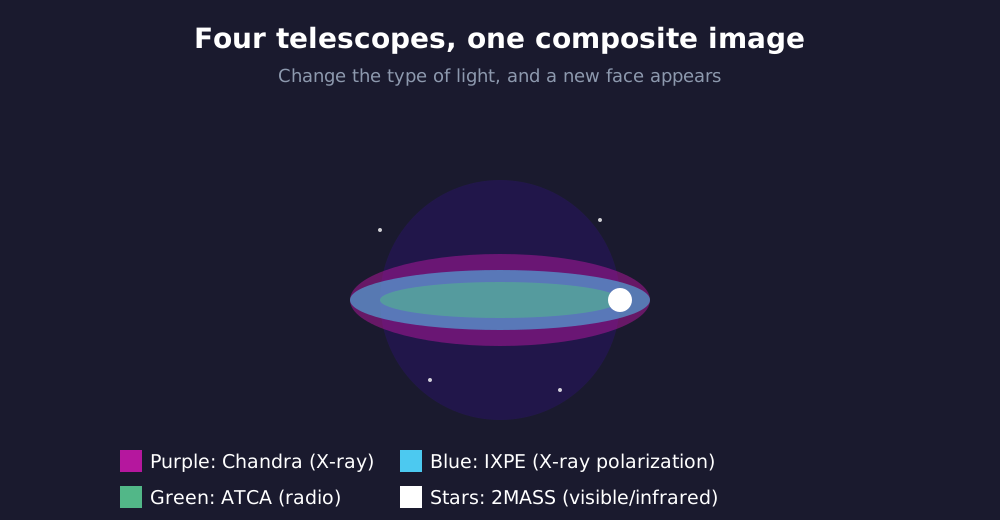
X-rays reveal extreme, high-energy processes; radio waves trace an entirely different population of particles. Any single wavelength only shows a fragment of the tail, but layer them together and the full length and structure snap into focus. Visible light — the kind our eyes can detect — is just a sliver of what the universe is actually broadcasting. The more telescopes you throw at an object, the more information you can pull out of it.
Combining telescopes to crack a single mystery has become standard practice in modern astronomy. The same approach helped astronomers untangle the mystery of Uranus’s outer rings.
Which brings us to the blue channel — IXPE’s contribution. What makes IXPE different from the other telescopes involved here?
What IXPE actually measured: the direction light “vibrates” in
IXPE is a satellite built specifically to measure the polarization of X-rays, and that polarization is the real scientific headline of this story.
“Polarization” might sound abstract, so here’s the short version. Light travels as a wave, vibrating as it moves. When those vibrations line up in a consistent direction, we call the light polarized.
Polarized sunglasses are a familiar example. They cut glare off water or glass by blocking light vibrating in one particular direction while letting the rest through. IXPE works on the same principle, except it reads the vibration direction of X-rays arriving from deep space. A standard X-ray telescope tells you where the light is coming from and how bright it is. IXPE goes a step further and tells you which way that light is vibrating.
Why does that matter for magnetic fields? Charged particles spiraling around magnetic field lines emit X-rays that vibrate in a direction tied to the field itself. Measure the polarization, and you can work backward to the magnetic field’s orientation at the source.
I’ll admit it: the idea of reading a magnetic-field map from the way light vibrates felt like sleight of hand to me for a while. Once you follow the physics, though, it all connects.
Why “directly measuring the magnetic field” is such a big deal
According to NASA, this research team used IXPE to directly measure the magnetic field of this kind of pulsar for the very first time. That word “directly” is doing a lot of work here.
Until now, magnetic fields around objects like this were largely inferred from theory and modeling. Polarization measurements let researchers pin down the field’s direction through actual observation rather than educated guesswork — upgrading the evidence from circumstantial clues to an on-scene photograph, so to speak.
The team behind this result, led by J. Dinsmore and colleagues at Stanford University and other institutions, published their findings in The Astrophysical Journal on July 9, 2026. Neutron stars rank among the most extreme objects in the universe, and there’s still a great deal we don’t understand about how their magnetic fields are arranged, both inside and around them.
If you could somehow stand inside this tail, you’d find yourself surrounded by invisible lines of magnetic force, with particles glowing as they trace those lines. What IXPE measured was the direction of those invisible lines — reading an extreme, unreachable magnetic field using nothing but the properties of light, since no compass could ever get close enough to try.
This observation only reveals clues about the field’s direction and structure — it doesn’t solve everything about neutron stars. Still, replacing a pure estimate with an actual measurement is a meaningful step forward. Point the same technique at other pulsars, and researchers can start filling in a map of these extreme magnetic fields, one object at a time.
A dead star, still running
Let’s fold everything we’ve covered into a single image. Twenty-one thousand light-years away, the city-sized corpse of a star races through space, dragging a tail of light nine times longer than the distance to our nearest stellar neighbor. Humanity has finally caught a direct glimpse of that tail’s magnetic field.
What’s striking is that this isn’t really a story about an ending. The star is dead, technically, yet it’s spinning furiously, racing forward, and still painting streaks of light across the galaxy. “Corpse” almost feels like the wrong word — this thing is putting on a show in an entirely new form.
Somewhere in the night sky, right now, a lighthouse is dragging its 37-light-year tail across the galaxy, sweeping its beam with the same steady rhythm it always has. The next time we manage to read the direction of that light, we’ll get one step closer to peering inside one of the most extreme stars in existence.