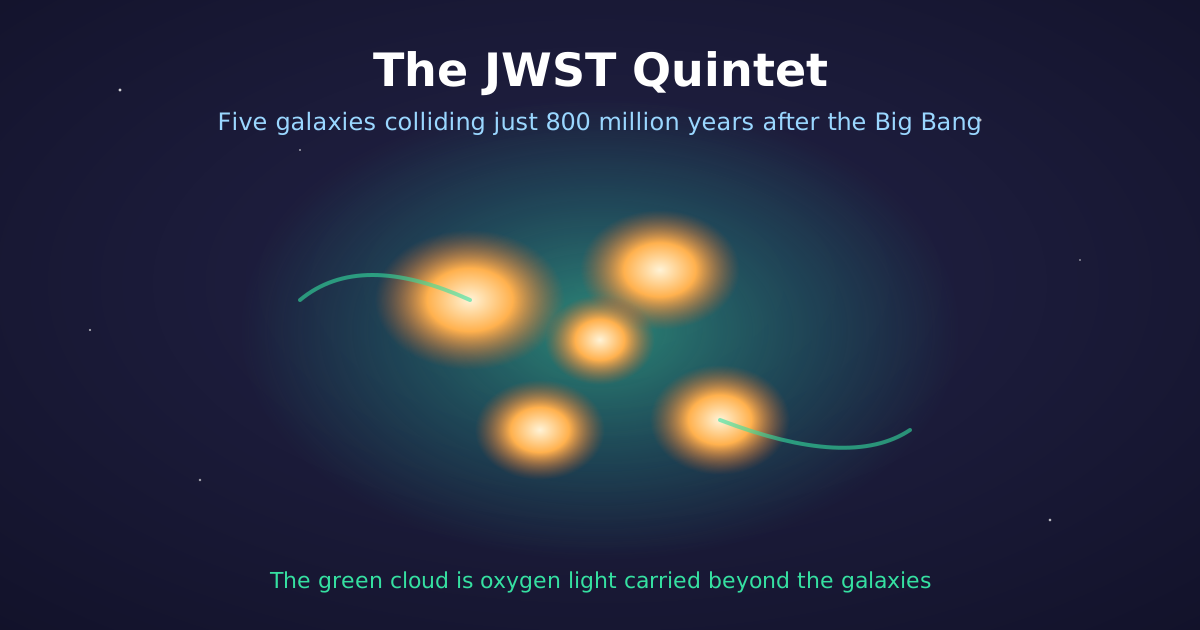
Back when the universe was only 800 million years old, five galaxies were crashing into each other in the same patch of sky. And the oxygen forged in that collision wasn’t staying put — it was leaking straight out into intergalactic space.
The universe today is 13.8 billion years old. Eight hundred million years is less than 6% of that — practically infancy. Finding a scene this crowded, this early, honestly wasn’t something anyone expected.
James Webb Space Telescope caught it. The research team gave this cluster of galaxies a name: the “JWST Quintet.”
Five galaxies packed together, just 800 million years in
Let’s start with what’s actually in the picture.
A team led by Weida Hu and Casey Papovich observed a region called GOODS-South, tucked near the constellation Piscis Austrinus. There, at least five galaxies were crammed tightly together. The team counted more than 17 galaxy-sized clumps in total.
The distance to this group, measured in redshift (the amount light stretches and reddens as it travels from increasingly distant objects), comes out to z=6.7. That places it about 800 million years after the Big Bang.
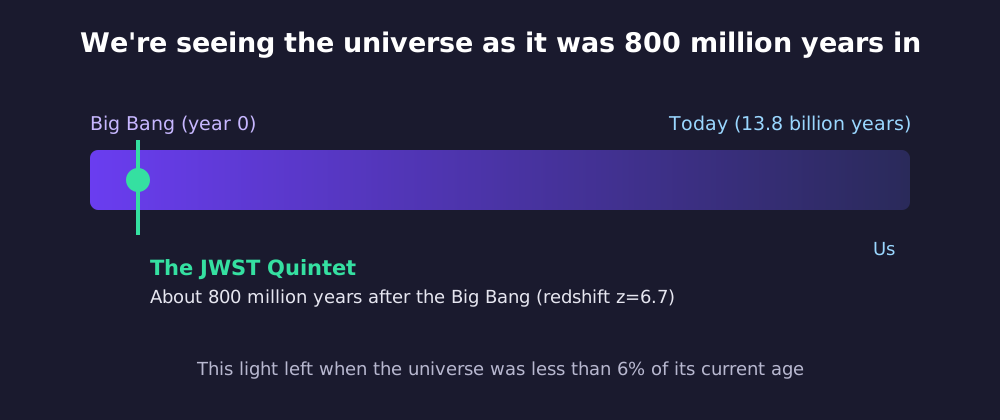
Here’s the thing worth remembering about looking far away: it means looking into the past. Light travels at a fixed speed, so light that’s taken 13 billion years to reach us carries a 13-billion-year-old snapshot along with it. We’re not seeing a photograph — we’re watching a live broadcast from the universe’s early days, just one that’s been in transit for an extraordinarily long time.
What’s stranger still is how tightly packed these five galaxies are. The team measured the whole span at roughly 24 kiloparsecs — about 80,000 light-years across. That’s five galaxies and more than 17 clumps of matter, all jostling for space within a region about the size of the Milky Way’s diameter.
If your eye is used to the Milky Way, where stars sit light-years apart in near-total emptiness, this looks like gridlock. Add up all the stars in the group and you get a mass equivalent to roughly 10 billion Suns.
The young universe was long assumed to be a quieter place. But apparently, galaxies were already slamming into each other in scenes this chaotic.
Collisions turn galaxies into star-making machines
So what actually happens when galaxies collide?
As galaxies approach each other, their mutual gravity churns up and compresses their gas. Denser, colder gas gives birth to new stars in rapid succession. A collision, in other words, flips the switch on mass star production.
How fast is this particular quintet cranking them out? The team’s estimate: it’s converting the equivalent of 240 to 270 Suns worth of material into stars every single year.
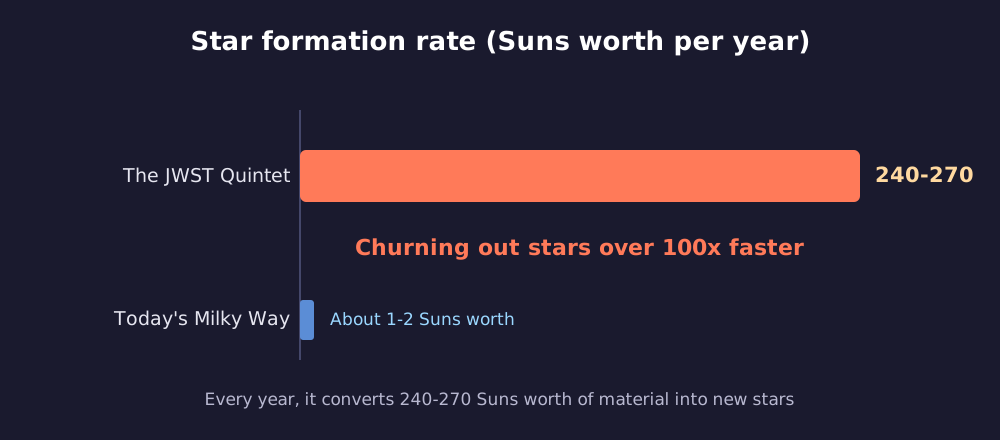
That number doesn’t mean much on its own, so here’s some context. Today’s Milky Way produces roughly one to two Suns worth of stars annually. Do the math and this galaxy group is outproducing our home galaxy by more than a hundred times over.
Put another way: what takes the Milky Way over a century to accomplish, this scene manages in a single year. That’s how violently the energy of collision accelerates star formation.
A star factory this productive, in a universe this young. If the story stopped here, it’d already be an impressive tale of a merger in progress. But the real surprise comes next.
Where did all that oxygen come from?
The most shocking part of this discovery wasn’t the star count or the production rate. It was the oxygen.
To understand why oxygen is the surprise, you have to go back to right after the Big Bang. The newborn universe contained almost nothing but hydrogen and helium. Heavier elements like oxygen and carbon — what astronomers lump together as “metals” — didn’t exist yet.
Those heavier elements only get forged through nuclear fusion inside stars, or in the explosions that mark a star’s death. So finding heavy elements anywhere is evidence that generations of stars have already lived and died there.
Yet here, just 800 million years after the universe began, this galaxy group was already loaded with oxygen. For something this young, it looked remarkably grown-up.
Cycling through generations of stars that fast — forming them, destroying them, forming more — requires running the whole process at breakneck speed. That hundred-times-faster star factory from earlier turns out to be exactly the mechanism that makes it possible.
And there was something else odd: the oxygen wasn’t glowing inside the galaxies. It was glowing outside them.
Torn-apart gas carries oxygen beyond the galaxies
JWST captured light from a specific oxygen emission line (called [O III]) along with hydrogen light. What it revealed was a glowing cloud wrapping around four of the galaxies, stringing them together like beads.
Why would gas spill outside a galaxy’s boundaries in the first place? The answer is tidal stripping. When galaxies pass close to each other, their gravity pulls at the other’s gas and stars from the side. It works the same way ocean tides do — the pull drags a long tail of gas loose from whichever galaxy is on the losing end.
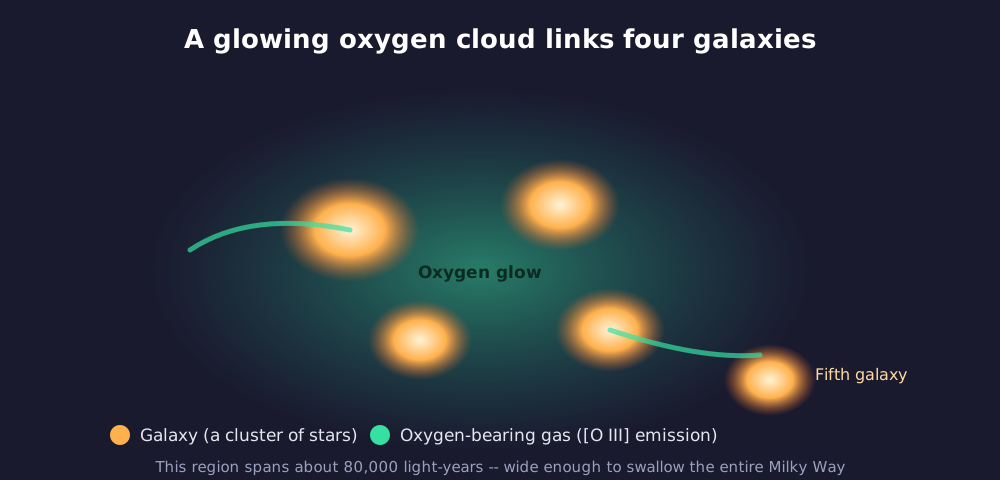
The team’s interpretation is that this oxygen-laced gas was scattered into the surrounding space by tidal stripping during the merger. In other words, the galaxies had already started distributing the heavy elements they’d cooked up internally, and the collision’s violence was flinging that material outward.
How big is this glowing cloud? Roughly 80,000 light-years across — large enough to swallow the entire Milky Way whole. Within that space sit five galaxies and the oxygen cloud spilling out from them.
Try picturing it for a second. If you could stand inside that cloud, four colliding galaxies would hang overhead, and all around you, freshly torn oxygen-rich gas would glow faintly in the dark. It’s a snapshot of cosmic raw material caught mid-delivery.
Galaxies as delivery trucks, distributing the ingredients of the cosmos
Pull all these threads together and you get a story like this.
Galaxies don’t grow up quietly in isolation — they grow by colliding. Collisions trigger furious bursts of star formation. Stars manufacture heavy elements. And the tidal forces of the merger scatter those elements far beyond the galaxy’s own boundaries. Galaxies, it turns out, double as delivery trucks for the universe’s raw ingredients.
This story of growth-through-collision is playing out closer to home too. The Milky Way itself is thought to have swallowed smaller galaxies repeatedly over billions of years to become what it is today, and astronomers have spotted two galaxies colliding much closer to us in cosmic terms. What makes the JWST Quintet special is catching this process happening in the universe’s earliest chapters — and catching the element-scattering part of it too.
The scattered oxygen doesn’t just drift off and disappear. Heavy elements floating around a galaxy’s outskirts eventually cool, mix into gas clouds, and get folded into the next generation of stars and planets. Bit by bit, this is how the universe is thought to have grown into a place capable of building stars — and planets — at all.
One distinction is worth making clear here. What was actually observed is the fact that oxygen-laced gas extends beyond the galaxies. That tidal stripping caused it is the team’s interpretation of that fact — and it’s worth keeping those two things separate in your head. The findings were published in Nature Astronomy, and follow-up observations should eventually reveal where that scattered material ends up next.
One last thought to bring this back down to Earth. The oxygen you’re breathing right now, the carbon that makes up your body — all of it was originally cooked up as a heavy element inside some star, in some galaxy. It’s in the steam rising off your kettle, and it’s in your blood. The oxygen those crowded, colliding galaxies were spilling out 13 billion years ago and the breath you’re about to take next are, in a strange way, directly connected.