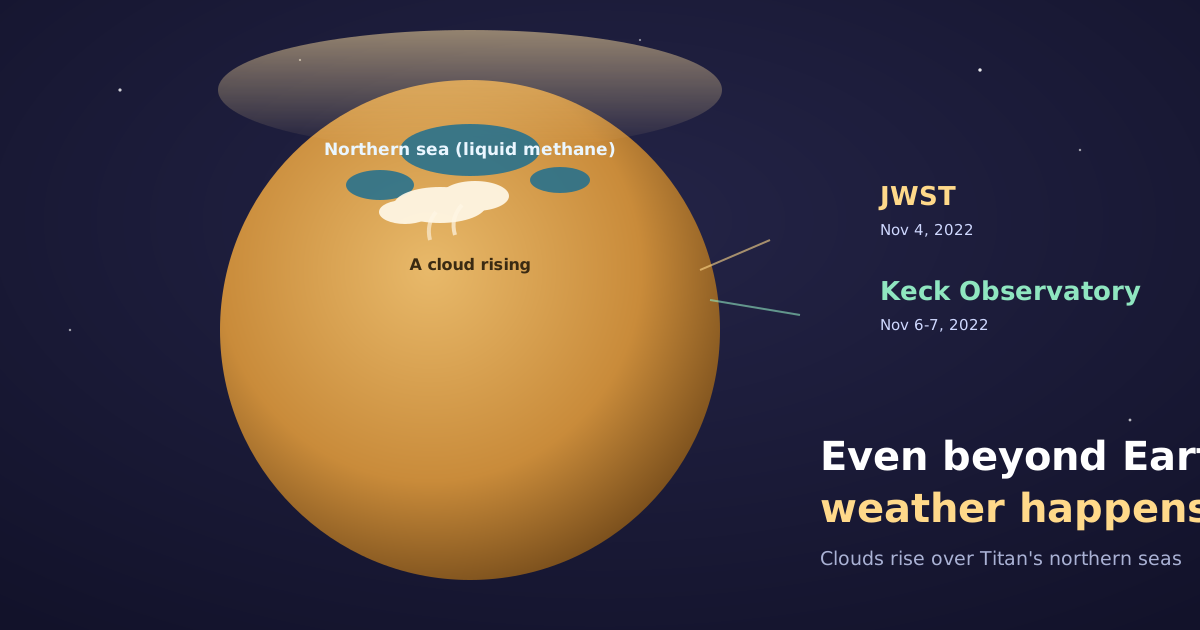
Over the northern sea of a giant moon circling Saturn, a cloud billowed up.
And Earth’s telescopes watched the whole thing unfold, from the swelling to the slow dissolve. The moon in question is Titan, more than a billion kilometers from Earth, orbiting Saturn. That familiar sight from your local weather report, a cloud puffing up into the sky, is happening way out at the edge of the solar system too.
I’ll admit it: for a long time, I pictured Titan’s sky as one flat, featureless haze. Turns out it’s a place with weather that feels remarkably close to home.
A Cloud Rises Over the Sea
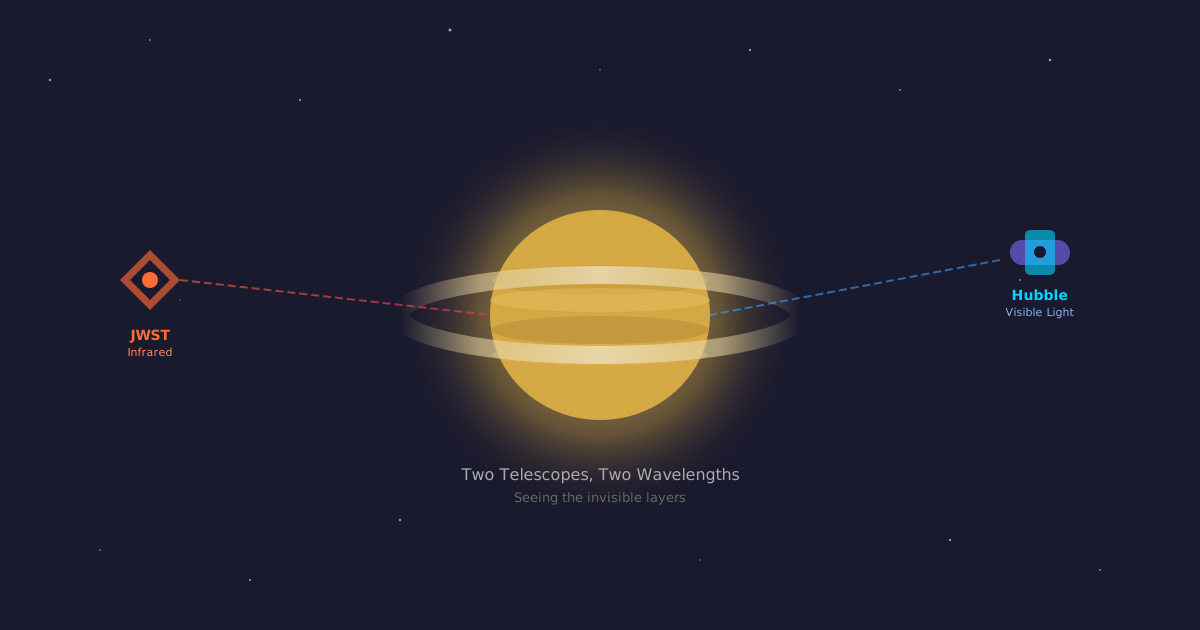
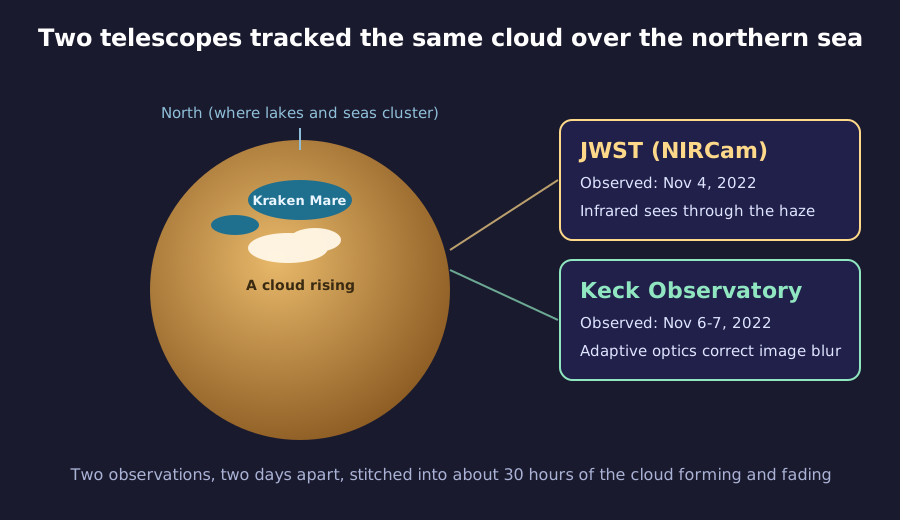
Two telescopes made the observation. NASA’s James Webb Space Telescope (JWST) turned its lens toward Titan on November 4, 2022, and the Keck Observatory in Hawaii followed up on November 6 and 7.
What they caught was a cloud billowing over Titan’s northern hemisphere, near Kraken Mare, the moon’s largest known sea of liquid methane. The research team, led by Conor Nixon at NASA’s Goddard Space Flight Center, worked alongside a Keck-based team led by Imke de Pater at UC Berkeley.
Titan is the only moon in the solar system with a thick atmosphere. It’s also the only place besides Earth where liquid rivers, lakes, and seas currently sit on the surface. So when a cloud forms over that sea, the scene isn’t so different from a coastline back home.
The northern location matters too. Most of Titan’s lakes and seas cluster up there, so researchers essentially caught the weather in action right above the moon’s “wetlands.” According to the team, this marks the first time anyone has tracked active cloud formation over the northern hemisphere in such detail.
But one question lingers: why the north?
Why “North”? Titan Has Seasons Too
The answer comes down to seasons. Titan cycles through them just like Earth does.
Here’s a detail worth sitting with, because it explains everything that follows. Titan orbits the sun alongside Saturn, and one full lap takes about 29.5 Earth years. That means a single Titan year stretches across nearly three decades of ours, so each season lasts roughly seven years.
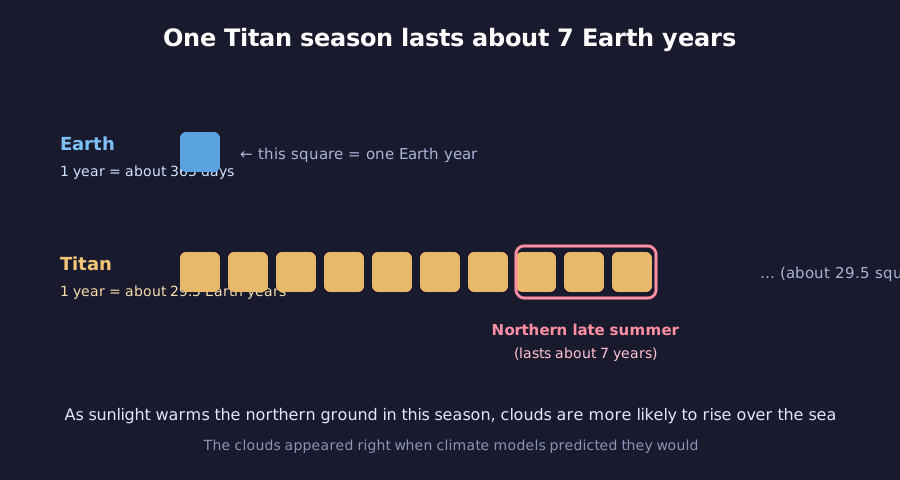
In recent years, the northern hemisphere has been moving through what amounts to late summer. Sunlight gradually warms the ground there, and warm ground pushes air upward, where it cools into clouds. It’s the same basic mechanic behind a summer afternoon thunderhead on Earth.
That said, Titan doesn’t get much sunlight to work with. Saturn orbits far beyond Earth, so sunlight there measures only about one percent of what we get. Even so, that faint light spends seven years slowly heating the sea, coaxing clouds into existence.
Here’s the part that makes this interesting: climate models have long predicted that clouds should form over Titan’s northern hemisphere during late summer. This observation found clouds exactly where and when those models expected them. The theory got checked against the actual sky, and it held up.
So what falls out of those clouds? Earth’s intuition doesn’t apply here.
It Rains Methane, Not Water
Titan’s average temperature sits around -180°C. At that temperature, water freezes solid as rock. It can’t fall as rain.
Methane takes its place instead. The same gas that fuels a stovetop on Earth exists as a liquid on Titan, cycling between sky and ground. It evaporates into clouds, falls as rain, runs through rivers, and collects in lakes and seas. Picture Earth’s water cycle, just swap in methane.
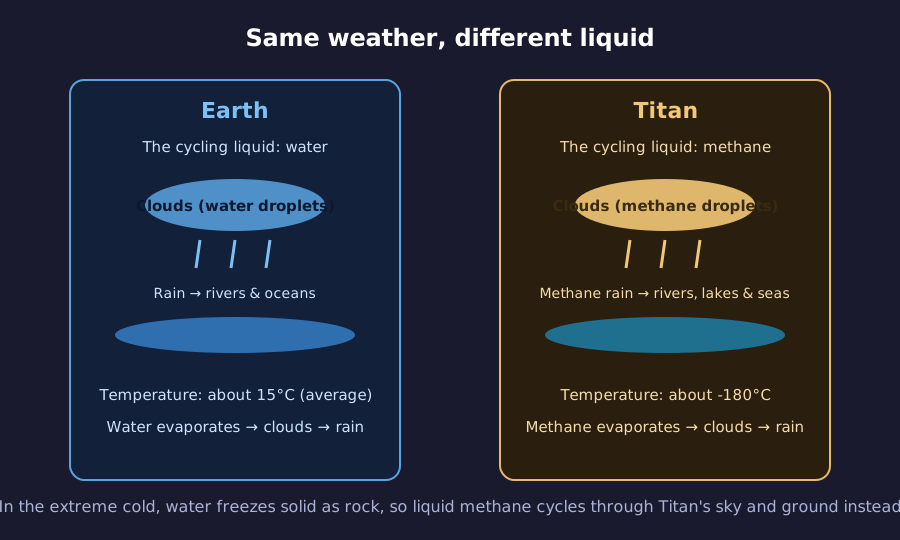
The methane cycle itself wasn’t news. The Cassini spacecraft, which orbited Saturn for years, and the Huygens probe, which landed on Titan’s surface, had already spotted northern lakes and seas along with river channels carved by rain. What’s new here is catching the engine of that cycle, the cloud itself, actively billowing over an active northern sea.
If Titan had residents checking their forecast the way we do, they might say “methane rain tomorrow” instead of “rain tomorrow.” Strange as that sounds, the cast of characters, clouds, rain, rivers, lakes, stays exactly the same. Only the leading liquid changes.
Titan’s atmosphere is mostly nitrogen too, which happens to match Earth closely; our air runs about 80 percent nitrogen. With a similar sky composition and structure, calling Titan “an Earth built from a different liquid” doesn’t feel like much of a stretch.
But clouds don’t just billow on their own. Air needs to actually move up and down for that to happen. Could researchers confirm that was really going on?
Thirty Hours of Watching Reveal a Restless Atmosphere
This is the crux of the whole observation. The research team stitched together images taken over time and tracked how the clouds changed across roughly 30 hours.
What they saw: one cloud rotated into view as Titan spun, while another shrank and vanished. Clouds weren’t fixed patterns painted on the moon. They were living things, born, growing, and fading away.
A single photo only tells you a cloud exists. Watching over time tells you it forms, drifts, and disappears, the difference between a snapshot and a movie. That motion is the evidence: air is rising and falling within Titan’s atmosphere, meaning convection, the same warm-air-rises-and-cools process that drives weather on Earth, is happening there too.
Try picturing it for a second. Say you’re standing on the shore of that methane sea. Above you, under an orange haze, pale clouds swell and thicken, and eventually cold methane rain starts falling in fat, slow drops. Somewhere near Saturn, there’s a planet where you’d actually need an umbrella.
A Bonus Find: A Molecule Caught Mid-Breakdown
The observation turned up one more thing. High in Titan’s atmosphere, researchers detected methyl radical (CH3), a molecule that’s more interesting than it sounds.
Titan’s methane (CH4) is a stable molecule holding four hydrogen atoms. But when sunlight or incoming particles strike it, one hydrogen gets knocked loose, leaving behind the unstable CH3. That “missing one hydrogen, caught halfway” state is the methyl radical.
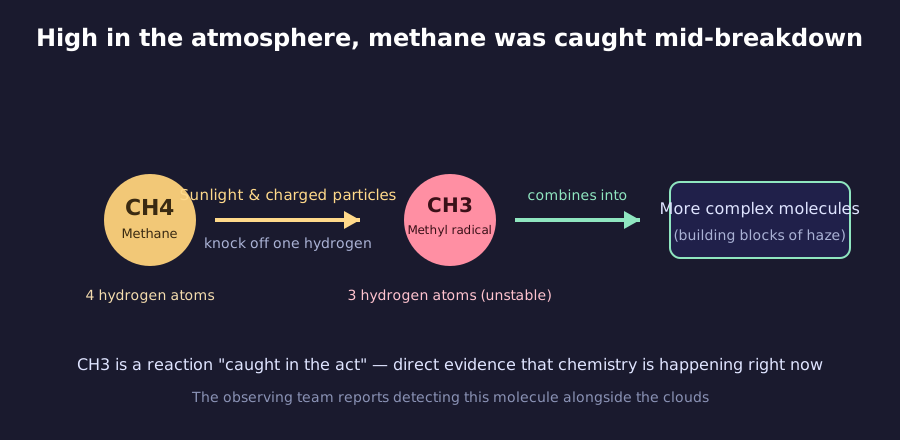
Think of it like walking into a kitchen and finding an ingredient half-chopped on the cutting board. Seeing that tells you the kitchen is actively in use right now, in this case, direct evidence that chemical reactions are actively unfolding in Titan’s atmosphere. The observing team reports catching this molecule alongside the cloud activity.
Titan’s haze and the organic material piling up on its surface are thought to build up through reactions exactly like this one: methane breaking apart, atoms recombining, molecules growing more complex over time. Catching that process mid-step is about as close as you can get to standing in the middle of an active chemistry lab.
A World Out There That Needs a Forecast
Clouds rise. Seasons turn. Rain falls. Chemistry churns away in the atmosphere. Line it all up, and what’s happening on Titan overlaps with life on Earth in startling ways. The main differences: the leading liquid is methane instead of water, and it’s about -180°C colder.
We might get to watch this Earth-like cycle up close from the ground before too long. NASA plans to send its Dragonfly rotorcraft to Titan in 2028, a drone-like explorer that will fly from site to site. The view from above will finally get a partner on the surface.
Tonight, when you check the forecast and wonder whether you’ll need an umbrella, remember this: over a billion kilometers away, near Saturn, there’s a world where clouds rise over the sea, and someone, or something, might reasonably be wondering about tomorrow’s weather too.