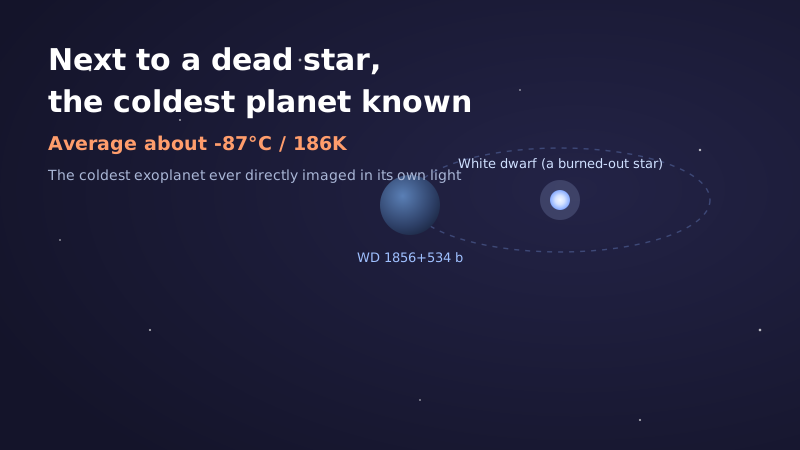
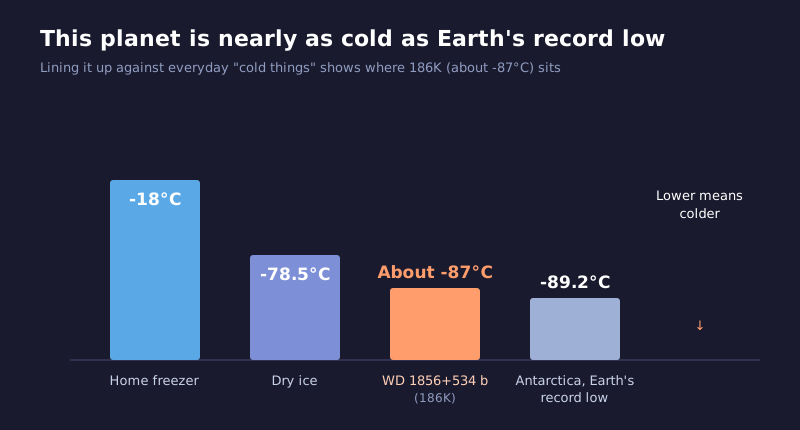
The lowest temperature ever recorded on Earth, at Russia’s Vostok Station in Antarctica, was -89.2°C—cold enough that standing outside feels like the edge of survival. About 82 light-years away, astronomers have found a planet orbiting at nearly that same temperature: an average of roughly -87°C.
And this planet is much bigger than Jupiter.
Here’s the stranger part. The object it orbits isn’t really a “star” anymore—it’s a white dwarf, the burned-out husk left behind after a star dies. The planet hugs this stellar corpse so closely that it completes one full orbit in just 1.4 days.
Nearly as cold as anything ever measured on Earth
The planet is called WD 1856+534 b. Using the James Webb Space Telescope (JWST), researchers measured its average temperature at about 186 kelvin. Since 0°C equals 273.15K, that works out to roughly -87°C.
On its own, that number just sounds cold. Line it up against familiar things, though, and the picture sharpens. A household freezer runs at about -18°C. Dry ice sits at -78.5°C. This planet beats them both, landing just a few degrees short of the coldest temperature humans have ever recorded on Earth.
The research team describes it as the coldest exoplanet ever directly imaged in its own light. Spotting an exoplanet—a planet outside our solar system—directly is genuinely hard. Most are known only indirectly, through the faint shadow they cast when passing in front of their star.
This time, astronomers caught the planet’s own thermal glow and used it to measure a real temperature. That’s the heart of the discovery.
So why is it so cold, when it’s orbiting right next to a star?
Its neighbor isn’t a glowing star—it’s a stellar ember
The answer lies in what kind of “star” sits next door.
A star like the Sun spends its final act blowing off its outer layers, leaving behind only its core. That leftover core is a white dwarf. It has stopped generating power through nuclear fusion and instead glows faintly on leftover heat, cooling down over billions of years. Think of it as a freshly extinguished coal ember—still warm, but fading.
The size change involved is staggering. A white dwarf packs roughly the mass of the Sun into a sphere about the size of Earth. The material is so densely packed that a single sugar-cube-sized chunk of it would weigh around a ton—like a pickup truck compressed into a sugar cube.
This detail matters, so bear with it for a moment. A white dwarf is small and already cooling. That means the light and heat it puts out are far weaker than those of a living star. Even orbiting right next to one, a planet simply never gets to warm up.
The same fate awaits our Sun. In roughly five billion years, it too will swell up, shed its outer layers, and settle into a quiet life as a white dwarf. In a sense, this system is a preview of our solar system’s distant future.
That explains why the planet stays cold despite being so close. But why is it so close in the first place?
Bigger than Jupiter, yet tucked in far closer than Mercury
This planet outweighs Jupiter. The research team estimates its mass at roughly five times Jupiter’s, with an upper bound just above six—a bona fide gas giant.
That massive body circles the white dwarf at a distance of just 0.02 astronomical units. One astronomical unit is the distance from the Sun to Earth, so this planet sits at 1/50th of that. Even Mercury, the innermost planet in our solar system, orbits the Sun at 0.39 AU—meaning this exoplanet is tucked in far closer than Mercury ever gets.
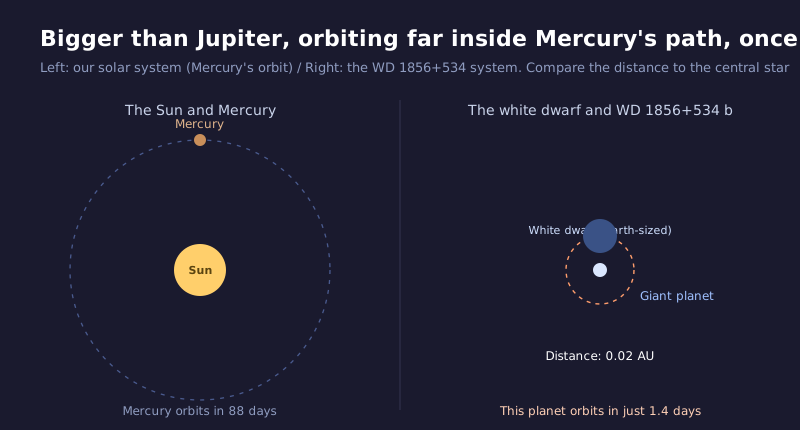
Being that close means a fast orbit. Mercury takes 88 days to circle the Sun once. This planet does it in a mere 1.4 days. On Earth, that would be like saying goodbye to someone on Friday and having them back by Sunday.
Big, close, and fast—so far, this just sounds like an unusual planet. The real puzzle is that its closeness shouldn’t be physically possible.
It should have been swallowed long ago
Before becoming a white dwarf, this star passed through a red giant phase—the stage where an aging star puffs up dramatically, ballooning to dozens of times its original size.
At that point, the star’s outer surface would have extended far beyond where this planet now orbits. In other words, if the planet had always been sitting at its current orbit, it should have been engulfed and destroyed when the star swelled into a red giant.
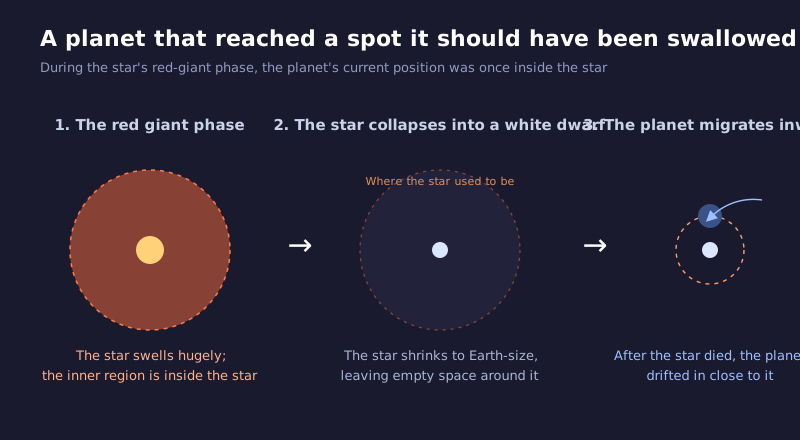
And yet here it is, undisturbed. The research team calls this region the white dwarf’s “forbidden zone,” and this is the first planet ever confirmed safely inside it. Calling it a survivor almost undersells the situation—it’s sitting somewhere it shouldn’t be able to survive at all.
Naturally, the question becomes: how? The leading explanation is that this planet originally orbited much farther out, then got kicked inward by some gravitational disturbance after the star’s death. The chaos of the star’s final act, in other words, may have flung the planet from a safe distance to right beside the stellar ember.
Even the researchers apparently weren’t quick to accept how close this planet sits. That skepticism is exactly why capturing its light and temperature directly mattered so much.
The faint heat that JWST picked up
The planet was first spotted in 2020 as a shadow crossing in front of the white dwarf—a periodic dimming of starlight that revealed something was there. But a transit shadow only tells you that something exists. It says nothing about temperature.
Measuring temperature required catching the heat the planet itself radiates. That’s where JWST’s Mid-Infrared Instrument, MIRI, came in—an instrument built specifically to detect the faint infrared glow of cold objects.
This is where the story gets genuinely exciting, and honestly my favorite part. The colder an object is, the fainter its light and the longer its wavelength drifts toward the infrared. A temperature of -87°C sat right at the edge of what direct imaging could even detect. MIRI picked up that faint signal clean enough to trust.
From the amount of heat detected, the team calculated an average temperature of about 186K. What began in 2020 as an indirect discovery—just a shadow—became, five years later, direct confirmation: a real planet, at this exact temperature, sitting right there.
Even around a dead star, a world remains
Many of us probably assume that once a star burns out, everything around it becomes an empty graveyard. This planet quietly proves that assumption wrong.
If you could float above this planet’s thick atmosphere, you wouldn’t see a blazing sun overhead. Instead, a white point no bigger than Earth would hang there, casting a dim glow. Bathed in that faint light, you’d watch the sky complete a full circuit every 1.4 days, the temperature locked at a steady -87°C the whole time.
A star’s death isn’t the end of the story. A planet can remain, keep moving, and eventually get spotted by telescopes built by a species on a small blue world light-years away. Five billion years from now, after our own Sun follows the same path, something is probably still going to be orbiting overhead. The first confirmed example of exactly that has just turned up, 82 light-years from here.