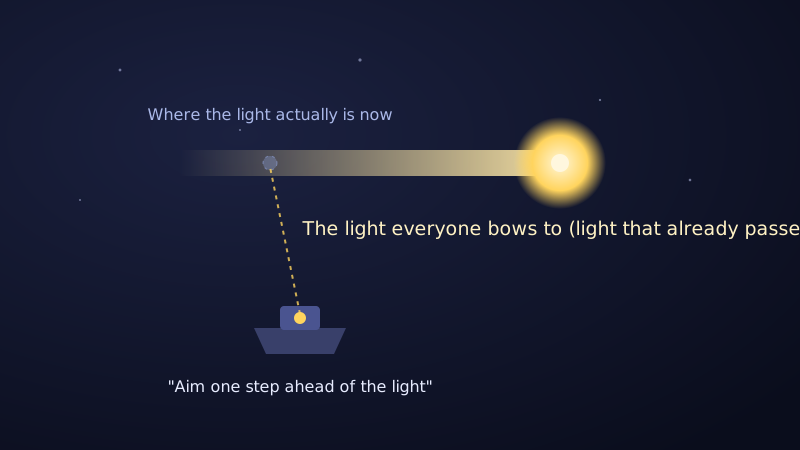
Tomo is the oldest escort boat in the harbor. “Escort boat” makes it sound grander than it is — it’s barely big enough for one person, and every evening it slips away from the pier on its own. It waits offshore, pulls alongside the incoming ships, and leads them home. It’s been doing that job, and nothing else, for fifty years.
Tomo has always had a strange habit. When it steers by the sky’s guiding light — the one everyone calls the Lantern — it never aims at the light itself. It points just a little past it, at a patch of nothing.
The Lantern is something like the harbor’s guardian spirit: a light that crawls slowly across the sky — or, really, tears across it at tremendous speed — trailing a long tail behind it. Because it seems to sit in the same place every night, people say, “As long as the Lantern is there, the harbor never loses its way.” Nobody, as far as anyone could tell, had ever stopped to wonder why it had a tail at all.
“Hey, Tomo. Why do you always point off to the side?”
Noe asked this with her legs dangling off the pier. She was the harbor keeper’s kid, ten years old or so, and she loved riding along in Tomo — mostly getting in the way of its work.
Tomo let out a low hum. It was as close to an answer as it gave. To Noe, it sounded something like, “Because that’s the rule.”
The harbor’s younger crowd thought that rule was a joke. If you’re aiming for the Lantern, you aim for the Lantern — straight on. Tomo’s habit was just a glitch, plain and simple. That spring, the town had installed a brand-new guide light at the pier: the True-Aim Light. It locked onto the brightest point of the Lantern with pinpoint precision, no drift, no error. Everyone was impressed. The True-Aim Light even came with a polished plaque bearing the names of everyone who’d donated to fund it.
Tomo’s paint, meanwhile, was peeling in a dozen places. The younger crew decided that after the next big ferry came through, Tomo would be pulled from service for good.
Early that summer, on the night the ferry was due, the town held a little ceremony to mark the occasion. The harbor inspector stamped his approval on the True-Aim Light and declared, chest puffed out, “No one will ever lose their way again.” Tomo sat in the corner of the pier, already as good as retired, humming its low hum.
Only Noe crouched down beside it.
“Are you sure about pointing off to the side tonight? A big one’s coming in.”
Tomo hummed once more and pointed toward the dark — longer than usual, this time.
That’s when it hit Noe. The bright head of the Lantern, the one everyone bowed to, was light that had passed through that exact spot a very long time ago. The real Lantern — the thing itself — must already be way out past its own tail, somewhere in that empty dark. Which meant that to guide a ship toward where the Lantern actually was right now, you couldn’t aim at the light. You had to aim one step past it. Tomo’s “glitch” had never been a glitch at all. Some harbor keeper, long before Noe’s time, had known this — and taught it to Tomo.
Down at the pier, the True-Aim Light held its lock on the bright head, dead steady. The incoming ferry, trusting that perfect light, slid straight toward it — straight past the harbor, out into the dark open water beside it. Its horn grew fainter and fainter. The people at the ceremony looked up at the bright light and applauded. Nobody noticed the ship had gone astray.
Noe grabbed Tomo’s lamp with both hands — the one already halfway decommissioned — and swung it, with everything she had, toward the empty dark one step past the Lantern.
Out of that darkness, the horn answered back. The sound that had been drifting away slowly turned, and came around. Before long, the ferry emerged from what should have been empty night and slid into the harbor. Down at the pier, the ceremony crowd was still applauding the bright light, as bright and as wrong as ever.