Deep inside Uranus and Neptune, diamonds might be falling like rain. And no one will ever get to collect a single one. They’re born far below the surface, at the bottom of a crushing pressure well, and they just keep sinking.
Honestly, when I first heard this, I assumed it was a joke. But trace it back far enough and it turns out to be a pretty serious piece of chemistry.
Methane, the unlikely star of the show
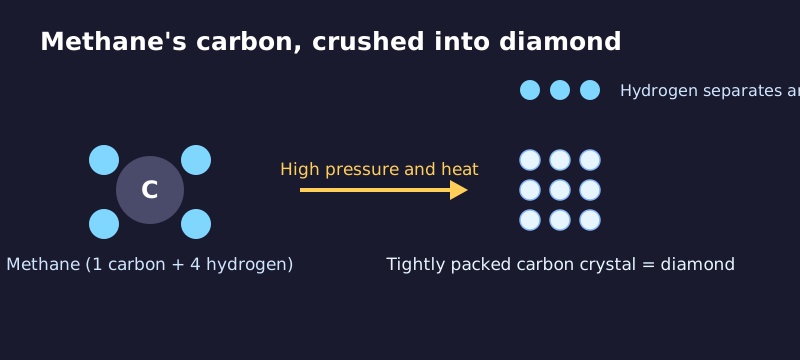
The main character here is methane — the same ordinary gas that shows up in city gas lines. Each methane molecule is one carbon atom with four hydrogen atoms attached (chemical formula: CH4). Both Uranus and Neptune carry a decent amount of it in their atmospheres.
That blue-green color you see in photos? That’s methane’s doing too. According to NASA, atmospheric methane absorbs red light and reflects blue light back out, which is what gives these planets their cool, oceanic hue. In other words, that soothing color is really just the signature of a carbon-bearing gas.
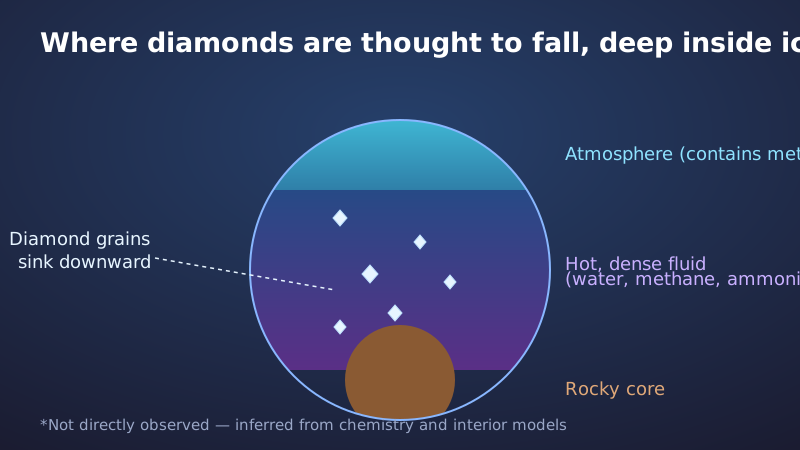
Deeper inside the planet, though, that carbon can’t stay gaseous for long. Naomi Rowe-Gurney, a researcher at NASA’s Goddard Space Flight Center, explains that lower in the atmosphere, carbon exists on its own and gets squeezed by the planet’s enormous surrounding pressure. As the compressed carbon clumps together and grows heavier, it eventually falls like rain — that’s the diamond rain.
Part of a gas turns into gemstones and falls through the planet. But why would squeezing something turn it into stone in the first place?
Compressed carbon wants to become diamond
Think about a pencil lead for a second.
Pencil lead is made of graphite, a material that — like diamond — is pure carbon. It’s jet black, and soft enough that rubbing it against paper leaves a mark. And yet that exact same carbon, with nothing more than a rearrangement of its atoms, can become diamond: transparent and the hardest substance known. Same raw material, opposite outcomes, depending entirely on the conditions it’s placed under.
Those conditions are high heat and high pressure. When carbon atoms get packed together tightly enough, they lock into a dense, orderly crystal lattice — that’s diamond. Graphite, by contrast, is the loosely stacked, layered version of the same element.
Once carbon becomes diamond, it’s also far denser than the fluid surrounding it. And dense things sink. So the diamonds that form keep falling, deeper and deeper, unable to stay put. That difference in density is exactly why we call it “rain.”
The same logic applies right here on Earth. Natural diamonds form deep underground under intense heat and pressure, then hitch a ride toward the surface on rising magma. Every diamond sitting in a jewelry store case is, in a sense, a souvenir carried up from the planet’s depths.
So making diamond doesn’t require exotic ingredients — just an environment that squeezes carbon hard enough. Inside Uranus and Neptune, carbon obeys the exact same physics. The real question is whether the pressure down there is actually strong enough to pull it off.
Ice giants are stuffed with hot, heavy fluid
Uranus and Neptune are called “ice giants.” The name alone conjures images of frozen, icy lumps drifting through space. I’ll admit — for a long time, I assumed that’s basically what they were.
But the interior is nothing like cold. According to NASA, more than 80 percent of each planet’s mass is made up of a hot, dense fluid composed of water, methane, and ammonia. Below that fluid layer sits a small rocky core. The word “ice” here doesn’t describe temperature at all — it’s just a label for the class of materials involved.
Uranus, incidentally, has its rotation axis tilted roughly 98 degrees, so it essentially rolls around the Sun on its side. Once you know the interior is a churning fluid rather than solid ice, that tumbling posture starts to make a strange kind of sense.
As for Neptune, scientists suspect that beneath its cold, visible clouds lies an ocean of superheated water. What keeps that water from simply boiling away is the staggering pressure bearing down on it. Water that would normally flash to vapor instead stays trapped as liquid, held in place by sheer force. It’s an extreme world by any measure.
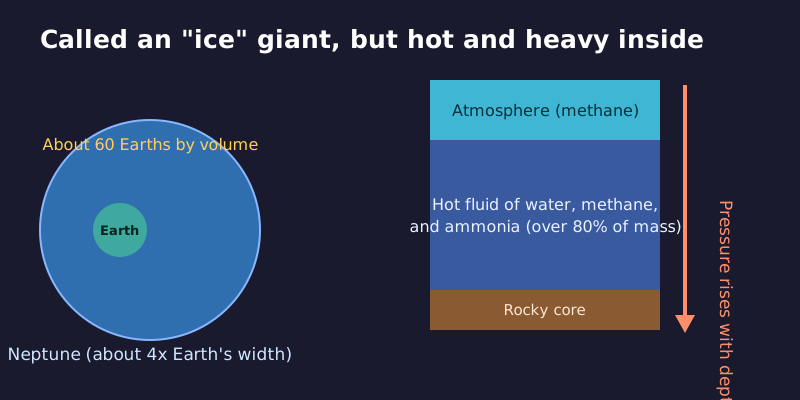
The scale involved is staggering too. Neptune is roughly four times wider than Earth, and by volume you could fit about 60 Earths inside it. It orbits some 4.5 billion kilometers from the Sun — about 30 times farther than Earth is. All that mass presses down relentlessly on the material inside, and the deeper you go, the harder that pressure squeezes.
There’s clearly enough force down there to turn carbon into diamond. But has anyone actually seen this diamond rain happening?
Too deep for anyone to have ever seen it
And here’s the crux of it: the answer is no, nobody has.
Diamond rain has never shown up in a telescope image or a probe’s photograph. It’s a conclusion drawn from chemistry — how carbon behaves under extreme conditions — combined with models of what a planet’s interior probably looks like. It’s an educated “this is likely what’s happening,” not a confirmed observation. It’s worth keeping that distinction clear: what’s been measured, and what’s been inferred, are two different things.
Rowe-Gurney herself has pointed out that even if diamonds really are forming, there’s no way to go retrieve them. They’d be forming far below the mid-level atmosphere she actually studies.
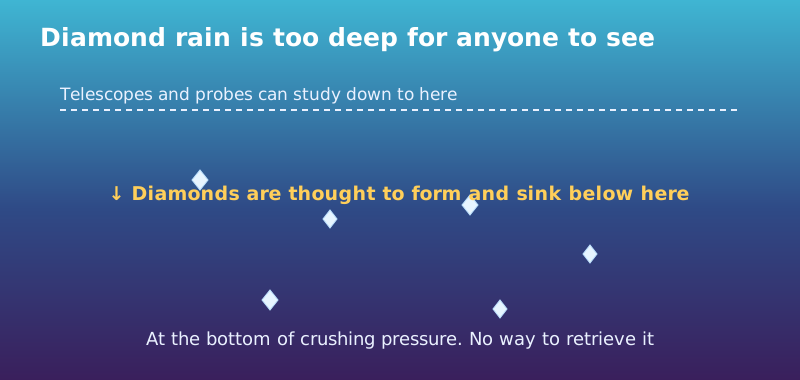
Picture it for a moment. If you could somehow drop through Neptune’s clouds and keep descending, the light would fade out entirely, the surrounding gas would grow heavier and heavier, and eventually you’d be inside pressure strong enough to crush you. Somewhere down there, tiny diamond grains would be quietly sinking alongside you. But there’d be no way back up. The gems sit at the bottom of a vault that never opens.
If nobody can go down and check, how do we even test whether this guess is right?
So scientists crush methane on the ground instead
When you can’t visit a place directly, researchers bring a piece of it to their lab bench instead.
There’s a whole field built on subjecting materials to extreme pressure and heat and watching what happens — essentially recreating, at a tiny scale, what’s presumed to be going on inside a planet. Stack enough of these lab experiments on top of planetary interior models, and together they form the foundation supporting the “diamond rain” idea. It’s not a proven fact so much as a well-supported hypothesis, built up from many independent clues pointing the same direction.
Here’s where it gets fun. The carbon and hydrogen at the heart of this whole story are things we’re surrounded by every day. Plastic shopping bags, plastic wrap, food trays — most plastics are just chains of carbon and hydrogen linked together. The same cast of characters as methane.
Which means the raw material for gemstones isn’t anything exotic. Ordinary carbon, depending entirely on the conditions it finds itself in, can end up as a piece of trash or as a diamond. The difference isn’t the material — it’s the pressure and heat applied to it. Once that clicks, diamond rain suddenly feels a lot less alien.
The most ordinary things have the biggest transformations hiding in them
Only one spacecraft has ever visited Uranus and Neptune — Voyager 2, and only briefly. A mission to properly study their interiors hasn’t happened yet (you can read about where that same probe is now in how Voyager keeps running on dwindling power out in interstellar space). So “diamond rain” may stay a hypothesis for a good while longer. Even so, there’s something oddly magnetic about the idea.
The most mundane gas imaginable turns into the most expensive gemstone imaginable. And it’s not some distant, magical process — it’s a direct extension of a fact sitting right next to you: pencil lead and diamond are made of the exact same element. Given the right conditions, the most ordinary things are capable of the biggest transformations.
Next time you pick up a pencil to write something down, take a second to think about that black graphite core. The same carbon, 4.5 billion kilometers away at the bottom of a blue planet, might be getting crushed into the sparkle of falling rain. Suddenly, that little pencil in your hand feels like it stretches a lot farther than you’d think.