A Sense of Scale

Light-years, the age of the universe, the count of galaxies—columns to feel the cosmic scale.

7 articles

Articles

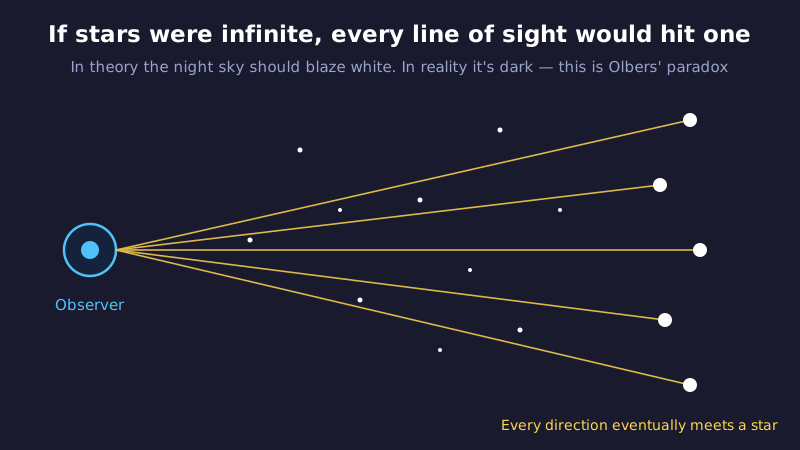
If Stars Were Infinite, the Night Sky Should Be Blinding White. It's Dark Because the Universe Has a Beginning — and Is Expanding

If the universe held infinite stars, every line of sight should eventually hit one, and the sky should blaze white. It stays dark because the universe is roughly 13.8 billion years old — so light from the most distant stars hasn't arrived yet — and because expansion stretches the light that does reach us into wavelengths we can't see. The whole sky is still glowing, in fact, just as invisible microwaves at 2.7 degrees above absolute zero.
Shrink the Sun to a Ping-Pong Ball, and the Nearest Star Sits 1,100 Kilometers Away

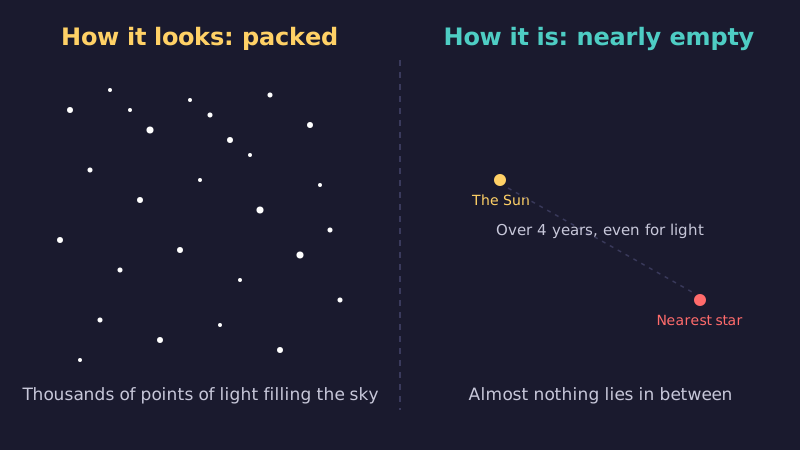
The night sky looks packed with stars. But shrink the Sun to a ping-pong ball (4 cm across), and Earth becomes a grain of sand 4.3 meters away, while the nearest star is another ping-pong ball roughly 1,100 km off. Set it down in Tokyo, and that star lands south of Kagoshima. In between: almost total vacuum. With over 100 billion stars in our galaxy, the universe is mostly made of the gaps between them.

The Night Sky Is a Collage of the Past — We've Never Seen the Universe's 'Now'

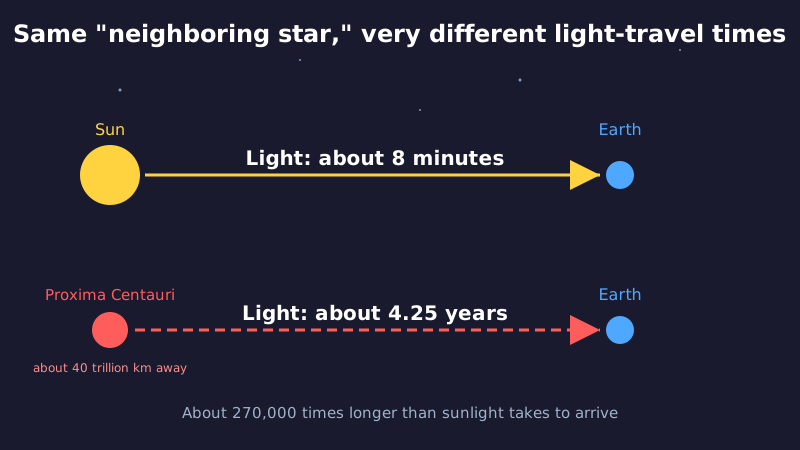
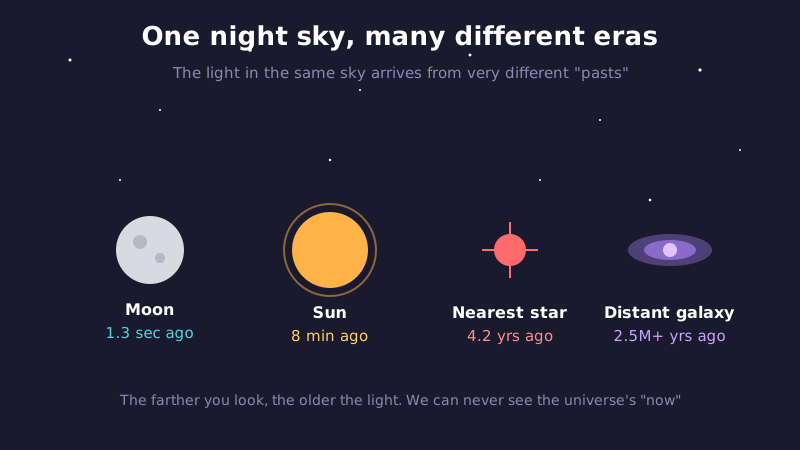
Sunlight left the Sun about eight minutes ago. Light from Proxima Centauri, our nearest star, is about 4.2 years old. The Andromeda Galaxy's light is roughly 2.5 million years old. Because light speed is finite, looking farther always means looking further back in time. SORABUMI translates this into everyday scale to explain why a single glance at the night sky holds hundreds of millions of years at once.