The sunlight streaming through your window isn’t the Sun as it is right now. It left the Sun’s surface about eight minutes ago.
If the Sun vanished this instant, we’d keep seeing a perfectly ordinary blue sky for another eight minutes. We wouldn’t notice a thing until the light ran out. Strange as it sounds, we’ve never once seen the Sun as it actually is — only as it recently was.
And the farther out you look, the deeper into the past you’re peering.
Even the Sun You See Is Eight Minutes Old
Light travels at roughly 300,000 kilometers per second — fast enough to circle the Earth seven and a half times in a single second. It’s the fastest thing in the universe. At everyday scales, light might as well be instantaneous. Flip a switch, and the room brightens with no perceptible delay.
Step outside the neighborhood of Earth, though, and even the fastest thing there is starts to lag.
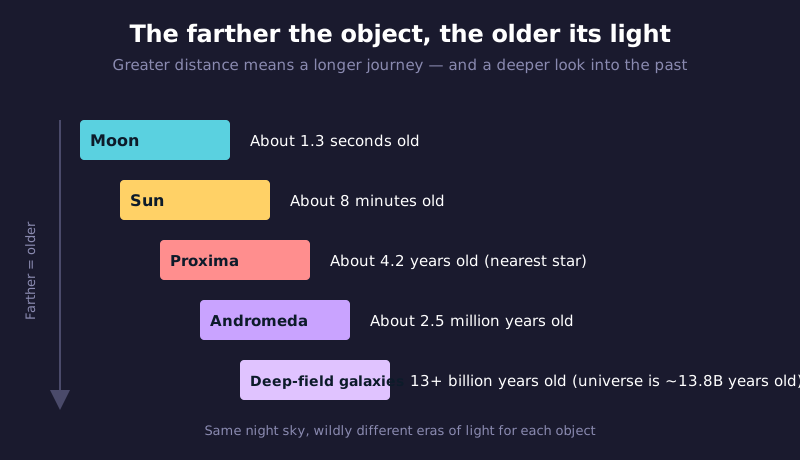
The Sun sits about 150 million kilometers away, and light takes roughly 8 minutes and 20 seconds to cross that gap. So the Sun you’re looking at is always a little over eight minutes out of date — about the time it takes to finish your morning coffee.
What about the Moon, our nearest neighbor at night? It’s around 380,000 kilometers away, and even light needs about 1.3 seconds to make the trip. When you look up at a full moon, its light left the surface 1.3 seconds earlier — a sliver of the past, barely longer than a blink.
So far, this all still counts as “basically now.” The real trouble starts beyond here.
Why Does the Speed of Light Create a Time Lag?
Why does distance turn into delay? Once this clicks, everything that follows makes sense.
The reason is simple: light is fast, but not infinitely fast. No matter how quick the trip, light from far away still needs time to travel. And that means looking at any distant object is the same as looking back into the past by exactly however long that trip took.
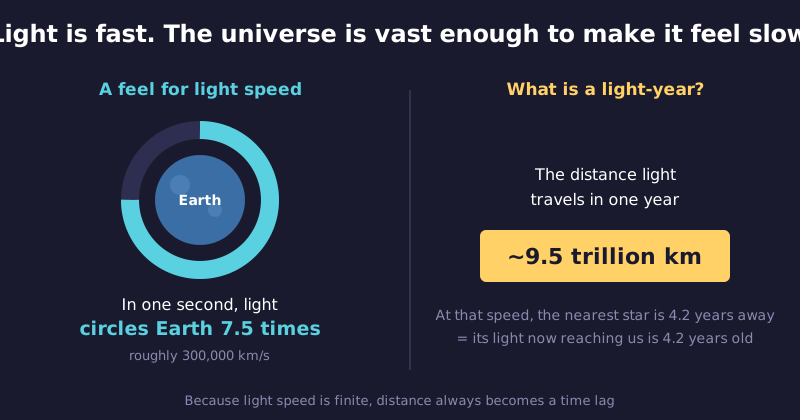
Even the “light-year,” the unit astronomers use to measure stellar distances, is really born from time rather than distance. One light-year is the distance light covers in a year — about 9.5 trillion kilometers.
That number is too big to feel real, so flip it around instead. Hear “a star 10 light-years away,” and what that actually means is: the light reaching you right now left that star 10 years ago. You think you’re measuring distance, but really you’re counting years back into the past.
To get a sense of just how lopsided this is, compare it to something familiar. Even the fastest passenger jet would take nearly 20 years to reach the Sun. Light crosses that same distance in eight minutes. Light is absurdly fast — and yet, against the sheer scale of the universe, even it starts to look like a sluggish vehicle that needs years, sometimes tens of thousands of years, to get anywhere. Change the scale, and your entire sense of “fast” flips upside down.
I’ll admit I walked right past this realization for a long time. I used to think of a light-year as just an enormous ruler. In reality, the universe’s distance chart and its history timeline are the same sheet of paper.
Your Neighboring Star Is a Few Years Old; Andromeda Is 2.5 Million
Now let’s leave the solar system behind.
The nearest star beyond the Sun is Proxima Centauri, still about 4.2 light-years away. If you caught its light tonight, it left Proxima roughly 4.2 years ago — around the time of one of your last few birthdays.
Go farther still. Our nearest large neighboring galaxy, Andromeda, sits about 2.5 million light-years away. Under a clear, dark sky, you can just make it out with the naked eye — one of the most distant objects visible without a telescope.
That light set out roughly 2.5 million years ago, back when our ancestors were still living in Africa. A span of time deep enough to swallow most of human history fits comfortably into tonight’s view.
Sit with that for a second. When you look up at Andromeda tonight, what hits your eye is Andromeda as it existed 2.5 million years ago. What that galaxy looks like this very instant is something we have no way of knowing — not because our instruments aren’t good enough, but because it’s physically impossible.
If something dramatic happened there right now, the news wouldn’t reach us for another 2.5 million years. None of us will ever witness it firsthand.
A Telescope Is a Time Machine
Telescopes let us push past what the naked eye can catch, and looking farther always means looking further into the past.
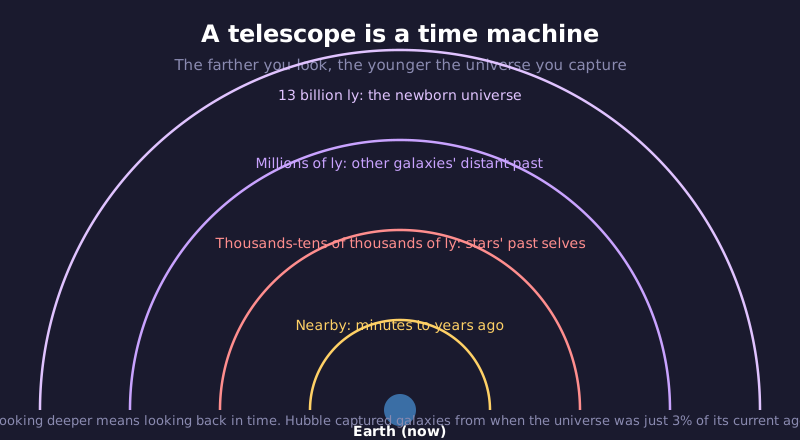
Here’s where it gets interesting. When astronomers point a giant telescope at the sky, they’re operating something close to a time machine. Look nearby, and you see a recent universe. Look far away, and you see a young one. The distance dial doubles as a time dial.
The Hubble Space Telescope once stared at a tiny patch of sky — smaller than a fingertip held at arm’s length — for a very long exposure, producing an image called the Hubble Ultra Deep Field. Packed into that sliver of darkness are roughly 10,000 galaxies.
According to NASA, the most distant galaxies in that image date from when the universe was only about 3% of its current age. Given that the universe is thought to be roughly 13.8 billion years old, that light is more than 13 billion years old.
And that light isn’t just old — it’s stretched. Because the universe is expanding, light waves get pulled longer over such a long journey, shifting toward the red end of the spectrum. Astronomers read that “redness” to figure out exactly how long ago the light departed. Distance, age, and color turn out to be three points on the same line.
The infant universe is landing on our cameras right now. The past doesn’t vanish — it keeps traveling through space as light, forever available to whoever catches it. In a sense, we can “observe” deep antiquity anytime we want. That’s arguably stranger than any time-travel story.
The Person in Front of You Is Also, Technically, in the Past
This might sound like a purely cosmic phenomenon, but the same time lag exists right here in your room.
The face of whoever you’re talking to across the table isn’t quite “now” either. If they’re a meter away, the light takes about a third of a billionth of a second — roughly 3.3 nanoseconds — to reach your eyes. You’ll never feel it, obviously. It’s a scrap of the past too small for human senses to register.
But the mechanism is identical to the Sun’s eight-minute delay. Wherever there’s distance, light burns time crossing it. Even on a video call with someone on the other side of the planet, the signal bounces through relays, and their voice and expression arrive a hair behind real time. We never see anyone — not other people, not even our own reflection — exactly as they are right now.
It’s a genuinely odd fact: nowhere in this universe is there a way to see a “perfect now.” Up close, the lag is too tiny to notice. The principle behind it never changes.
We Have Never Seen the Universe’s “Now”
With all that in mind, that opening line starts to read differently.
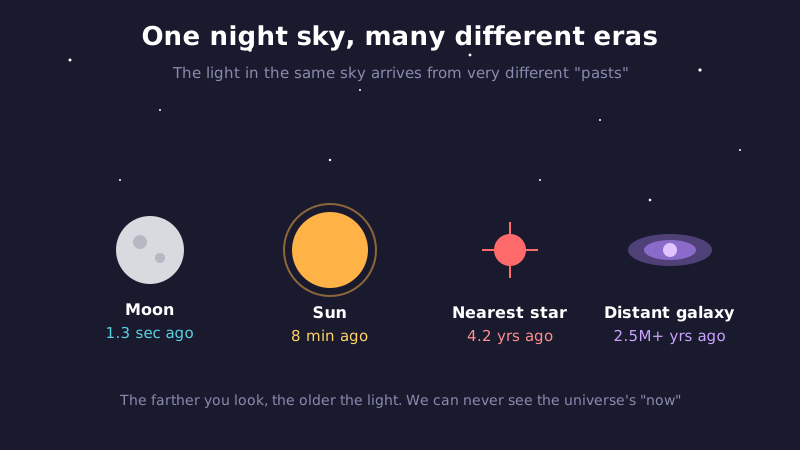
Picture a single photo of the night sky. In it, the Moon appears 1.3 seconds old, the Sun 8 minutes old, the nearest star 4.2 years old, Andromeda 2.5 million years old, and the youngest visible galaxies over 13 billion years old — all layered into the same frame. Light from wildly different eras just happens to cross paths on the same night, in the same field of view.
A photograph of “the universe right now” doesn’t exist anywhere. There’s no way, even in principle, to know what a distant object looks like this exact instant. What you’re seeing is always someone else’s past.
So tonight, when you look up, hold onto this thought: in that same glance, the nearest light left seconds ago and the farthest light left when the universe was still a newborn — and both are landing on your eyes at once. A collage of pasts, arriving together, becomes a single night sky right before you.