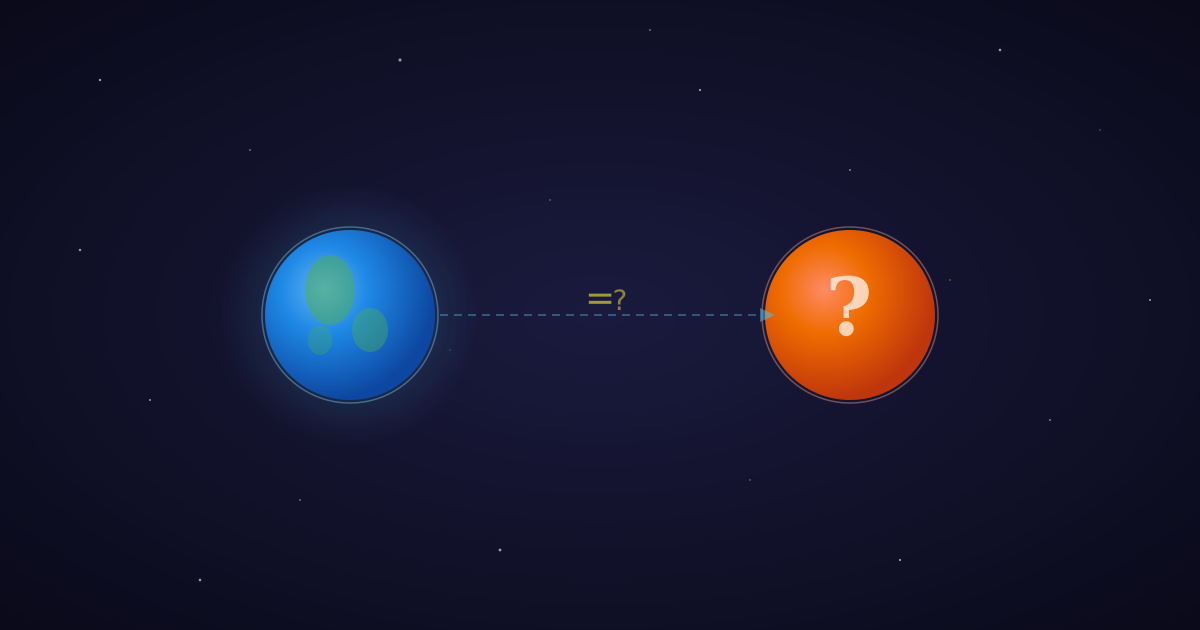
Imagine someone watching the Sun from unimaginably far away. Once a year, Earth drifts across their line of sight. How much dimmer do you think the Sun would look at that moment?
The answer: about 0.008 percent. Less than one part in ten thousand. Picture a moth fluttering past a floodlight on a nighttime sports field—that’s roughly the scale of the flicker.
Hunting for a second Earth means waiting, patiently, for that exact kind of blink around some star light-years away. That’s precisely what PLATO, a telescope the European Space Agency (ESA) is building for a planned 2027 launch, is designed to do.
What actually makes a star dim for a moment
Planets don’t glow on their own, which makes photographing a distant one nearly impossible—it simply gets lost in its star’s glare.
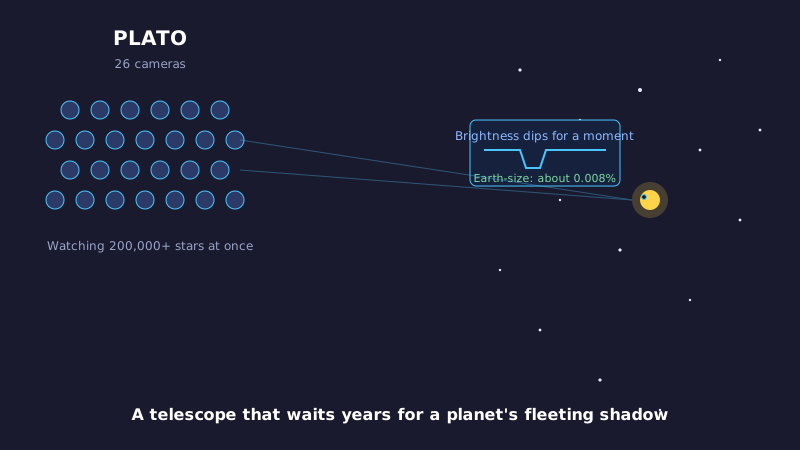
That’s where the transit method comes in: it catches the tiny dip in brightness as a planet passes in front of its host star. When a planet crosses a star’s disk, it blocks just a sliver of light. Spot that dip, and you’ve found evidence of a planet you’ll never actually see. PLATO’s own name comes from this idea—it stands for PLAnetary Transits and Oscillations of stars.
The trouble is how shallow that dip really is. A planet the size of Jupiter dims its star by roughly 1 percent. An Earth-size planet, though, produces that 0.008 percent figure from the opening of this article. Honestly, the first time I saw that number, my reaction was: how does anyone measure a change that small?
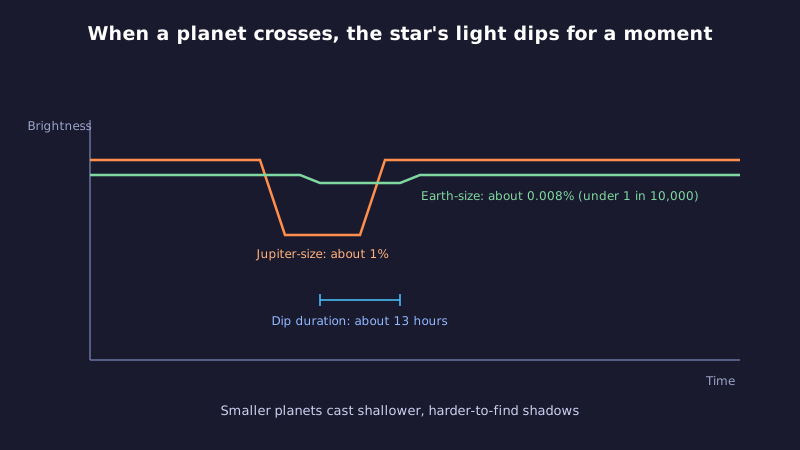
And the shadow doesn’t linger. For an Earth-Sun pairing, the crossing lasts around 13 hours. Out of an entire year, you get thirteen hours—and within that window, a change smaller than one part in ten thousand that you cannot afford to miss. How could anyone possibly pull that off?
Why watch 200,000 stars at once?
There’s a second complication lurking here. Unless a planet’s orbit happens to line up edge-on from our vantage point, it will never pass in front of its star at all.
Tilt that orbit even slightly, and the planet simply slides past the star’s edge—no shadow, no dip. Based on the Earth-Sun geometry, the odds of an orbit lining up just right work out to roughly 1 in 200. So even if every single star out there hosted an Earth-like planet, only about one in 200 would ever show us its shadow.
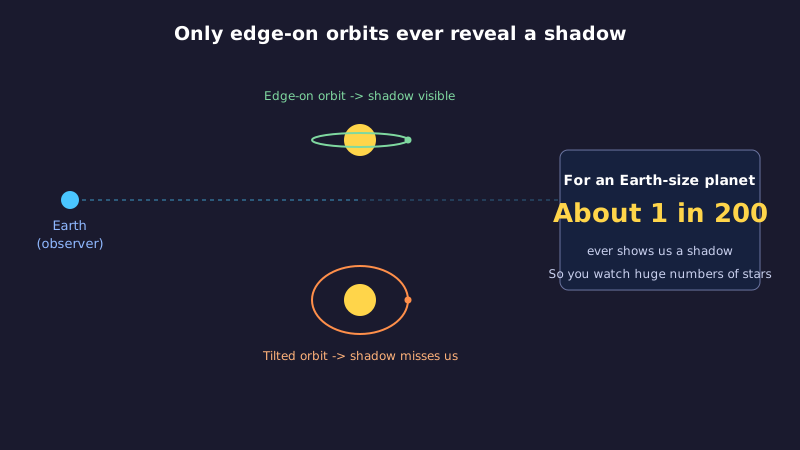
Given those odds, there’s really only one strategy: play the numbers. According to ESA, PLATO plans to monitor more than 200,000 stars simultaneously. If your odds of winning are low, you buy more tickets.
To pull that off, the mission relies on an array of 26 cameras scanning the sky at once. Each sensor packs 81.4 megapixels; put all 26 together, and you get roughly 2.1 billion pixels total. If a smartphone camera shoots at 40 megapixels, that’s the equivalent of pointing 40 smartphones at the sky simultaneously. The cameras’ fields of view overlap, so bright stars get watched by many cameras at once while fainter ones get fewer—many eyes trained on the same patch of sky. And that patch is enormous: the PLATO team says the mission’s total field of view is roughly 10,000 times the area of the full Moon.
Here’s a question worth pausing on, though. Even with all those eyes catching a momentary dip, how would anyone actually confirm it’s a planet?
This is where patience takes over
Stars flicker even without any planets involved. Starspots on the surface, internal convection, instrument noise—plenty of things can dim a star’s light for a moment. A single dip alone can’t tell you whether you’ve spotted a planet or just stellar mood swings.
To be sure it’s a planet, you need to watch the same dip—same depth, same shape—repeat on a regular schedule. But an Earth-like planet only crosses its star once a year. Confirming a second and third crossing means watching the same star for years on end, with no way around it.
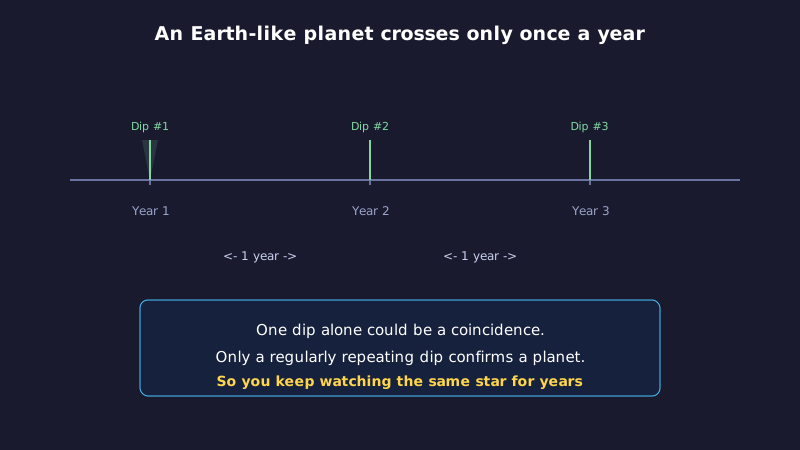
Picture yourself as that distant observer watching the Sun. You wait a full year for a single 13-hour window. During that stretch, and only that stretch, a flicker one part in ten thousand appears—and you can’t blink. Now do that, year after year, for 200,000 stars at once.
I’ll admit it: I expected exoplanet hunting to be flashier than this. In reality, it’s a science built almost entirely on waiting. PLATO is designed to stare at the same field of stars for years at a stretch.
And even after catching that shadow, the shadow alone can’t tell you whether the planet is truly an “Earth sibling.”
Listening to a star’s tremors to learn its secrets
The depth of a transit dip only tells you the ratio between the planet’s size and its star’s size. If you don’t know the star’s true size, you can’t pin down the planet’s real size either.
That’s where the second half of PLATO’s name comes in: Oscillations of stars. Stars quiver ever so slightly as sound waves ripple through their interiors. The technique of picking up that trembling through tiny brightness fluctuations is called asteroseismology—the stellar equivalent of using seismic waves to map Earth’s interior.
Here’s the interesting part: analyzing those tremors reveals a star’s size, mass, and even age. ESA lists precise measurements of planetary radius, mass, and age among PLATO’s core goals. Knowing a star’s age tells you how old its planetary system is—and whether there’s been enough time for life to take hold.
Catch the planet through a momentary shadow, then confirm what it is by listening to the star’s tremors. That two-part strategy sits at the very heart of the PLATO mission.
Is there really an “Earth sibling” out there?
Astronomers have already confirmed thousands of exoplanets. As shown by an AI that scanned 2.2 million stars and confirmed 118 planets, the field has entered an era where discoveries come through statistics at scale.
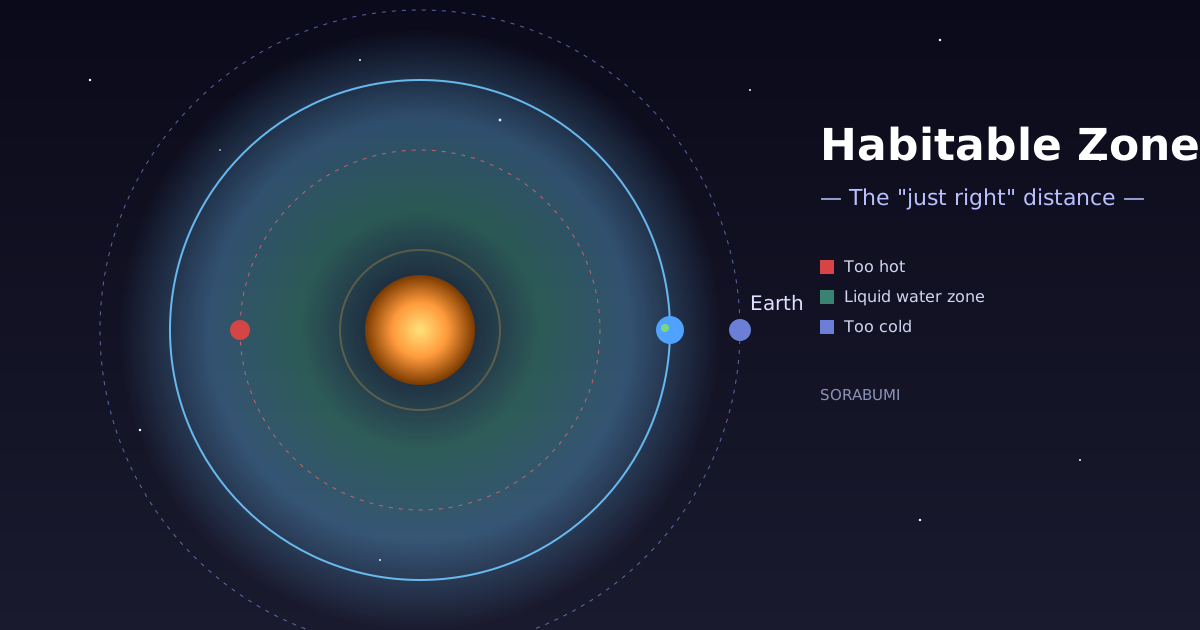
But most of what’s been found so far are planets orbiting close to their stars on short cycles—the closer the orbit, the more frequent the crossings, and the easier the dip is to catch. Flip that around, and you’ll find that rocky planets orbiting Sun-like stars at just the right distance for liquid water—the habitable zone (the not-too-hot, not-too-cold region where life might take hold, sometimes called the Goldilocks zone)—remain largely unexplored. That’s the same distance Earth sits from the Sun.
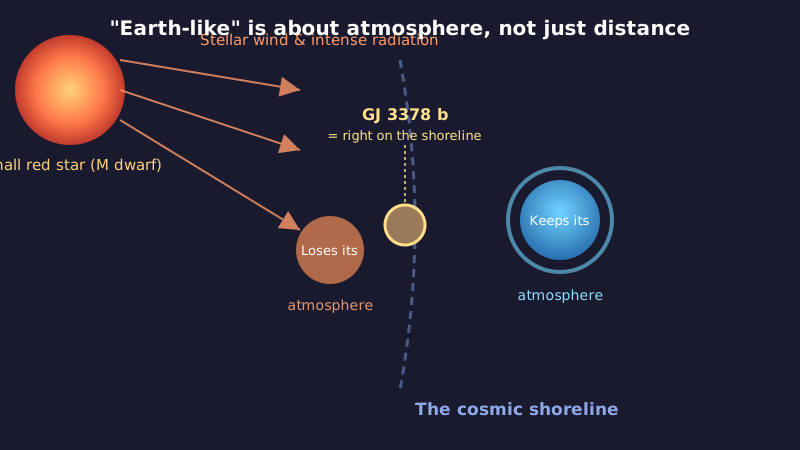
ESA has set PLATO’s sights squarely on rocky planets in the habitable zones of Sun-like stars. Worth being clear about what PLATO can and can’t do: it can confirm that an Earth-size rocky planet exists there. Whether it has water, let alone life, is a question for other telescopes down the line. Still, ESA frames this mission as a step toward answering a bigger question—are there other worlds out there like our own?
A telescope powered by patience
PLATO will operate from L2 (the second Lagrange point, one of the spots where the Sun’s and Earth’s gravity balance out), roughly 1.5 million kilometers from Earth—about four times the distance to the Moon. From there, it will hold perfectly still and stare at the same patch of sky for years.
The telescope launches in 2027. Sometime in the 2030s, scientists hope to point at a single star in the night sky and say: there’s another Earth here. Getting there means patiently waiting, right now, for a flicker no bigger than a moth crossing a floodlight—repeated across 200,000 stars.
Next time you catch a bug fluttering past a streetlamp at night, remember this: somewhere out there, around some distant star, someone is probably watching for that exact same fleeting shadow.