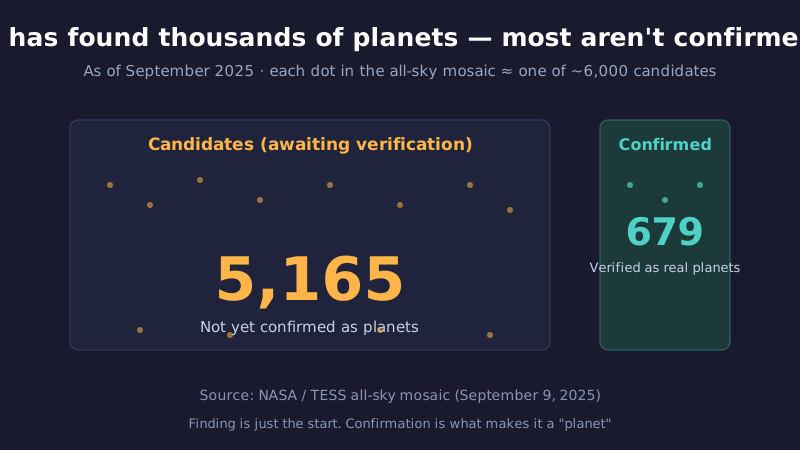
NASA’s exoplanet hunter TESS has spent years scanning the sky, and its map is dotted with roughly 6,000 flags marking possible planets. As of September 2025, though, only 679 of those have been confirmed as the real thing. The other 5,165 are still sitting in limbo, suspects who might turn out to be planets.
That’s a hit rate of barely one in ten. And that gap is where today’s story starts.
”Found” and “Confirmed” Are Two Very Different Words
Exoplanet headlines love the moment of discovery. But on the ground, in the actual work of astronomy, a candidate doesn’t automatically graduate to planet status. TESS has been staring at the sky in 96 separate sectors since it launched in April 2018, tracking the brightness of tens of thousands of stars without pause.
Out of that mountain of data, a computer flags the instant a star’s light dims ever so slightly. That’s a candidate. But a candidate is just a name on a suspect list — not a verdict.
I’ll admit I used to gloss over this distinction myself, assuming “found” meant “there’s a planet there.” In reality, proving that a dip in starlight actually comes from a planet takes a dizzying amount of follow-up checking.
So why does a slight dimming even count as “maybe a planet” in the first place? Let’s start there.
Catching a Star Blink by 0.01 Percent, From Space
TESS relies on something called the transit method. When a planet passes in front of its star, as seen from Earth, it blocks a sliver of the star’s light. Catch that dimming happening on a regular cycle, and you’ve got evidence a planet might be there.
The catch is just how tiny that dimming is. Even a Jupiter-sized planet crossing a Sun-like star only dims it by about 1 percent. Shrink the planet down to Earth’s size, and the dip drops to a mere 0.01 percent.
That number doesn’t mean much on its own, so here’s a way to picture it: it’s like lining up 10,000 candles and blowing out exactly one. And astronomers are measuring that from a spacecraft, watching a star hundreds of light-years away.
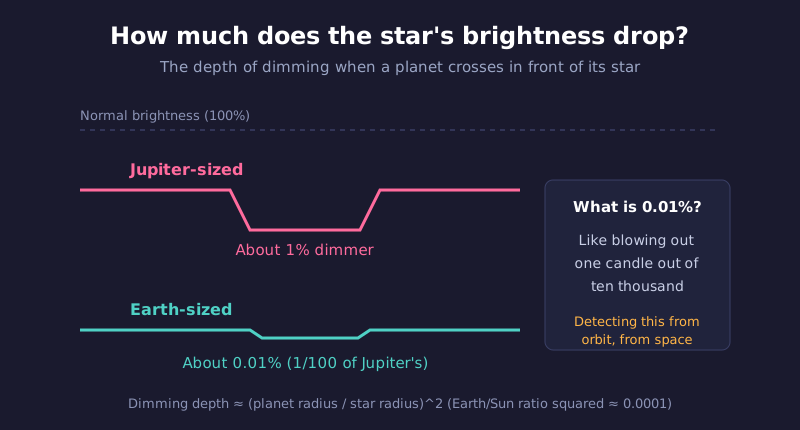
The depth of the dip roughly tracks the square of the ratio between the planet’s radius and the star’s radius. So from the dimming alone, you can work backward to a rough size for the planet. So far, so elegant.
But here’s where it gets complicated. A planet isn’t the only thing that can cause that faint dip.
The Dimming Has More Than One Suspect
A star’s light dropping on a regular cycle can be caused by more than a passing planet. NASA’s citizen-science project Planet Patrol notes explicitly that dips in a light curve can come from temporary instrument noise, starspots, or dust — not just planets. Being suspicious of every candidate is practically part of the job description in astronomy.
The trickiest impostor is the eclipsing binary: two stars orbiting each other, where one periodically blocks the other from view. Seen from outside, that produces a regular dimming that can look remarkably like a planet’s transit.
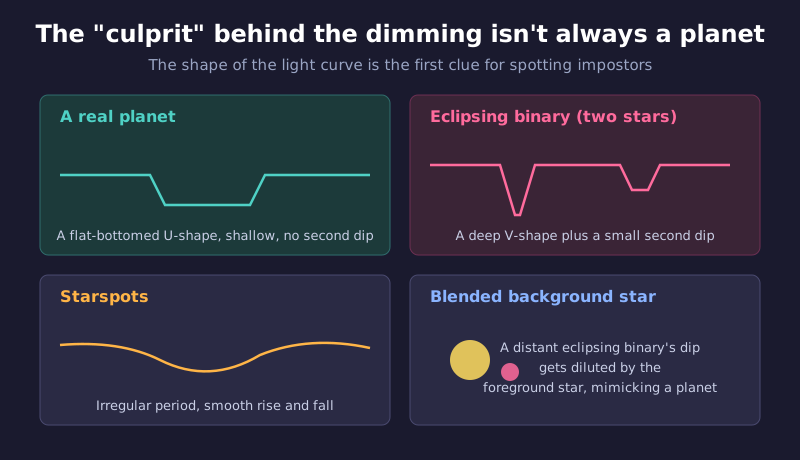
Starspots on a star’s surface cause trouble too. As a spotted star rotates, its overall brightness drifts up and down, which can be mistaken for a transit. Even harder to untangle is a “blended background” case, where a faint, distant eclipsing binary sits almost directly behind a brighter foreground star. The binary’s deep dip gets diluted by the bright star’s light, ending up looking exactly like a shallow, planet-sized transit.
TESS’s cameras cover wide patches of sky per pixel, which makes this kind of mix-up especially common. In other words, the pile of candidates is loaded with false positives. This is where the real verification work begins.
First, Question the Shape of the Light
The cheapest way to sniff out a fake is to simply study the shape of the dip closely. It’s unglamorous, but it works remarkably well.
A genuine planetary transit produces a light curve that looks like a flat-bottomed U: the planet slides in from the star’s edge, holds a steady dimness for a while, then slides back out. Eclipsing binaries, on the other hand, often trace a sharp V, or show two dips of different depths across one orbital cycle — because when the stars alternately block each other, the deep dip comes from hiding the brighter star and the shallow dip from hiding the dimmer one.
Starspot-driven variation tends to look different again: the cycle isn’t perfectly regular, and the curve rises and falls more smoothly. These shape quirks help astronomers weed out the most obvious fakes early.
Here’s where it gets interesting, though. For candidates that the shape alone can’t settle, statistics step in. Researchers estimate how likely it is that a nearby eclipsing binary or a confusing background star could be lurking in the vicinity, then use that to push down the probability the signal is anything other than a planet — a method known as statistical validation.
But statistics only ever gives you a probability, not a verdict. Calling something “confirmed” takes one more piece of evidence. Is there a way to pin down the culprit more directly?
Weighing a Planet by Measuring a Star’s Wobble
Enter the radial velocity method — personally, I think it’s the most elegant step in the whole verification process.
A planet isn’t just passively pulled around by its star’s gravity. It tugs back, however slightly, and that tug makes the star trace a small wobble in sync with the planet’s orbit. When the star wobbles toward Earth, its light shifts very slightly toward blue; when it wobbles away, the light shifts toward red. Track the rhythm of that color shift, and you can measure how hard something is pulling on the star.
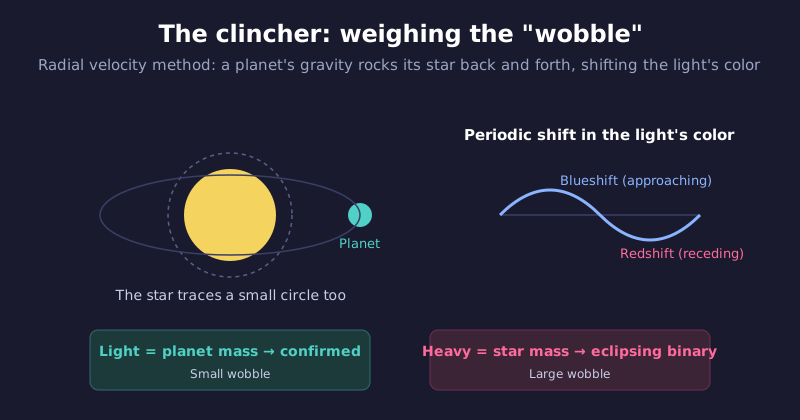
This wobble is, again, almost absurdly small. Our own Sun wobbles at roughly a dozen meters per second thanks to Jupiter’s pull — not much faster than a sprinting human. If Earth were the only planet tugging on it, that wobble would barely reach 10 centimeters per second. Astronomers are reading motion that subtle, in a star hundreds of light-years away, purely from the shifting color of its light.
The strength of that tug depends directly on the mass of whatever is doing the pulling. So by carefully tracking the wobble with large ground-based telescopes, researchers can work out just how heavy the culprit is. Light enough to be a planet, and it’s confirmed. Heavy enough to be a star, and the “candidate” turns out to be a binary star system in disguise.
TESS spots the candidates from orbit; ground-based telescopes weigh them one by one. That partnership is the last gate a candidate has to pass before becoming confirmed — and it’s exactly why more than 5,000 candidates remain stuck in queue. There simply isn’t enough telescope time or staff to chase down every single one.
Discovery Only Means Something Because Someone Double-Checks
Across every exoplanet mission combined, astronomers have confirmed just over 6,270 planets to date. Behind every single one of those numbers lies the same quiet, stubborn process: scrutinizing the shape of a dip, running the statistics, and measuring a star’s wobble night after night.
And this work isn’t limited to professionals. Through its Exoplanet Watch program, NASA invites amateur astronomers to observe transits with their own backyard telescopes and help verify candidates. More eyes on the sky is always a good thing.
If you picked any single point in the night sky and happened to catch the exact moment a star dimmed by 0.01 percent, nobody could tell you on the spot whether that was a planet or just one star hiding behind another. The answer only arrives weeks later, after the follow-up observations are done.
Behind every flashy “planet discovered” headline sits this quiet arithmetic of verification. Next time you see news of a newly discovered exoplanet, it’s worth remembering that somebody, somewhere, spent months interrogating thousands of suspects to get there.
If you’re curious how these candidates get found in the first place, our piece on an AI that scanned 2.2 million stars and confirmed 118 planets fills in the front half of the story. And for a fictional look inside the verification room, try our short story False Alarm.