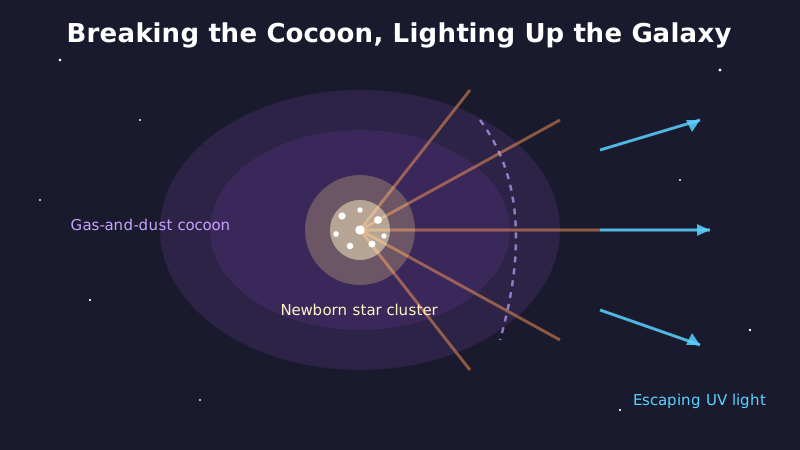
If the Sun were an adult weighing 60 kilograms, this object would weigh about as much as two hard-boiled eggs. And yet researchers are filing it under “failed star,” not “planet.”
About 1,000 light-years away, the James Webb Space Telescope has spotted an object barely twice the mass of Jupiter — the lightest known candidate for a brown dwarf, the strange middle child that never quite became a star.
So why does something the size of two Jupiters count as a star relative rather than a planet? And where exactly is the line between the two supposed to sit? Let’s follow the trail.
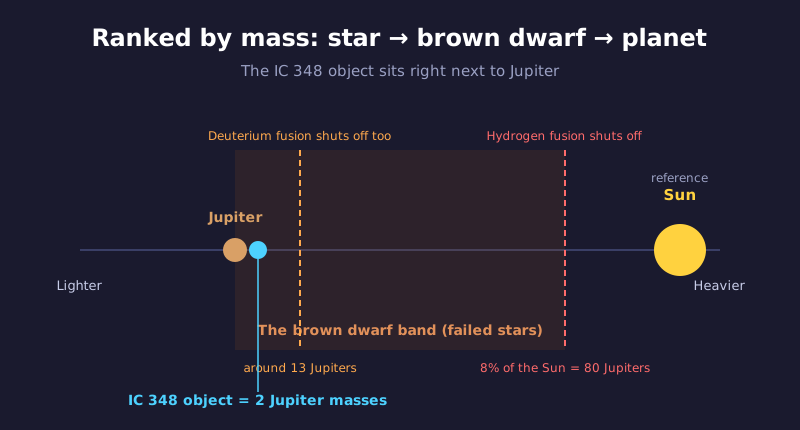
Two Jupiter masses, yet somehow a star relative
The discovery turned up in IC 348, a star-forming region in the direction of Perseus, roughly 1,000 light-years from Earth. It’s a dense nursery of gas and dust where young stars are being born all the time.
When Webb turned its infrared eyes on the region, a handful of previously invisible, dim objects popped into view. According to NASA and ESA, the lightest of these weighs in at about twice Jupiter’s mass — a mere 0.19% of the Sun’s mass.
Numbers like that don’t mean much on their own, so try this: picture the Sun as a 60-kilogram adult. On that scale, this object would weigh around 114 grams — about as much as two hard-boiled eggs.
And yet it isn’t a planet. That’s the strangest part of this story.
Calling something a planet usually requires it to orbit a parent star. This object does no such thing. It floats alone in the gas cloud, unattached to anything. There’s no parent in sight.
So is it a star, then? Not that either — it’s far too light. Objects stuck in this in-between zone are called brown dwarfs. The trouble is, astronomers long assumed brown dwarfs had a floor of their own — a point below which such an object simply shouldn’t be able to form. This discovery just pushed that floor lower.
Between star and planet lies a cliff called “can it ignite?”
Size and appearance don’t separate stars from planets. What matters is a single switch: does nuclear fusion ignite at the core?
A star crushes its own center under its own weight. Once the pressure and temperature climb high enough, hydrogen starts fusing and the whole thing lights up. The Sun’s glow is that fire, still burning after billions of years.
Lighter objects never generate enough force to pull that off. Below roughly 8% of the Sun’s mass — about 80 Jupiters — hydrogen fusion simply never ignites. Cross that line, and an object loses its right to call itself a star.
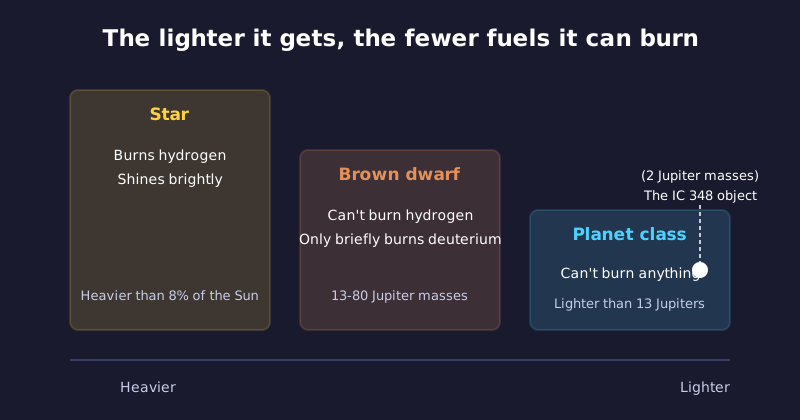
Here’s the interesting part: even without enough mass to ignite hydrogen, an object can sometimes burn a lighter fuel for a while. That fuel is deuterium, hydrogen’s heavier cousin. Objects heavier than roughly 13 Jupiter masses are thought to burn a little deuterium in their youth.
So as mass drops, there are two cliffs. Hydrogen fusion cuts off around 8% of the Sun’s mass, and deuterium fusion cuts off around 13 Jupiter masses. Whatever sits between those two cliffs is what we call a brown dwarf.
The object found in IC 348, though, weighs in at about 2 Jupiter masses — well below even the second cliff, too light to burn deuterium at all. It’s still classified as a brown dwarf, because researchers think it was born the way stars are born, not the way planets are.
Born like a star, or born like a planet?
The question shifts here, from “what can it burn” to “how did it form.” I’ll admit this is the part that took the most head-scratching.
Star-like objects can form in one of two ways.
The first path: a cloud of gas and dust collapses under its own gravity. Wherever the cloud happens to be a little denser than its surroundings, that spot starts pulling in more material, snowballing into a clump until fusion finally ignites at the center. That’s how stars are born — and brown dwarfs, too, are thought to form the same way, from a collapsing cloud.
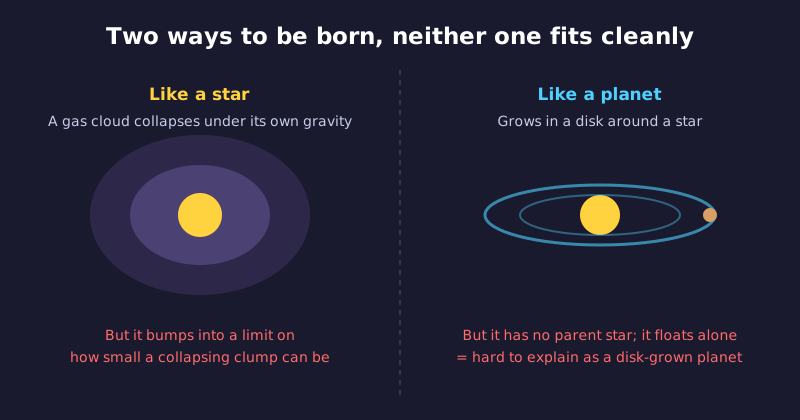
The second path: dust grains slowly clump together inside a disk surrounding an already-shining star. This is how planets like Jupiter come to be — built from disk leftovers, tagging along with a parent star.
The catch is that cloud collapse is thought to have its own lower limit — a mass below which a clump simply can’t form this way. According to the research team, an object just a few Jupiter masses heavy is sitting right at that limit, or possibly below it.
Since this object has no parent star and drifts entirely on its own, a disk-grown origin doesn’t fit. That leaves cloud collapse as the likely explanation — except it seems too light for that mechanism to work. This contradiction is exactly the puzzle the discovery has handed to star-formation theory.
How did Webb spot something this faint, 1,000 light-years out?
Finding a dim object with only twice Jupiter’s mass, 1,000 light-years away, was never going to be easy.
Take a moment with that distance. A light-year is how far light travels in a year. Even moving at 300,000 kilometers per second, light from 1,000 light-years away left its source a thousand years ago. What we’re seeing of this object right now is infrared light that set out around the late Heian period in Japan.
An object that far away, and that dim to begin with, is nearly invisible in visible light. That’s where Webb’s infrared vision comes in — even a cold, faint object still glows faintly with heat in the infrared.
The observation happened in two stages. According to NASA and ESA, Webb’s NIRCam (Near-Infrared Camera) first imaged IC 348 in 2024, flagging faint candidates. The following year, in 2025, NIRSpec (Near-Infrared Spectrograph) broke down the light from those candidates color by color.
Splitting light apart like that reveals what’s in an object’s atmosphere. And that’s where the team ran into something they weren’t expecting.
An unexpected molecule showed up in the atmosphere
When researchers broke down the light from the lightest objects, they found traces of hydrocarbons — molecules made of nothing but hydrogen and carbon.
The signature showed up strongly only in the dimmest, lightest objects. Kevin Luhman of Penn State University and Catarina Alves de Oliveira of ESA, who led the research, suggest these objects might form their own new spectral class — a category defined by the unique fingerprint of their light.
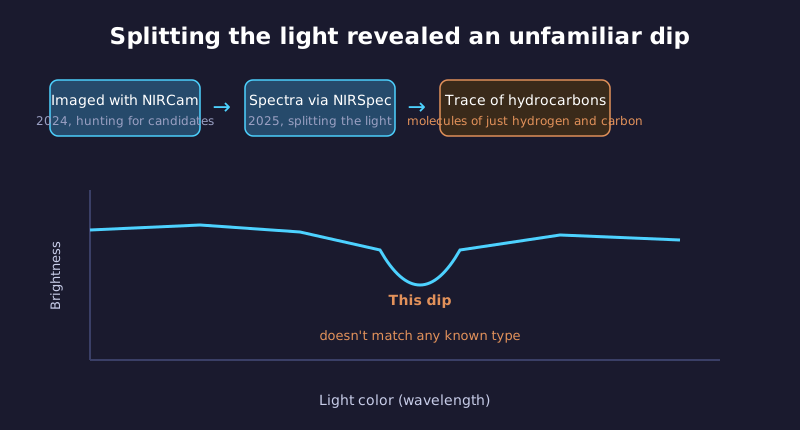
This part gets a little technical, but skip it and the rest won’t quite land. Both stars and planets carve distinctive dips and peaks into their light depending on what’s in their atmosphere. Spectroscopy — classifying objects by the shape of that light — relies entirely on this. The hydrocarbon dip found here doesn’t cleanly match any known type.
That’s as far as the observation itself can tell us — it doesn’t explain why hydrocarbons show up there in the first place. The team suspects the molecule is a natural feature of the coldest, youngest brown dwarfs’ atmospheres, but the actual mechanism behind it is left for future spectroscopy to sort out.
It’s not just a record for lightness. Even the atmospheric fingerprint looked unfamiliar. Down at the faint, low-mass edge of the gap between stars and planets, there may be a whole class of worlds that doesn’t have a name yet.
The line keeps getting redrawn
Stand next to this object, hypothetically, and you wouldn’t see anything like the Sun’s blaze. There’s no fusion fire — just the faint infrared warmth of a slowly cooling clump. Too dim to be a star, too unattached to be a planet.
We like to sort the universe into tidy boxes: “star” here, “planet” there. But the universe itself seems to have laid a gradient across the gap between those boxes. An object just twice Jupiter’s mass has lit up a corner of that gradient nobody had seen clearly before.
When Pluto got dropped from the planet list, what changed wasn’t the object itself — it was the line humans had drawn around it. Something similar is probably happening again. This small object in IC 348 is quietly rewriting the answer to “where does a star begin?”
Next time Webb looks into this band, it might find something even lighter than two Jupiters — another almost-star. When that happens, we’ll have to redraw the line once more.