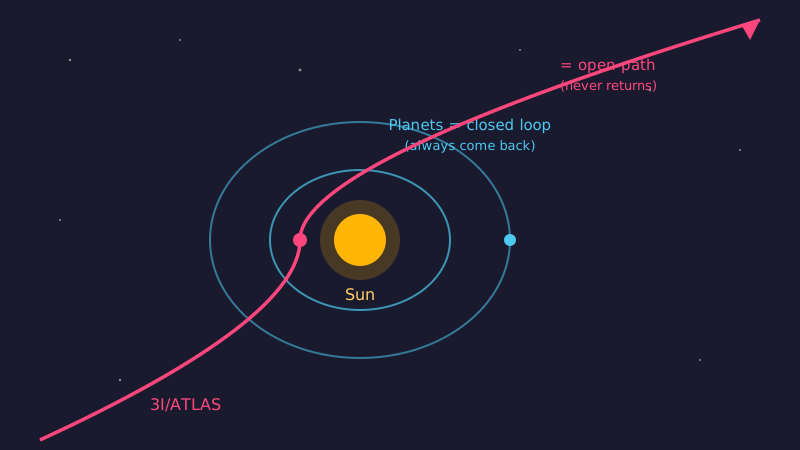
On July 1, 2025, a telescope in Chile caught a faint point of light crossing the sky. Nothing unusual about that; comets drift past all the time. But this one would sweep by the Sun exactly once and never come back. It was a genuine outsider, a visitor that had wandered in from beyond our solar system.
Its name is 3I/ATLAS, only the third interstellar object humanity has ever confirmed. What makes the story interesting is how astronomers figured out where it came from. They didn’t recognize some telltale “look” to the comet. What gave it away was the shape of the path it traced across the sky.
An outsider gives itself away by its path, not its face
Point a telescope at a comet, and it doesn’t come with a label reading “not from around here.” A ball of ice and dust venting gas as it nears the Sun looks essentially identical whether it was born in our solar system or somewhere else entirely. Appearance alone can’t tell a local from a traveler.
So how do astronomers tell the difference? They track the object’s position over days or weeks and work out the line it traces through space, plotting the trajectory point by point across the vast map of the night sky.
For 3I/ATLAS, that trajectory turned out to be decisive. Once astronomers combed through earlier images, they found the comet had already been caught on camera around mid-June 2025, about two weeks before its official discovery. Connecting those older sightings to the newer ones revealed a shape no homegrown solar system object could ever draw.
So what does a homegrown object’s path normally look like? Understanding that is the key to seeing just how strange 3I/ATLAS really was.
Anything caught by the Sun’s gravity has to loop
Every object moving through the solar system, whether planet, comet, or asteroid, is held by the Sun’s gravity. Think of it as being tied to the Sun by an invisible leash. No matter how far an object wanders, gravity eventually reels it back.
The result is a closed loop, an elliptical orbit. Earth completes one lap in about a year; Halley’s Comet takes roughly 76 years. Long period or short, the line always connects back to where it started.
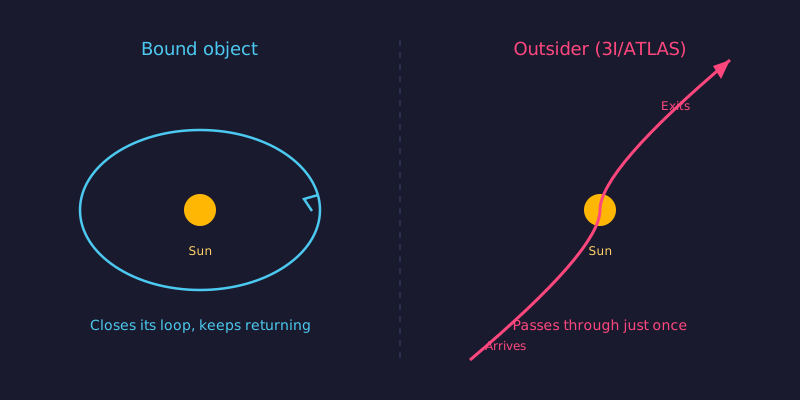
Picture a conveyor-belt sushi restaurant. Each plate loops around the counter and, sooner or later, passes in front of you again. Solar system natives behave exactly like those plates. They always come back around.
So why do some objects return and others don’t? The answer comes down to speed. Pass the Sun slower than a certain threshold, and gravity reels you into a loop. Cross that threshold, and gravity can’t bend your path enough; you sail straight through and out. The dividing line is a remarkably narrow margin of speed.
Which raises the real question: can an object exist that never comes back at all? Where does a plate go once it slips its leash?
An open orbit means a single, one-way pass
How “open” an orbit is comes down to a single number: eccentricity. A perfect circle scores 0; a long, stretched ellipse climbs toward 1. Every value up to that point still describes a closed loop.
Cross eccentricity 1, though, and the line stops connecting to itself. Instead of a closed loop, you get an open curve, a hyperbola, that grazes past the Sun with both ends racing off toward infinity. Nothing about the Sun’s gravity can pull an object like that back. Once it passes, it’s gone for good.
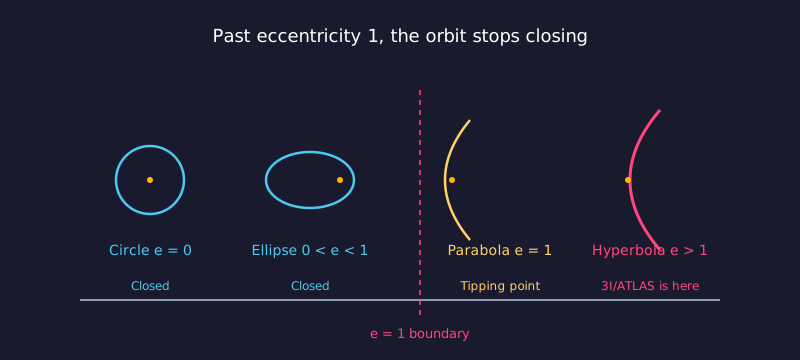
3I/ATLAS’s orbit sat squarely on that open side of the line. It had never been captured by the Sun before, and it never will be. That means it wasn’t born in the Sun’s gravitational neighborhood at all; it arrived from somewhere else and is now on its way back out.
The “I” at the front of its name stands for interstellar. The number marks the order of discovery, and 3I/ATLAS is the third confirmed object of its kind. The name itself carries the verdict: this thing came from outside our solar system.
I’ll admit it took me a while to appreciate just how cleanly that single threshold, eccentricity crossing 1, separates locals from outsiders. One number, and it tells you where something was born.
So why are astronomers so confident it came from outside?
An open orbit alone might make you wonder: couldn’t something inside the solar system have simply been flung out by a close encounter, then happened to pass by? It’s a fair question.
But 3I/ATLAS came in moving far too fast for the Sun’s gravity to ever bend its path into a loop. It’s hard to imagine a homegrown object randomly reaching that speed. And the direction it arrived from, roughly the constellation Sagittarius, only reinforces the case. Trace the path backward, and it points straight out past the edge of the solar system.
Take a moment to imagine riding along on this comet. Your trip wouldn’t be a lap around the Sun. It would be a single, once-in-a-lifetime pass, a diagonal slice across the Sun’s front yard, then straight through to a completely different patch of the galaxy.
Confirmed interstellar visitors like this are still exceedingly rare, only three so far. The first was ‘Oumuamua in 2017, the second Borisov in 2019. These are travelers we’re lucky to catch once every few years.
Which star did it come from, though? That part remains genuinely unclear. Nearby stars drift slowly over the vast stretches of time involved, so running the trajectory backward can’t pin down a single point of origin. Researchers consider tracing its exact home star essentially impossible. We know it came from outside; we just can’t say from where. Strange as that sounds, it’s part of what makes this traveler so fascinating.
Even its size remains only half-known
For all we’ve learned about its identity, 3I/ATLAS’s physical details stay surprisingly fuzzy. Hubble Space Telescope observations from summer 2025 put the nucleus’s diameter somewhere between 440 meters on the low end and 5.6 kilometers at the high end. That’s the difference between a small mountain and a mid-size building; astronomers still can’t narrow it down further.
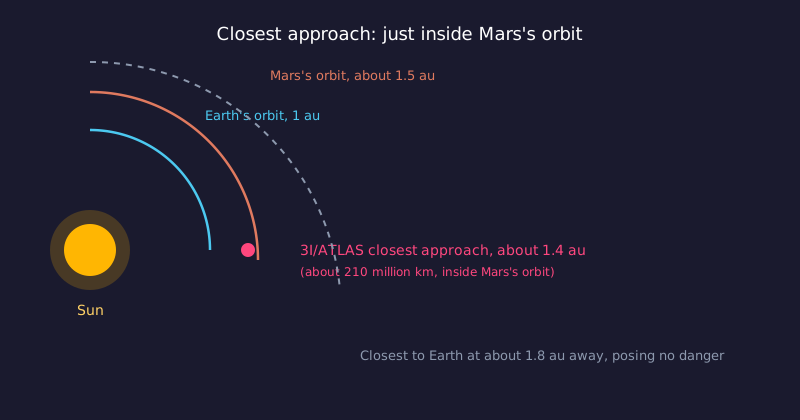
The orbital details are much better pinned down. Perihelion, its closest approach to the Sun, fell around October 30, 2025, at a distance of about 1.4 astronomical units. One astronomical unit equals the average Earth-Sun distance, roughly 150 million kilometers, so 1.4 works out to about 210 million kilometers, just inside Mars’s orbit. At its nearest, it never came closer to Earth than about 1.8 astronomical units, posing no danger, according to NASA.
The observation window was tight, too. Ground-based telescopes could track it only until around September 2025, after which it swung behind the Sun and reemerged in early December. Observatories around the world scrambled to point their instruments at it during that brief opening.
Why the rush? Because 3I/ATLAS is literally raw material formed around a different star. Whatever ice, whatever gas is mixed into it, studying that directly is as close as we’ll get to analyzing a fragment of a distant star system in our own backyard. Chances to point a lens straight at debris from another star passing through our solar system simply don’t come along often. Wide-field survey telescopes like ATLAS are what catch these fleeting visitors first.
Watching a guest who will never return
What 3I/ATLAS ultimately teaches us is that an object’s birthplace isn’t written in its appearance; it’s written in its motion. A ball of ice and dust can look just like a homegrown comet, yet whether the line it draws closes or stays open settles the question of where it came from, decisively.
Our own Voyager probes have spent half a century inching their way out of the solar system, while from the other direction, visitors like this arrive with no warning at all. And they pass through just once, barely pausing to say hello before continuing on. Decades of us reaching outward, and a stranger dropping in unannounced, are really two views of the same fact: how vast that sea of stars actually is.
Right now, 3I/ATLAS has finished its one and only rendezvous with the Sun and is quietly receding toward a different sea of stars than the one it came from. Somewhere in tonight’s sky, that point of light that will never come back is still moving, steadily, outward.


