Planets don’t shine. Unlike stars, they don’t burn, so from a distance they’re not even a dim point of light — they’re nothing at all. And yet astronomers have already confirmed more than 6,000 of them beyond our solar system.
NASA’s official tally of exoplanets — planets orbiting stars other than the Sun — comfortably clears 6,000. So how do you count something that gives off no light of its own?
How do you count a planet you can’t see?
Exoplanet hunters rely on five main techniques, according to NASA: the transit method, radial velocity, direct imaging, astrometry, and gravitational microlensing.
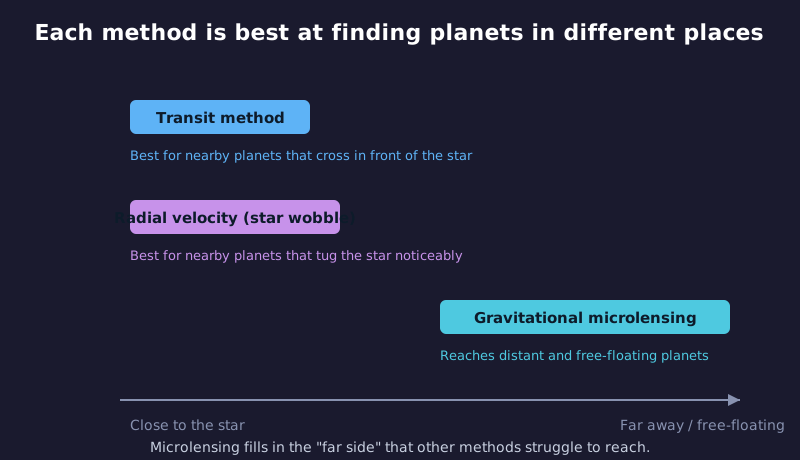
The workhorse is the transit method. When a planet crosses in front of its host star, the star’s light dims by a tiny amount. Astronomers watch for that periodic flicker.
The second most common approach is radial velocity. A planet’s gravity tugs on its host star just enough to make it wobble, and that wobble is what astronomers measure.
Both methods share a blind spot, though. They only work when a planet sits close to its star and happens to line up with Earth’s line of sight. Planets on wide, distant orbits — or planets with no star at all, drifting alone through space — slip right through this net.
So how do you find a planet that’s far away, dark, and nowhere near a star?
Turning “gravity bends light” into a telescope
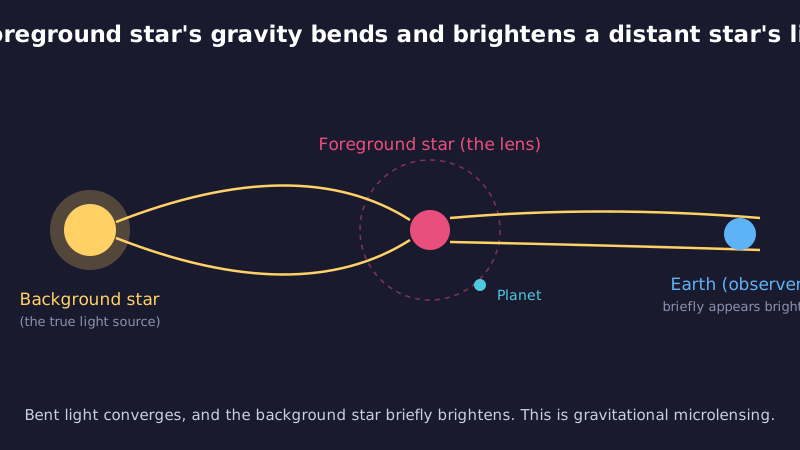
This is where a strange property of gravity comes in: it bends light. Near any massive object, space itself warps, and any light passing through gets bent along with it.
When a foreground star’s gravity gathers the light from a star directly behind it, the light briefly appears brighter from our point of view. That’s a gravitational lens — and when the effect happens on the scale of a single star, astronomers call it microlensing.
Think of it like a magnifying glass. Focus sunlight through a lens and you get a blinding point of light. Here, gravity plays the role of the glass.
When a foreground star, a background star, and Earth happen to line up almost perfectly, the background star gradually brightens, then fades back to normal — a quiet surge that can last anywhere from days to weeks.
I’ll admit I misunderstood this for a long time, thinking of it as a way to photograph a massive object. It’s actually the opposite: the lensing star itself doesn’t need to be visible at all. What matters is only how much its light output rises and falls.
A planet leaves a small bump in the brightness chart
Here’s where it gets interesting. What happens if that foreground star has a planet orbiting it?
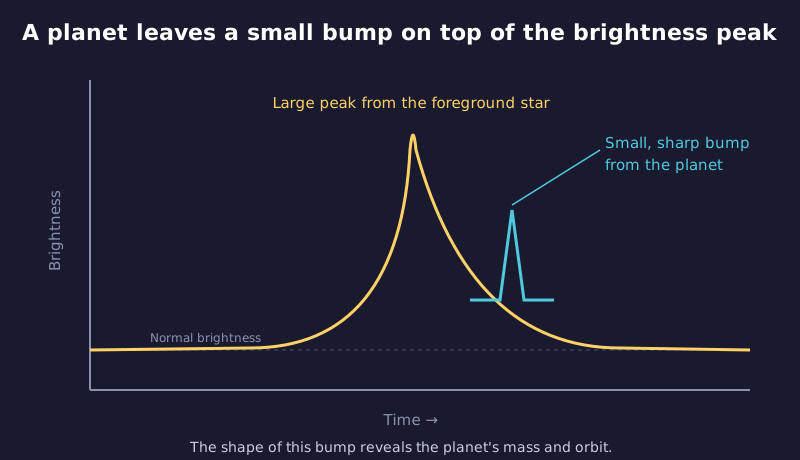
The planet’s own gravity pitches in for a brief moment, adding a second, sharper spike right near the peak of the star’s much larger brightening. NASA describes it as “a second, smaller spike” riding on top of the main event.
The star’s contribution rises and falls gently over days. The planet’s bump, by contrast, can come and go in a matter of hours. That means the whole game comes down to tracking brightness over time — a light curve — in painstaking detail.
The height and width of that small bump reveal the planet’s mass and how far it orbits from its star, all without ever capturing a single image of the planet itself.
Pause on that for a second. If you were watching that background star and blinked at the wrong moment, missing the tiny spike riding the peak, the evidence that a planet was ever there is gone. Forever.
It never happens twice — so watch millions of stars at once
Microlensing has an awkward quirk that no other method shares: the alignment of foreground star, background star, and Earth is pure chance, and it happens exactly once.
With the transit method, a planet keeps coming around, so a suspicious signal can be confirmed on the next orbit. Microlensing offers no such second chance. The same alignment will never happen again, so there’s no way to repeat the observation.
Honestly, when I first learned this, my reaction was: how do you find planets with only one shot? The answer turns out to be sheer scale. Watch an enormous number of stars, all at once, without a single gap.
That weakness doubles as a strength. Because microlensing doesn’t require a planet to pass directly in front of its star, it can detect worlds on far-flung orbits — and even rogue planets that drift through space with no star at all. Researchers expect this to become microlensing’s specialty: exactly the territory where other methods fall short.
The catch is that this kind of mass surveillance demands a telescope built for the job, watching from space.
Roman Space Telescope is chasing a count of 100,000
That’s the job of NASA’s Nancy Grace Roman Space Telescope. Using microlensing alongside other techniques, it’s set out to run something like a statistical census of exoplanets.
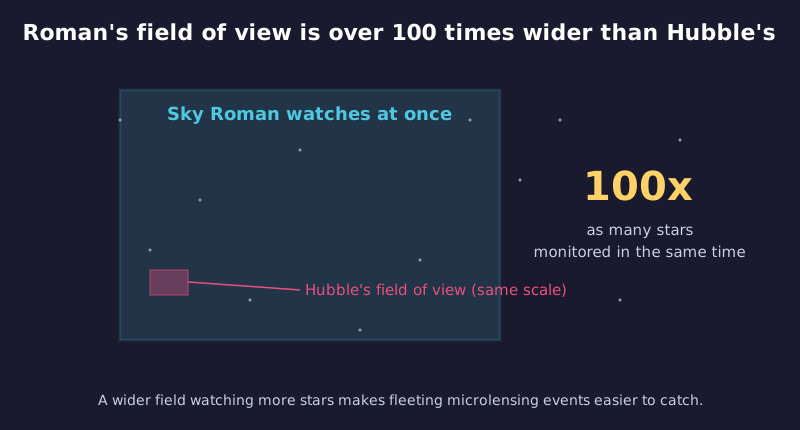
The key advantage is field of view. According to NASA, Roman can survey more than 100 times as much sky at once as the Hubble Space Telescope. Watch 100 times as many stars in the same amount of observing time, and your odds of catching a one-off microlensing event jump dramatically.
NASA expects Roman to discover more than 100,000 new exoplanets. Given that the current tally sits at just over 6,000, that’s a jump of two orders of magnitude.
That leap is honestly my favorite part of this whole story. Six thousand confirmed planets already felt like a lot — and a single telescope might multiply the known count nearly twentyfold, much of it in territory — distant orbits, rogue planets — that’s been out of reach until now.
Measuring what you can’t see by its effect on everything around it
What gravitational microlensing really does is measure the invisible through the influence it leaves behind. The planet itself never appears in any image. All you see is how its gravity warped light borrowed from somewhere else.
Come to think of it, that’s actually one of astronomy’s oldest tricks. Infer the existence of something invisible from tiny disturbances in light or motion. A star’s wobble reveals a planet; a galaxy’s rotation hints at mass we can’t see. In a sense, humans learned to sense planets before we ever learned to see them.
And this technique’s biggest moment is still ahead. Once Roman starts watching millions of stars at once across its wide field, planets on distant orbits and rogue planets with no star at all — worlds whose light has never once reached us — should start appearing, one after another, as tiny bumps in brightness. Researchers believe that’s when we’ll finally get a real picture of just how many planets exist beyond our solar system.
We published a short story alongside this article today, built around the same idea: something can be genuinely there even when it’s never seen. If you’re in the mood, you can read it here.
Tonight, somewhere behind an ordinary dark point in the sky you glance at, someone’s planet might be bending a distant star’s light for just a moment — announcing, however briefly, that it’s there.


