Sunlight takes about eight minutes to reach Earth.
The star right next door to the Sun — our nearest stellar neighbor — takes more than four years to get here.
So if you look up at that star tonight, what actually hits your eyes is light that left four years ago. Nobody alive knows what’s happening there right now.
The star you’re looking at “now” isn’t the star as it is “now”
Light is fast. But it isn’t infinitely fast.
In a vacuum, light travels at roughly 300,000 kilometers per second — fast enough to circle the Earth seven and a half times in a single tick of a clock. That speed feels instantaneous in daily life. Flip a light switch, and the bulb glows without any perceptible delay.
But once distances turn cosmic, that “finite speed” starts to matter. A lot.
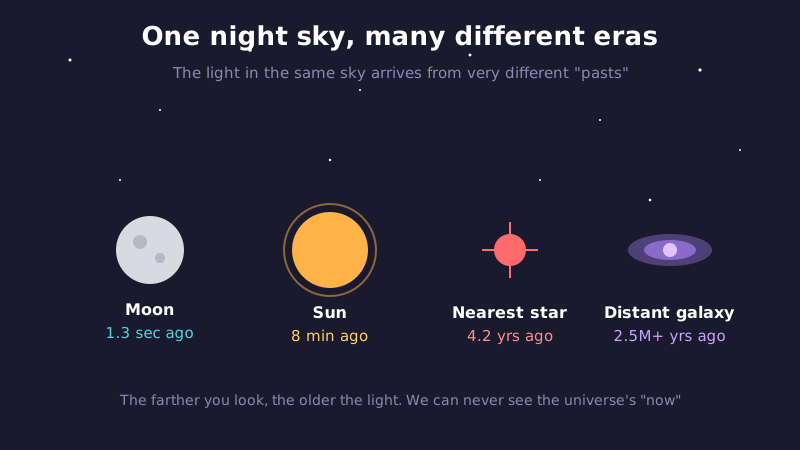
Start with the easiest example: the Moon. Light takes about 1.3 seconds to travel from the Moon to Earth, so when you look up at a full moon, you’re seeing it as it was 1.3 seconds ago. The Sun is a bigger delay — about 8 minutes and 19 seconds for light to cross roughly 150 million kilometers of space.
Sit with that for a second.
Whenever you sense the Sun overhead (without staring directly at it, of course), you’re sensing light that left it eight minutes earlier. If the Sun vanished eight minutes ago, we’d keep going about our day, oblivious, for several more minutes. Even the face across the table from you, or your own reflection in the mirror, is technically a little bit in the past — the delay is just nanoseconds, so small you’d never notice.
So how far does this delay stretch once you look past the Sun, to the very next star over?
Proxima Centauri: the Sun’s closest neighbor
That star is called Proxima Centauri.
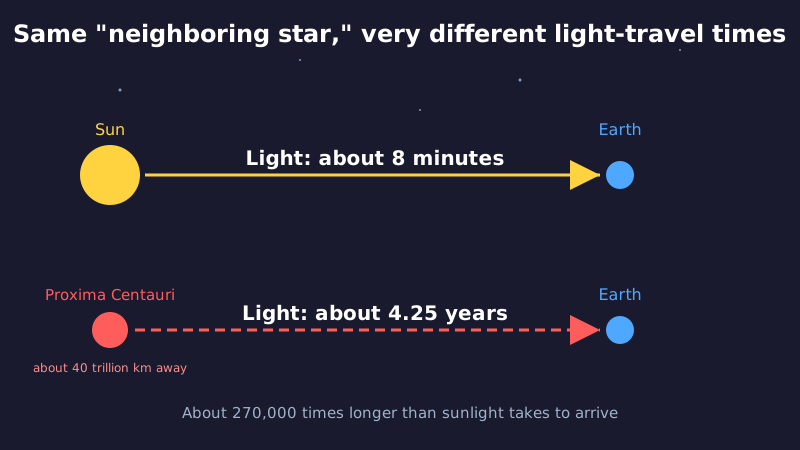
According to NASA, it’s the closest star to our solar system — a red dwarf (a star smaller and dimmer than the Sun) sitting in the direction of the constellation Centaurus, visible from the Southern Hemisphere. Its distance from Earth is just over four light-years, or more precisely, about 4.25 light-years.
A light-year is the distance light covers in a year. So 4.25 light-years means that even light itself needs 4.25 years to make the trip.
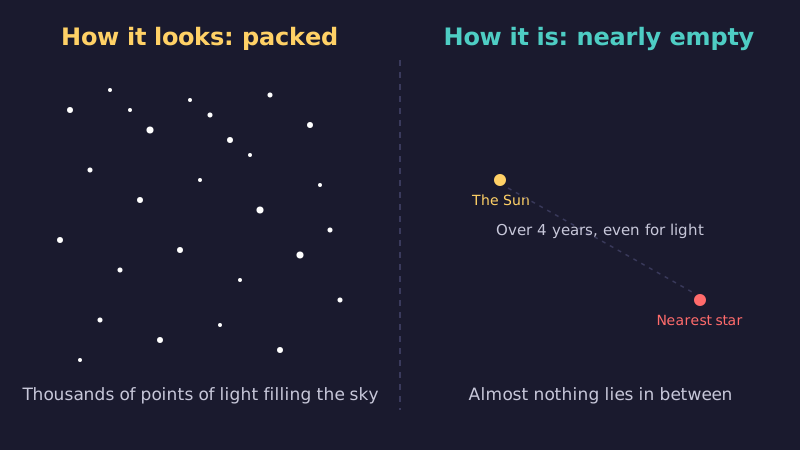
Convert that to kilometers, and you get roughly 40 trillion — a 4 followed by 13 zeros. If the Earth-Sun distance is your yardstick of “1,” Proxima sits about 270,000 of those units away. NASA’s own figure puts it at roughly 268,770 astronomical units (one astronomical unit being the distance from Earth to the Sun).
Honestly, the first time this fact really landed for me, it felt strange. Even the “nearest” star turns out to be an almost incomprehensible distance away — even for light.
So just how far is four light-years, in terms we can actually picture? Let’s measure it with things that move.
Measuring four light-years with everyday vehicles
Forty trillion kilometers is such a huge number that it stops meaning anything. Let’s translate it into speeds we actually understand.
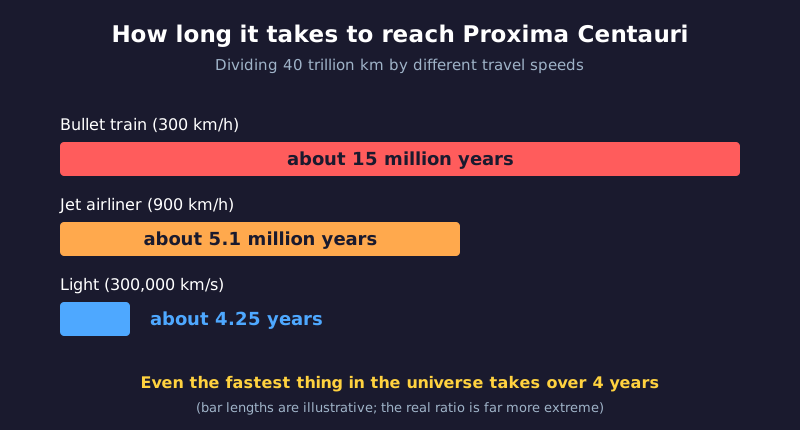
Imagine a bullet train cruising nonstop at 300 km/h. It would reach Proxima Centauri in about 15 million years — a trip that would have had to launch long before humans even existed.
A jet airliner, flying nonstop at 900 km/h, does a little better: about 5.1 million years.
And light, screaming along at 300,000 kilometers every second, covers the distance in 4.25 years. Remember that sunlight takes a mere eight minutes to reach us — so the gap between the Sun’s light and Proxima’s light is roughly 270,000-fold. Same label, “neighboring star,” wildly different travel times.
Here’s where it gets more interesting.
Given how long Proxima’s light takes to arrive, can you actually see the star with your own eyes? The answer surprised me.
And yet, you can’t actually see it
I’ll admit it: for a long time, I assumed the nearest star to us had to be one of the brightest things in the sky.
The opposite turns out to be true.
Proxima Centauri is a red dwarf, far fainter than the Sun. NASA typically shows it off through Hubble Space Telescope imagery, not as something you’d casually spot overhead — it’s simply too dim to pick out with the naked eye, telescope-free, despite being our closest stellar neighbor.
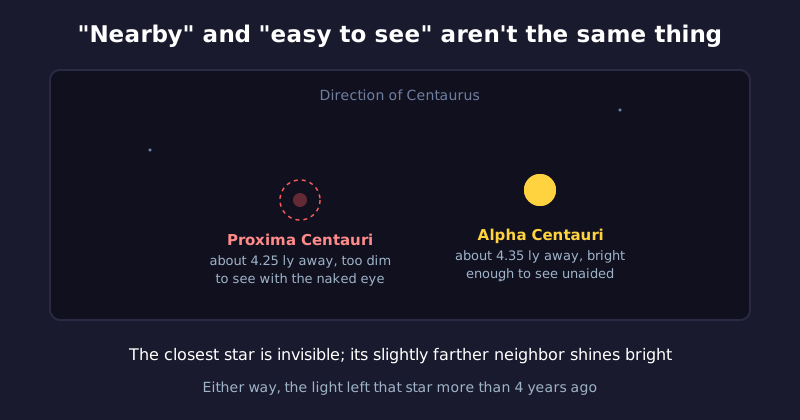
Compare that to Alpha Centauri, sitting just a bit farther out at roughly 4.35 light-years. According to NASA, it’s the closest main-sequence star that’s actually visible without any equipment — a standout, easily spotted point of light from the Southern Hemisphere.
Picture yourself looking toward Centaurus from somewhere south of the equator. Proxima — technically the closer of the two — is out there in that exact direction, yet it never reaches your eyes. What you do see is Alpha Centauri, whose light is also more than four years old by the time it gets to you.
“Closer” and “more visible” simply don’t mean the same thing out there.
So what about the countless other stars scattered across the night sky?
The night sky is really a photo album of the past
This, for me, is the best part of the whole story.
Every star in the sky sits at a wildly different distance from Earth. Some are a handful of light-years away; others are hundreds, or thousands. And because distance determines delay, the light reaching you from each one is frozen at a different moment in its past.
In other words, a single glance at the night sky mixes four-year-old light with light that’s centuries old, and light that’s older still — all arriving together, right now.
Take the Helix Nebula, a NASA-documented object sitting about 650 light-years from Earth. The light you see from it tonight set out roughly 650 years ago. For most of that journey, entire chapters of human history played out on Earth — the light was still traveling through all of it, only just now arriving. And the Helix Nebula itself is thought to be the gaseous shell left behind after a Sun-like star finished its life. So in a very real sense, we’re receiving the dying glow of a star that quietly ended its life centuries before the light finally reached us. What you’re looking at isn’t the nebula “now” — it’s a single frame cut from the deep past.
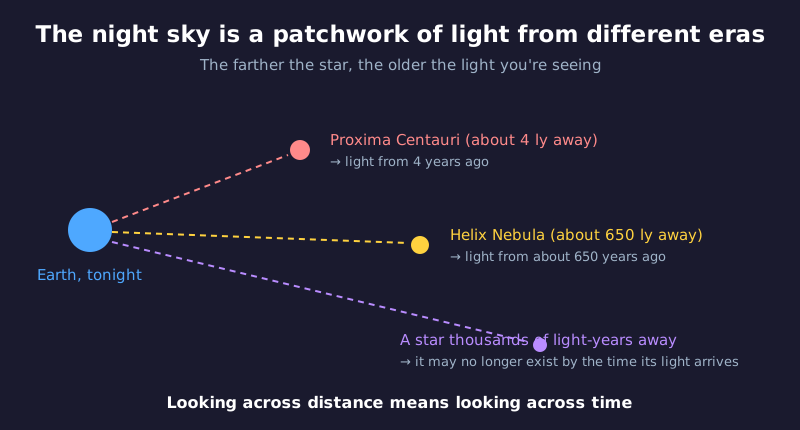
Push the distance out even further, and things get genuinely strange. For a star thousands of light-years away, it’s entirely possible the star itself has already ended its life by the time its light reaches us. Stars many times more massive than the Sun burn especially bright and especially fast, often exhausting their fuel within just a few million years. In some cases, the time it takes for a star’s light to cross space to Earth can outlast the star’s own remaining lifetime. Researchers have pointed out that some of the points of light in our sky might be, in effect, messages from stars that no longer exist. Once you consider that the star behind a given pinprick of light might not even be there anymore, the whole sky looks just a little different.
That shouldn’t be too surprising, really, given the sheer number of stars involved. NASA estimates the Milky Way alone holds more than 100 billion stars, and the observable universe may contain as many as 10 to the 24th power — an almost nonsensical figure. Each one of those stars is delivering its own slice of the past to us, all in this single moment.
The night sky, then, isn’t a snapshot of “now.” It’s a vast album, pages of light from every era pasted together into one frame.
The most familiar time machine, hanging over your head every night
If there’s one takeaway from all this, it’s that looking across distance is the same thing as looking across time.
The farther out you look, the further back in time you’re seeing. That’s why peering at a distant galaxy through a telescope is, in effect, peering into the universe’s past. It’s the entire reason astronomy gets called “the science of looking backward.”
And you don’t need any special equipment to feel this.
Step out onto a balcony tonight, or glance up on your walk home, and the light hitting your eyes left its source years ago — while you were somewhere else entirely, doing something completely different. Even the nearest star took over four years to deliver that light to you. In those years, your life changed, your surroundings changed, maybe even the place you’re standing to look up changed. And still, the light arrives exactly as it was when it departed.
We’ve been carrying a tool for touching the past right above our heads since the day we were born. All you have to do is look up.