Step outside on a clear, dark night, far from city lights, and you run into a strange problem: there are too many stars. You can’t even tell which constellation is which anymore. With the sky packed that tight, it’s natural to assume the universe itself must be pretty crowded.
The truth is almost the opposite. Space between stars is so empty it’s unsettling — so vast that light itself needs years to cross it.
This is a story about that emptiness itself. Not about light arriving late, or seeing the past (that’s a different story). Just: how much nothing is actually out there between one star and the next? And what happens if we shrink that distance down to something we can feel in our bones?
The Sky Looks Packed. Reality Is Nearly Empty.
Let’s start with where that “packed” feeling comes from.
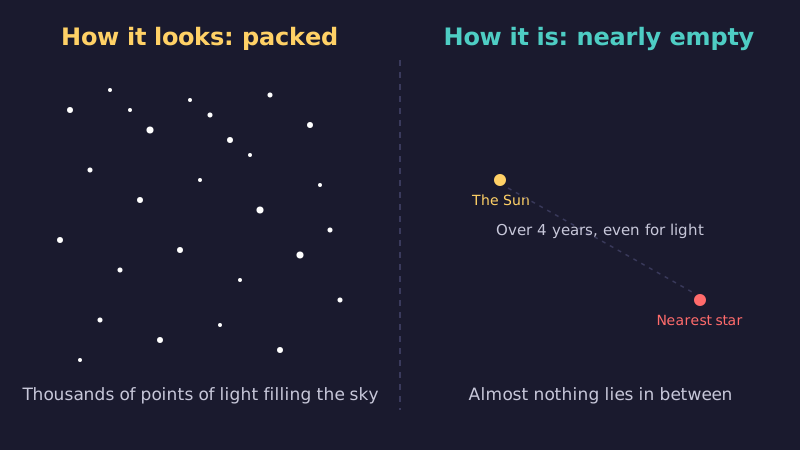
Under good conditions, the naked eye can pick out a few thousand stars at most. They all seem to sit on the inside of one big dome overhead. Near or far, bright or faint, every star reads as the same flat dot pinned to the same patch of sky.
And brightness is a terrible guide to distance. A dim star right next door can easily look fainter than a monster star thousands of light-years away. Just by looking up, you genuinely cannot tell which stars are close and which are impossibly far.
That’s the first trick being played on you: you’re not seeing depth at all.
In reality, one star might be a few light-years away, another a few hundred, a third a few thousand. You’re looking at light scattered across wildly different distances, all flattened onto a single plane. Squash a 3D scene down to 2D, and even something sparse starts to look crowded.
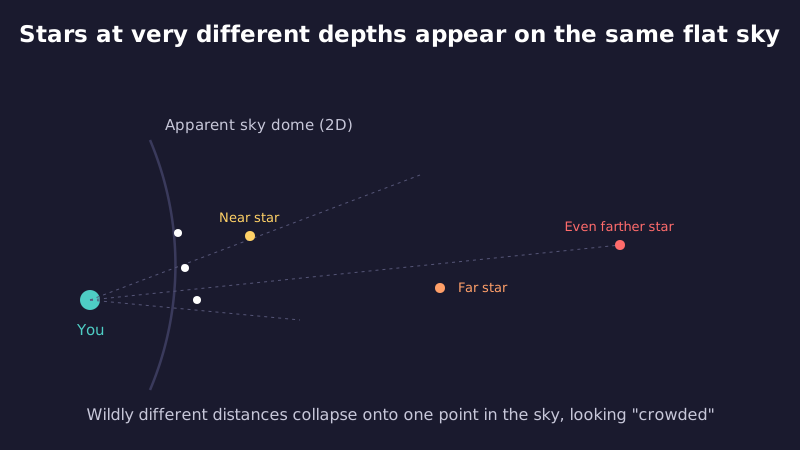
It’s the same illusion as looking out a crowded train window: the nearby utility pole and the distant office tower both just register as “the view.” What things look like and how much space actually separates them are two completely different stories.
So how big is that gap, really?
The Nearest Star Is a Little Over Four Light-Years Away
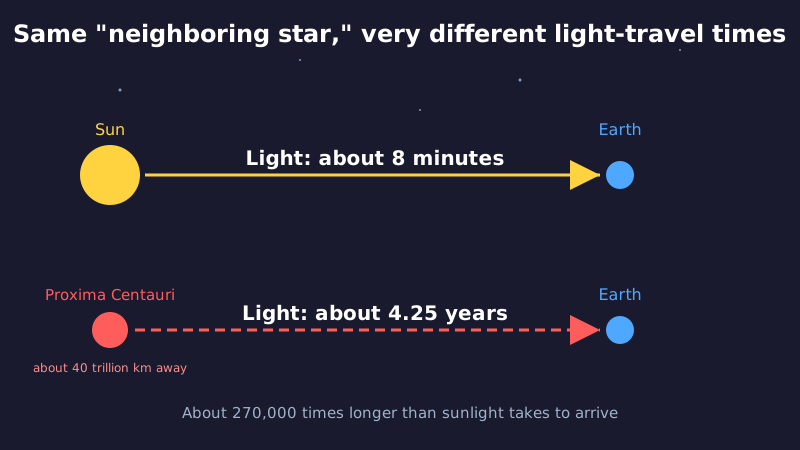
Setting the Sun aside, Earth’s closest stellar neighbor is a star called Proxima Centauri. NASA calls it our nearest stellar neighbor, and puts the distance at a bit over four light-years.
A light-year is the distance light covers in one year. According to NASA, that works out to roughly 9 trillion kilometers.
Nine trillion kilometers doesn’t mean much on its own. You can add that a year is about 31.5 million seconds, or that light circles the Earth seven and a half times every second — none of it really sinks in.
Let’s stack a few more numbers on top. The nearest star sits about 4.3 light-years away. Multiply 4.3 by 9 trillion, and you get roughly 39 trillion kilometers. Earth sits about 150 million kilometers from the Sun, so that nearest star is more than 260,000 times farther than that.
I’ll admit it: for years, I filed numbers like this under “very far away” and left it there, without ever really grasping what they meant. “260,000 times” just bounces off the brain.
And that’s the real problem with cosmic distances — the more digits you add, the less real they feel. So let’s try a different approach entirely.
Shrink the Sun to a Ping-Pong Ball, and the Neighbor Is 1,100 Kilometers Away
Numbers too huge to grasp? Just shrink everything down until they fit in your hand.
The Sun is about 1.4 million kilometers across. Shrink it down to a ping-pong ball — 4 centimeters — and scale everything else by the exact same ratio. Suddenly the emptiness of space becomes something you can feel at human scale.
Start with Earth. In real life it’s about 13,000 kilometers across, but at this scale it shrinks to a grain of sand barely 0.4 millimeters wide. And that grain sits about 4.3 meters from the ping-pong-ball Sun — clear across the room, the kind of speck you’d need to squint to spot. That’s Earth.
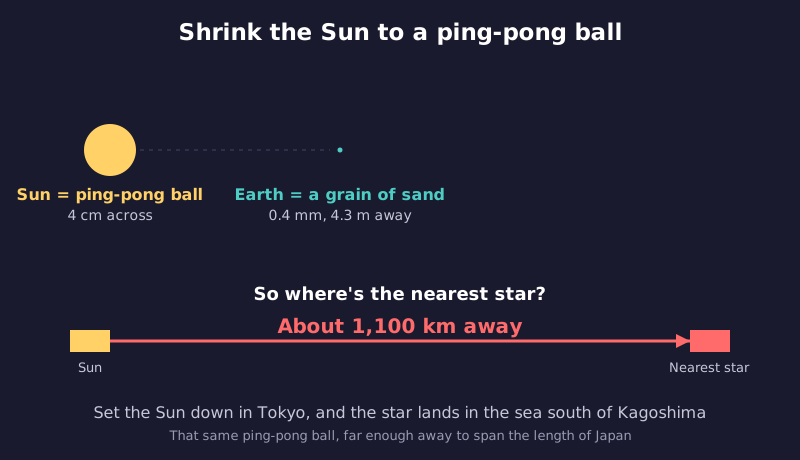
Sit with that for a second. Even Earth is just a grain of sand, one room-width away from its ping-pong-ball Sun.
So where does the nearest star land, at the same scale? About 1,100 kilometers away.
Put that ping-pong-ball Sun on your desk in Tokyo, and the nearest star — still just a ping-pong ball — ends up floating somewhere over the sea south of Kagoshima, far enough to span the entire length of Japan. That’s what “next-door neighbor” means in cosmic terms.
Between the Two Ping-Pong Balls, There’s Almost Nothing at All
Here’s where it gets interesting. Between that ping-pong ball in Tokyo and the one off the coast of Kyushu — across those 1,100 kilometers — what do you think is actually there?
Almost nothing.
The Sun has planets around it, sure, but at this scale they’re just a handful of sand grains scattered near the ball. Even the farthest planet in our solar system fits within about 130 meters of the Sun. The star at the far end has its own scattering of grains, just as close.
The remaining 1,100 kilometers or so? Just empty space, the whole way. Imagine walking from Tokyo to the waters south of Kyushu without passing a single grain of sand — that’s the honest shape of the gap between stars.
To be precise, it’s not a perfect void. Thin gas and dust do drift between stars. But “thin” undersells it — this stuff is emptier than any vacuum chamber ever built on Earth. Anything you could actually touch and feel exists almost entirely near one star or the other.
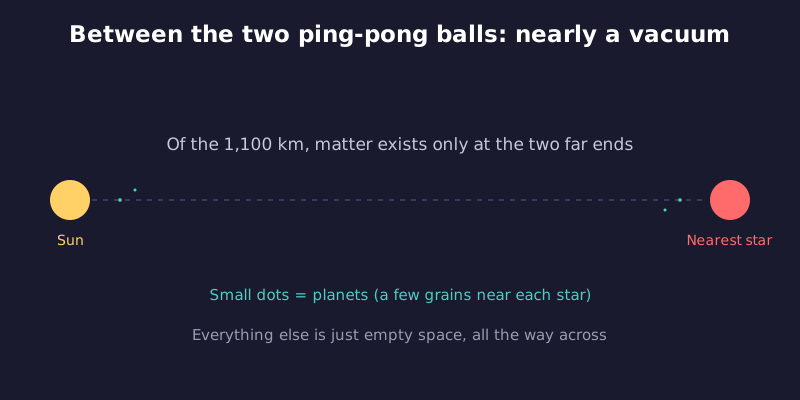
If you somehow stood exactly halfway between those two ping-pong balls, look in any direction and both stars would shrink to pinpricks of light. Within arm’s reach: genuinely nothing. This staggering emptiness isn’t the exception in the universe — it’s the default.
NASA estimates our galaxy alone holds more than 100 billion stars. And yet, with numbers like that, each one still claims this much elbow room. That’s exactly why stars almost never collide.
This Emptiness Is Actually the “Crowded” Part of the Universe
Here’s a twist that flips the whole picture again.
The Sun’s neighborhood is actually one of the livelier, more star-dense patches of the universe as a whole. A density where the nearest star sits 1,100 km away — that counts as “crowded.”
Closer to the galactic center, stars pack in even tighter. But step outside a galaxy entirely, into the space between galaxies, and emptiness jumps to a whole new order of magnitude. In our ping-pong-ball model, the nearest star was 1,100 km away. The nearest galaxy, at that same scale, would be farther than any distance you could measure on Earth — circle the planet once, and you still wouldn’t be close.
Which means our solar system actually floats in one of the more “sociable” corners of the universe. And even here, the nearest neighbor sits a full island-chain away. Emptier neighborhoods than ours make up the vast majority of the cosmos.
NASA suggests the observable universe could contain as many as 1 septillion stars — a 1 followed by 24 zeros. A number large enough to make your head spin. And still, every single one of those stars sits impossibly far from its neighbors.
Think of a map app on your phone. Pinch to zoom out, and the cluster of restaurant pins that looked packed together suddenly scatters across the screen. Stars behave the same way: zoom in and they look dense, zoom out and they thin out. The only difference is that in the universe, “zoomed out” operates on a scale that blows past anything a human mind is built to handle.
Huge numbers and vast emptiness aren’t a contradiction. In fact, you need both at once to get an honest picture of the universe.
What That “Packed” Night Sky Really Is
Back to where we started: that night sky.
Nothing fake about how crowded it looked. Those few thousand points of light are genuinely there. But each one is shining across a gap so enormous that, at ping-pong-ball scale, it would take the length of an entire island chain to close.
(As for why that light takes so long to arrive — and why every star you see is really a glimpse of its past self — that’s a separate story, one we’ve already told in The Nearest Star You See Is Four Years Old. Today’s story was only ever about the emptiness between the stars.)
Next time you look up, remember: that packed, glittering sky is just an illusion of flattening. Between any two points of light, there’s roughly 1,100 kilometers of darkness — no grain of sand, nothing at all, folding over and over into the distance. The universe isn’t really made of stars. It’s made, almost entirely, of the space between them.