Watch any video beamed down from the space station and you’ll notice something off about the astronauts’ faces. Eyelids look swollen, cheeks look fuller, and the whole effect reads like someone who just rolled out of bed.
Nothing is actually wrong with them. If anything, they feel fine. Their faces just puff up anyway.
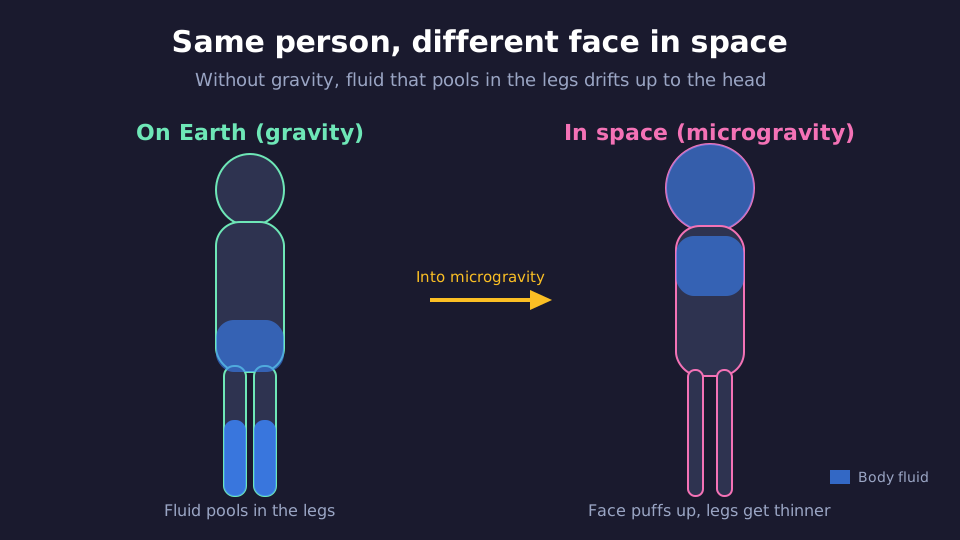
The cause is the absence of gravity. Fluid that would normally settle in the legs has nowhere to go, so it drifts up into the upper body and head. That one small shift turns out to be the starting point for one of the trickiest health problems in human spaceflight.
In orbit, astronauts barely look like themselves
Blood, lymph, and the fluid that fills the gaps between tissues make up roughly 60% of the human body by weight. In space, that fluid rushes upward almost all at once.
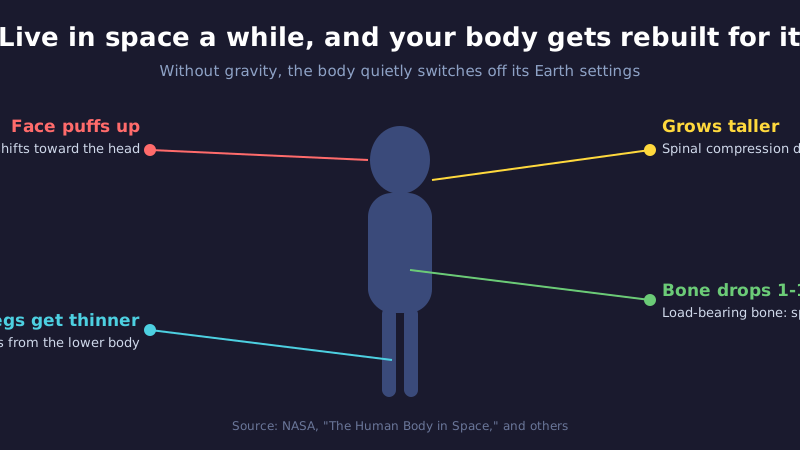
NASA explains that in microgravity, bodily fluids shift toward the head. The face swells, neck veins bulge, and the legs, by contrast, become noticeably thinner. Astronauts have talked about this for decades.
Down here on Earth, we run the opposite process every day. Standing upright pulls blood downward, which is why your feet feel swollen by evening or your shoes feel tighter after a long flight.
In space, that whole system flips upside down. So why does removing gravity alone send fluid upward in the first place?
Gravity is the culprit — fluid that should sit in the legs has nowhere else to go
On the ground, gravity is constantly pulling fluid downward. Left unchecked, blood would simply pool in the legs. So the body works around the clock, using the heart and blood vessels to pump that fluid back up and redistribute it.
That brief head-rush feeling when you stand up too fast is just your circulatory system momentarily failing to keep pace. We rarely notice it, but our entire circulation is built on the assumption that it’s fighting gravity.
In space, there’s nothing left to fight.
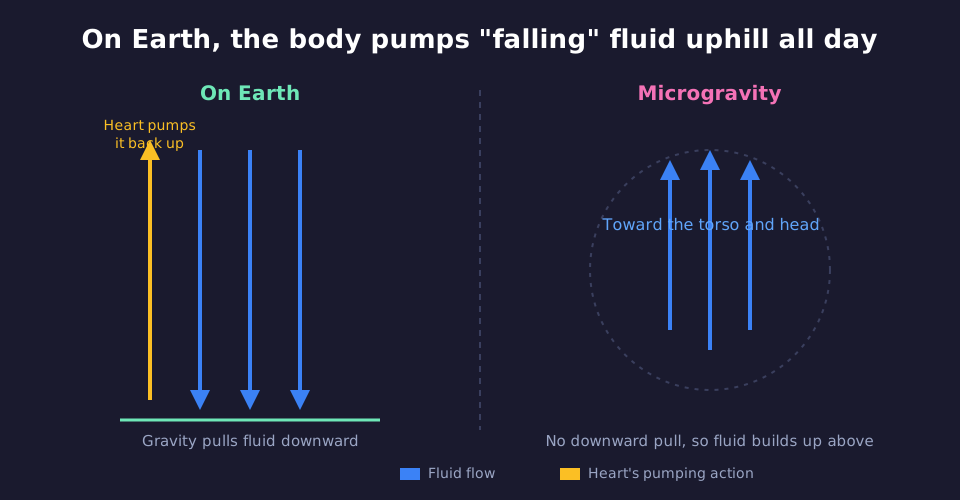
The pumping machinery keeps running exactly as before — it’s only the downward pull that disappears. The result: fluid piles up in the torso and head with nowhere else to go. A puffy face, in other words, is a body built for gravity spinning its wheels without it.
I’ll admit I used to think of this in the vaguest possible terms, something like “space is weightless, so bodies just get a bit floaty and swollen.” It’s actually the opposite: the body’s pumps keep working diligently, and that’s precisely why the fluid they move has nowhere to land except upward.
The body mistakes “too much fluid” for a surplus — and starts dumping water
This is where it gets genuinely interesting.
Once fluid piles up in the chest and head, the body reads that as a signal that it has too much water on board. From the body’s point of view, it looks exactly like what happens after drinking too much fluid.
So it dutifully corrects for it, flushing out what it judges to be the excess as urine. That’s reportedly why astronauts need frequent bathroom trips during their first few days in orbit.
The catch is that this process shrinks the body’s total fluid volume.
By the time the body has adjusted to feeling puffy, there’s actually less fluid circulating than there would be on Earth. Then, back on the ground, gravity returns all at once. Fluid rushes back down into the legs, except now there isn’t enough of it to go around.
That gap — gravity returning before fluid levels catch up — is a big reason astronauts often feel lightheaded right after landing, sometimes needing help just to stand. Even the mild head pressure and stuffy nose they felt in orbit trace back to the same fluid shift. The puffiness comes back to bite them, in reverse, the moment they’re home.
The real trouble is the eyes — nearly 70% of long-duration crew show changes
Facial puffiness and dizziness fade with time. There’s a quieter, more stubborn problem: the eyes.
When fluid pools in the head, that pressure presses on the eyeballs and optic nerves too. NASA notes that this headward fluid shift can squeeze the eyes and lead to vision problems.
The condition even has a name: Spaceflight-Associated Neuro-ocular Syndrome, or SANS — a disorder with no real equivalent on Earth.
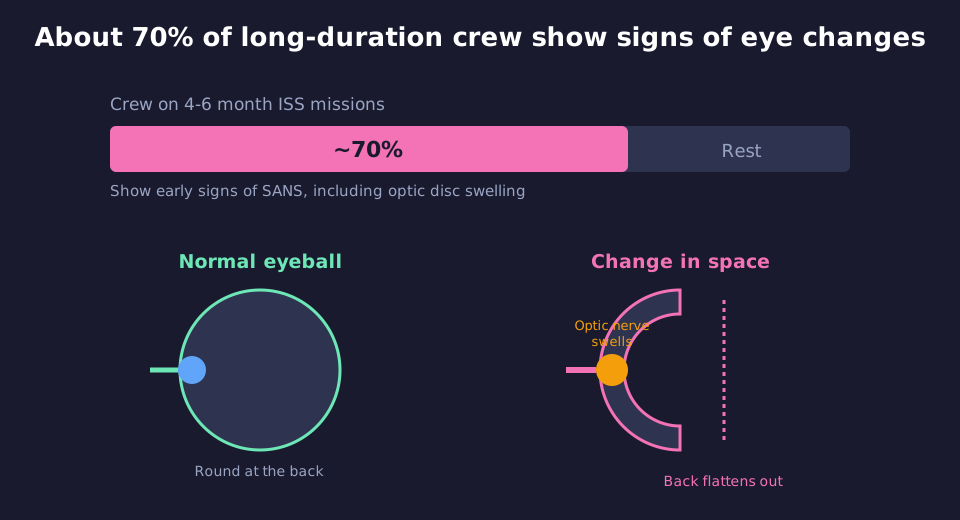
According to NASA research, roughly 70% of crew members on four-to-six-month space station missions show early warning signs such as swelling of the optic disc. Other reported changes include a flattening at the back of the eyeball, wrinkling of the retina, and a shift in vision toward farsightedness.
These signs tend to show up before an astronaut notices any change in how well they see. NASA reports detecting them as increased retinal thickness using optical coherence tomography, or OCT — the same imaging technology used in routine eye exams. A scan not far removed from a standard eye checkup has become the frontline warning system for a very unusual kind of bodily change.
Put a number on it, and that’s 70% of the crew. In a class of 30, that’s 21 people showing some sign of change in their eyes. This isn’t a rare mishap — it’s an ordinary response that shows up in a large share of anyone who spends enough time in orbit.
It’s worth pausing on that for a second. The closest you could come to recreating head-pooled fluid on Earth is lying down with your head tilted slightly below the rest of your body — and staying that way. Imagine spending six straight months in a bed tilted just enough to put your head a little lower than your feet, your eyes under constant, quiet pressure the entire time.
Why does this particular effect get so much attention? Many astronauts do recover after returning home, but it’s still not fully understood how much of the damage to the optic nerve reverses, or how. Researchers list the role of intracranial pressure — pressure inside the skull — as one of the biggest unresolved pieces of the puzzle.
And this problem has direct consequences for a future crewed mission to Mars. NASA classifies the SANS risk as significant enough to require countermeasures on a Mars mission, where the round trip could stretch anywhere from roughly 730 to 1,224 days. Protecting eyesight through more than two years of fluid constantly drifting toward the head is a problem no one can skip if humanity is going further than the Moon.
A vacuum-cleaner-like device that pulls fluid back to the legs
So how do you counter this? The underlying idea is refreshingly simple: recreate something like gravity’s pull inside a weightless environment.
One approach is a compression cuff worn around the thighs, which keeps blood in the lower body and reduces how much fluid migrates toward the head. It works on roughly the same principle as compression socks reducing swelling here on Earth.
The other is a device that encloses the lower body in a cylinder and lowers the air pressure inside it. It’s known as LBNP — lower body negative pressure.
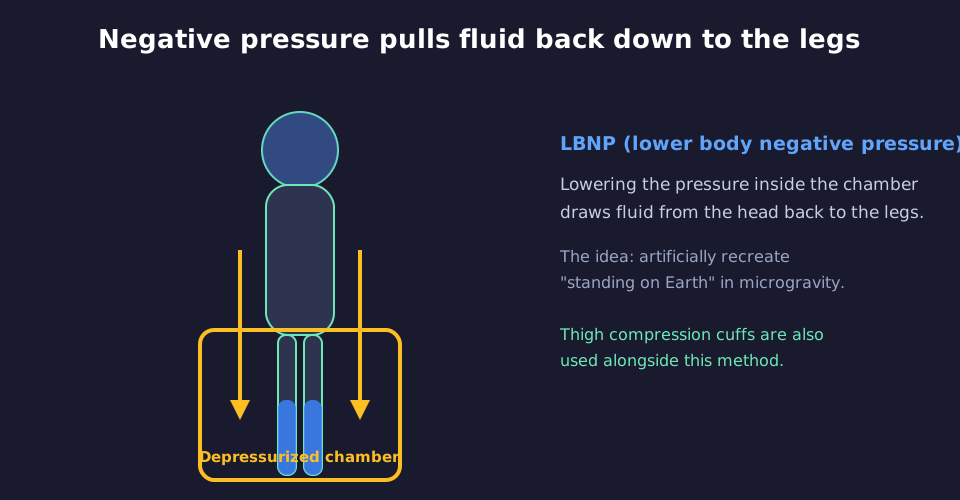
Dropping the pressure inside the cylinder draws fluid down toward the legs. NASA says devices like this can help pull fluid that has accumulated in the head back down to the lower body — essentially manufacturing the sensation of “standing up” inside a weightless environment.
This connects to a related issue: bone and muscle loss follow much the same logic. On long missions, bone density drops by roughly 1 to 1.5% every month, and muscle wastes away faster than it would on Earth, because the body interprets the missing load of gravity as a sign those tissues are no longer needed and lets them go. (We covered that bone-and-muscle remodeling in more detail in a separate article.)
That’s why the ultimate countermeasure under study is artificial gravity generated by rotation. NASA has run long-duration bed-rest studies on the ground, tilting volunteers horizontally for weeks at a time, to test whether centrifuge-generated artificial gravity could counteract the effects of weightlessness. At bottom, the single thing space is missing the most is gravity itself.
Our bodies were built with gravity as a given
An astronaut’s puffy face isn’t just a curious quirk. It’s a mirror reflecting how deeply gravity is wired into human biology.
Distributing fluid up and down, loading weight onto bones, fine-tuning circulation so we don’t faint when we stand — the body on Earth does all of this unconsciously, every single moment, on the assumption that gravity is there. Even NASA’s study comparing identical twin astronauts found that the twin who spent nearly a year in space accumulated changes his Earth-bound brother never experienced.
Some mornings you catch your eyelids looking a little puffy in the mirror. That’s just fluid that drifted toward your head overnight while you were lying down. Get up and start walking, and gravity resets it almost instantly.
Astronauts don’t get that everyday reset for months at a time. Behind a small, familiar phenomenon like a puffy face hangs a much bigger question: how humanity is going to survive, long-term, outside the one planet where our bodies evolved to work.