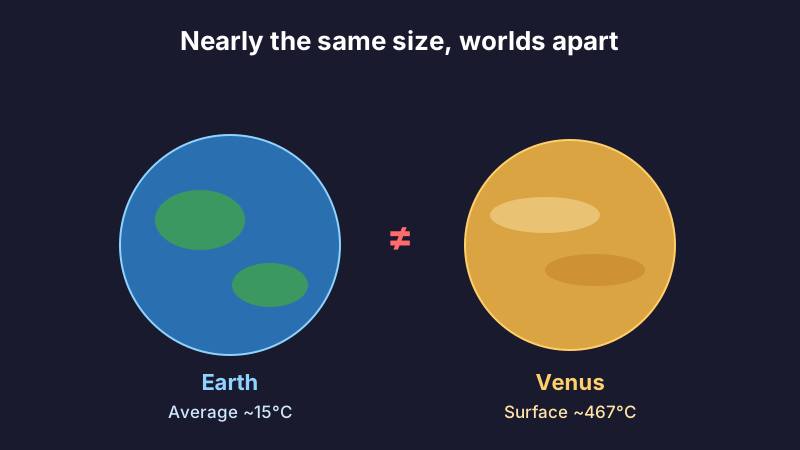
Venus was born almost as Earth’s twin. Similar size, similar mass, built from much the same raw material at roughly the same time. And yet its surface today sits at around 467°C — hot enough to turn lead into a puddle.
Two worlds, formed side by side from nearly identical ingredients. One became a blue ocean planet draped in green. The other became a furnace where lead liquefies. The fork in the road was something you hear about on the news almost every week: the greenhouse effect. Stick with that for a second, because the story gets stranger than it sounds.
Born as Near-Identical Twins
Line up NASA’s numbers and the resemblance between Venus and Earth jumps right out.
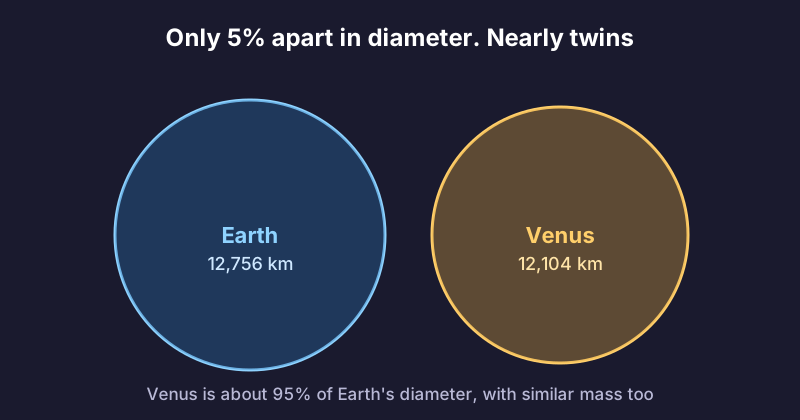
Venus has an equatorial diameter of about 12,104 km. Earth’s is about 12,756 km, which makes Venus roughly 95% of Earth’s size. Their masses are close too, and Venus orbits the Sun just one lane inside Earth’s own orbit. Judged purely on planetary pedigree, these two are practically siblings.
That’s why Venus has long been called Earth’s twin, or sometimes its sister planet. If you’d watched the two of them take shape from a distance, billions of years ago, you probably couldn’t have told which was which. Among all the planets in the solar system, Earth and Venus are an outlier pair — remarkably alike.
And yet the two planets’ present-day faces couldn’t be more different. One has oceans, clouds, and living things. The other has heat that melts lead and clouds made of sulfuric acid.
So what went wrong?
Standing on a Surface That Melts Lead
Picture yourself standing on the surface of Venus for a moment.
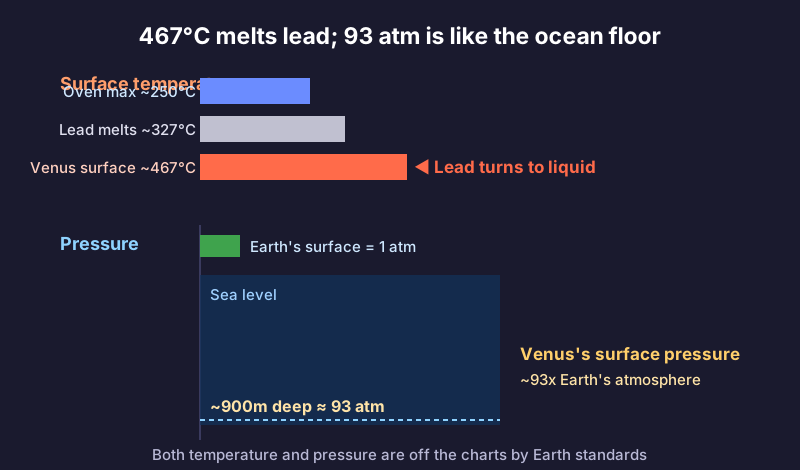
Start with the temperature: about 467°C. Honestly, the first time I saw that number, I assumed someone had misplaced a decimal point. A home oven maxes out around 250°C. Venus runs nearly double that, with the heat radiating straight off bare ground. Lead melts at about 327°C, so if you set a block of it down on Venus, it would puddle like spilled water.
Then there’s the pressure. Surface atmospheric pressure on Venus is about 93 times Earth’s. That’s roughly what you’d feel underwater at a depth of 900 meters — deep enough that even submarines rarely go there. On Venus, you get that crushing pressure just by standing on the ground. Either the heat or the pressure alone would kill a person; Venus serves up both at once.
Look up and there’s no blue sky. Venus’s atmosphere is almost entirely carbon dioxide, topped by a thick, permanent layer of sulfuric acid clouds. It’s a world that’s been heated, crushed, and doused in acid all at once. Sunlight filters through as a dull haze, and the horizon fades into a smudge of orange. There’s no spot on that surface where a person could take a single step.
The obvious question follows: isn’t Venus just hotter because it’s closer to the Sun? It is a little closer, sure. But that explanation falls apart fast.
Proximity to the Sun Doesn’t Add Up
Venus does receive more sunlight than Earth does. But 467°C is far too extreme to chalk up to that extra bit of solar proximity.
What’s more, Venus’s thick cloud deck reflects most of that incoming light back into space — it isn’t even soaking up the sun unapologetically. And yet its surface runs hotter than Mercury’s, the planet actually closest to the Sun. A world one rung farther from the Sun outheating the one right next to it makes no sense if distance is the whole story.
Distance isn’t the culprit. The real suspect is whatever is trapping the heat in the first place.
This next part gets a little technical, but skip it and the rest of the story won’t land, so bear with it for a moment. The key is the blanket of carbon dioxide wrapped around the planet.
The Runaway Greenhouse Effect — a Blanket That Won’t Let Go
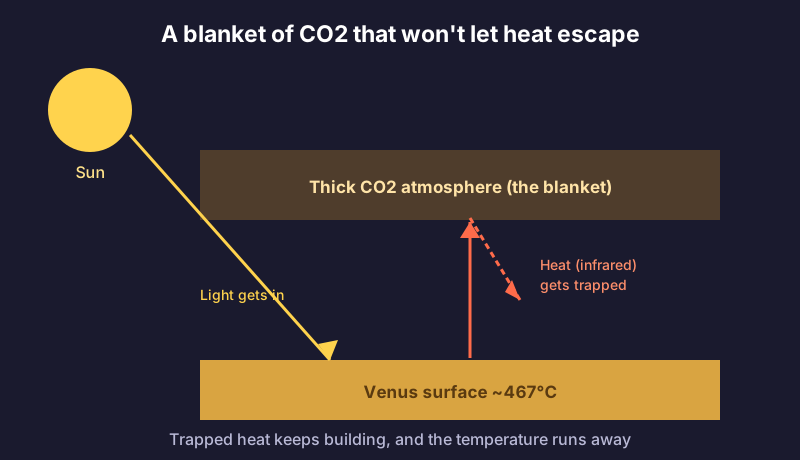
Think of a greenhouse effect the way you’d think of a winter greenhouse made of plastic sheeting: sunlight gets in easily, but the heat inside has trouble getting back out. Planetary atmospheres can do something remarkably similar.
Sunlight — mostly visible light — passes through the atmosphere fairly freely and warms the ground below. That warmed surface then tries to radiate the heat back out to space as infrared light, which is invisible to our eyes. Carbon dioxide, though, absorbs that outgoing infrared and bounces a good deal of it straight back down. The heat can’t escape, so it piles up near the surface instead.
Earth’s atmosphere has carbon dioxide too, and a modest greenhouse effect with it — which, honestly, is a good thing. Without any greenhouse effect at all, Earth’s average temperature would plunge below freezing. The real issue on Venus is one of scale.
Venus’s atmosphere is almost entirely carbon dioxide, piled on at a pressure more than 90 times Earth’s. Wrap a planet in a CO2 blanket that thick, and heat simply has nowhere left to go. NASA has a blunt name for this state: the runaway greenhouse effect.
Heat gets trapped, the temperature climbs, and the warmer surface traps even more heat behind it. That feedback loop runs unchecked until it bottoms out at a hellish 467°C. The same mechanism that gently warms Earth, taken past a tipping point, turns from a blessing into a curse.
Maybe the Fork in the Road Was Water
So why didn’t Earth suffer the same fate? And was Venus always this scorched?
That’s where water enters the story as the real protagonist.
Water vapor, as it happens, is also a potent greenhouse gas. Researchers have sketched out a plausible sequence of events. Sitting slightly closer to the Sun, early Venus may have had an ocean whose water evaporated more readily than Earth’s. More water vapor in the air strengthens the greenhouse effect, which raises the temperature further, which evaporates still more water. Once that feedback loop runs away, the ocean boils dry completely — and a planet with no ocean left has nothing around to soak carbon dioxide back out of its air.
Earth, meanwhile, sat at just the right distance from the Sun. Its oceans never fully evaporated, and all that liquid seawater kept dissolving carbon dioxide out of the atmosphere. As CO2 got locked away in water and rock, Earth never pulled the trigger on runaway warming. In effect, Earth’s ocean worked like a giant piggy bank for carbon dioxide.
That alone would be an interesting footnote. What makes it genuinely gripping is that Venus might not have always been this hellish.
NASA’s DAVINCI mission, now in development, aims to probe how Venus has changed over the past 4.5 billion years — and to ask whether it once held liquid water and the conditions for life, much like Earth. In other words, Venus is unmistakably hell today, but whether it was always that way remains an open question.
The Fate That Befell Earth’s Other Twin
NASA also has a second mission on the books for Venus, called VERITAS. Between these two spacecraft, the agency is making a serious attempt to figure out exactly what happened to Earth’s twin.
Seen from a distance, the Venus story isn’t some oddity happening on a far-off world. The very same mechanism — the greenhouse effect — acts as a life-preserving blanket on one planet and a life-incinerating furnace on the other. The difference wasn’t in the raw ingredients, and it certainly wasn’t cosmic favoritism. It came down to a fairly thin line: how much carbon dioxide piled up, and whether an ocean managed to survive.
Venus also spins remarkably slowly, taking 243 Earth days to complete one rotation. Its year — one full orbit around the Sun — lasts only 225 Earth days, so a single “day” on Venus runs longer than its “year.” Stranger still, it spins backward relative to Earth: if you ever caught a glimpse of the Sun through a gap in those thick clouds, you’d see it rise in the west and set in the east. Pretty much everything about Venus runs opposite to what we’d expect.
You might be looking at that backward little world again tonight. Low in the western sky at dusk, or the eastern sky before dawn, there’s a strikingly bright point of light people call the evening star or the morning star. That’s Venus — and on the ground of that gleaming, serene-looking point of light, lead is melting right now, this very moment.