The culprit is nowhere to be found. The rock that wiped out the dinosaurs 66 million years ago vaporized the instant it hit Earth, leaving no trace of itself behind.
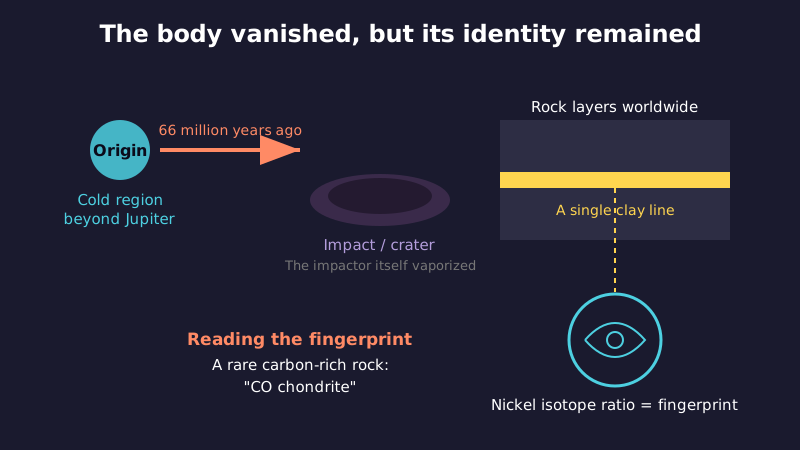
And yet, scientists recently cracked its identity anyway. The only clues: a faint clay line running through rock layers worldwide, and the nickel “fingerprint” hidden inside it. What that fingerprint revealed was a rare kind of rock — one that makes up only a few percent of all meteorites — born in the cold outer reaches beyond Jupiter.
The body disappeared, but its birthplace left a record. Here’s how researchers pieced the story together.
A City-Sized Rock Fell From the Sky 66 Million Years Ago
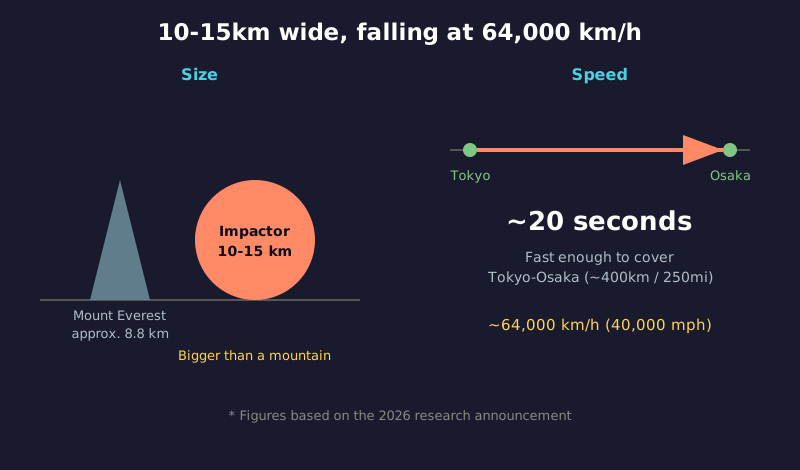
First, what actually hit us? According to the research team’s announcement, the object that struck Earth was a rock 10 to 15 kilometers across, traveling at roughly 64,000 kilometers per hour.
Raw numbers like that don’t mean much on their own, so let’s translate them into something tangible. A rock over 10 km wide is bigger than Mount Everest, which stands about 8.8 km tall. And it slammed into the surface at 64,000 km/h — fast enough to cover the roughly 400 km between Tokyo and Osaka in about 20 seconds.
It came down near what is now Mexico’s Yucatán Peninsula, where the massive Chicxulub crater still lies buried underground. That single impact is thought to have wiped out roughly 75% of all species alive at the time — including every dinosaur that couldn’t fly.
Sixty-six million years is hard to grasp, but here’s some perspective: our own species, Homo sapiens, has existed for only a few hundred thousand years. The dinosaurs vanished an almost unimaginably long time before that. Back then, the mammals that would eventually lead to us were still small, unremarkable creatures scurrying around in the shadows at night.
All of this is well-trodden textbook material. But one question has lingered for decades: what kind of rock was it, exactly?
The Vanished Culprit’s Only Souvenir
Why couldn’t anyone answer that question? Simple — the entire object vaporized.
Slamming into Earth at over 10 km per second, the rock flash-heated into gas on impact, shattering and scattering across the planet. There’s no chunk of it sitting in a lab anywhere waiting to be scanned.
But it didn’t disappear completely empty-handed. The scattered debris drifted down slowly and settled everywhere, etching a razor-thin line into rock layers across the globe — a band of clay marking the boundary.
Truthfully, for a long time nobody suspected that this single thin line could say so much. Geologists had known about it for decades as the marker separating the age of dinosaurs from what came after. In 1980, researchers discovered that this clay layer contained an unusually high concentration of iridium — a metal that’s exceedingly rare in Earth’s crust — and that finding became the smoking gun for the giant-impact theory.
In other words, the impactor destroyed itself but scattered trace metals across the crime scene. The question was whether those traces could reveal where it came from.
Nickel Carries an Accent From Its Birthplace
This is where nickel enters the story. Nickel, it turns out, comes with siblings — isotopes.
Isotopes are versions of the same element that differ slightly in weight. Nickel has both lighter and heavier forms, and the exact ratio in which they mix depends on where in the solar system the material originally formed.
Think of it like a regional accent. Just as people speaking the same language pick up slightly different intonations depending on where they grew up, meteorites carry their own “accent” in the form of nickel isotope ratios — and each type of rock has its own characteristic pattern.
This part gets a little technical, but skip it and the rest won’t land. When the solar system was still young, raw material mixed together in slightly different proportions depending on location. That variation is still preserved today, locked into rocks as isotope ratios. Measure the nickel ratio precisely enough, and you can work backward to figure out which family of rocks it belongs to — like running a recording of the culprit’s voice through accent analysis to narrow down where they grew up.
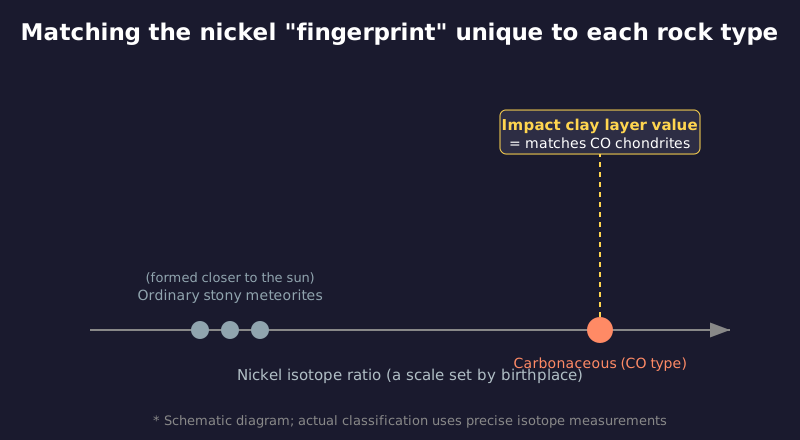
The research team spent years collecting clay-layer samples from around the world and measuring their nickel isotope ratios with extreme precision — then checked which known rock family that “accent” matched.
Geology borrowing the tools of chemistry to trace a vanished culprit by its voiceprint. Personally, this is the part of the story that gives me chills.
The Answer: A Rock That Almost Never Falls to Earth
The match pointed to a type of rock called a CO chondrite — a member of the carbonaceous chondrite family, meteorites known for their high carbon content.
Just how rare is that? According to the team’s announcement, carbonaceous chondrites make up only about 5% of meteorites found on Earth — roughly 1 in 20. CO chondrites are just a sliver of that already small group.
So the culprit turns out to have been a genuinely unusual visitor, a kind of rock that almost never falls to Earth. Most meteorites that do reach us are far more ordinary stony rocks. That the dinosaur-killer belonged to this rare minority rather than the common majority reportedly surprised the research team itself.
A single sample could be written off as a fluke. What makes this finding credible is that the team spent years gathering clay-layer samples from around the world and found the same “accent” everywhere they measured. A single line encircling the entire planet, all telling the same story.
Which raises a natural question: why is this particular rock so rare? The answer lies in where it was born.
Rocks Rich in Carbon and Water Form Far From the Sun
Carbonaceous chondrites live up to their name — they’re loaded with carbon, and they also retain relatively large amounts of water and other volatile compounds. That property is exactly what points to their birthplace.
Close to the sun, it’s hot. Volatile ingredients like water and carbon tend to boil off before they can get locked into rock. Farther out, in the solar system’s colder regions, those same ingredients freeze solid and get trapped inside forming rocks.
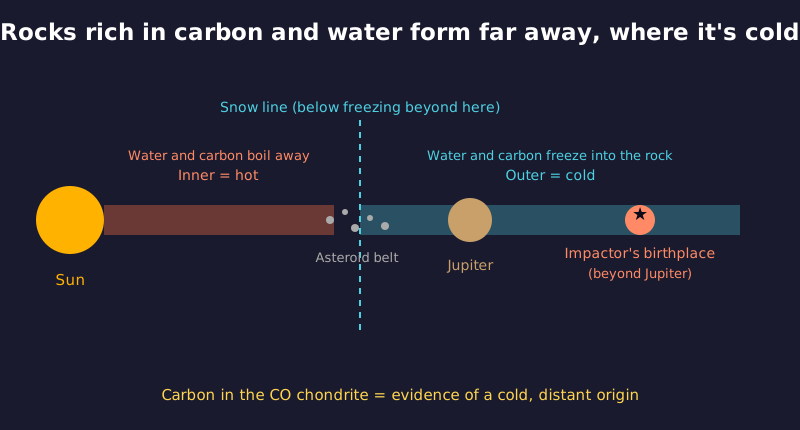
So a rock loaded with carbon and water is essentially proof of a cold, distant birthplace. The research team concludes that this particular CO chondrite formed somewhere far out in the solar system — beyond Jupiter, or perhaps at the outer edge of the asteroid belt.
If you’d been standing on Earth that morning 66 million years ago, looking up, what was bearing down on you wasn’t some familiar object from the solar system’s inner neighborhood. It was a rock that had spent an unfathomable stretch of time drifting through the frozen dark beyond Jupiter’s orbit before finally making the long journey home.
The Culprit’s Birthplace, Written Into the Ground Beneath Our Feet
An impactor that erased itself entirely, identified down to its birthplace using nothing but trace metal residue. This research shows that feat is genuinely possible.
Why does this matter? Knowing what kinds of objects hit Earth, and where they come from, is useful information for thinking about future impact risks. And there’s something else worth sitting with: the object responsible for one of the most consequential events in the history of life on Earth turns out to have been a rare wanderer from the solar system’s distant edge. That’s a quiet but striking reminder that the ground beneath our feet and the far reaches of space are more connected than they seem.
This boundary clay layer isn’t some rare find, either — it’s been located in cliffs and rock exposures all over the world. Sites in Italy and Denmark are especially well known, but the point is that this single line effectively wraps around the entire planet.
Next time you find yourself at a museum or standing before an exposed rock face, and you spot that thin line marking the boundary of the dinosaur age, take a moment to remember what it holds. Tucked into that narrow band of clay is the business card left behind by a visitor from beyond Jupiter — one that vanished in an instant but never quite disappeared.