Just 1.935 grams. Less than the weight of a couple of coins. And yet that pinch of sand carried an unexpected message: the same Moon has two faces, and they’ve soaked up very different amounts of solar wind.
Sand brought back from the Moon’s far side turned out to have solar wind particles lodged deeper than sand from the near side. The culprit, it seems, was Earth itself — sitting hundreds of thousands of kilometers away.
Two hemispheres, two different tans
The sand came home aboard China’s Chang’e-6 spacecraft. In 2024, it became the first mission in human history to collect soil from the Moon’s far side and return it to Earth. The landing site was the South Pole–Aitken Basin, a colossal depression on the far side.
The far side of the Moon never faces Earth, and radio signals can’t reach it directly. That’s made landing there — let alone communicating with a spacecraft on the surface — notoriously difficult. Simply holding far-side sand in your hand and comparing it to near-side sand is, in itself, a milestone.
Researchers at the Chinese Academy of Sciences compared the new far-side samples with near-side sand that Chang’e-5 had returned earlier. What they measured were noble gases — helium, neon, argon, krypton, and xenon — elements that barely react with anything else.
Because noble gases are so chemically inert, once they lodge inside a grain of sand, they tend to stay put rather than get erased by later chemical reactions. That makes them convenient record-keepers, preserving a snapshot of conditions from whenever the solar wind first struck.
And the far-side sand held solar wind particles that had traveled deeper and arrived with more energy. The pattern was unmistakably different from the near-side samples. The team published its findings in the journal Nature Geoscience in July 2026.
Think of it like sunburn. The far side had baked more deeply than the near side. Same Moon, presumably the same amount of time in the sun — so why the difference?
What the solar wind actually is
Before going further, it helps to know what the solar wind actually is. Despite the name, it has nothing to do with air.
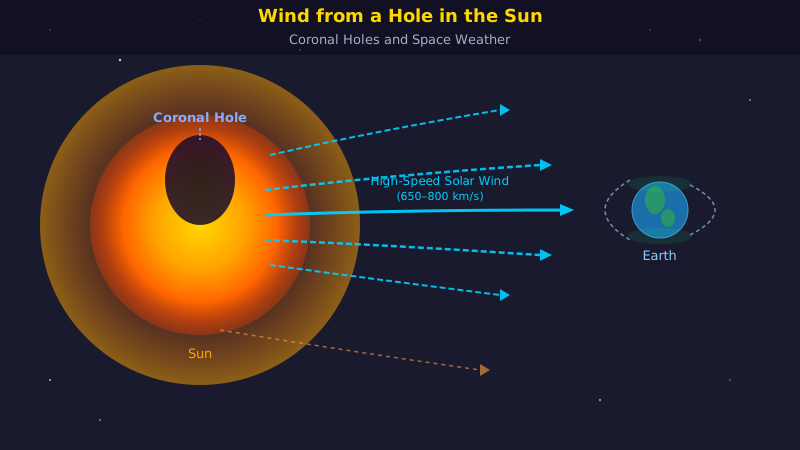
The solar wind is a continuous stream of charged particles blasting out from the Sun — mostly protons and electrons, far too small to see, hurtling through space at extraordinary speed.
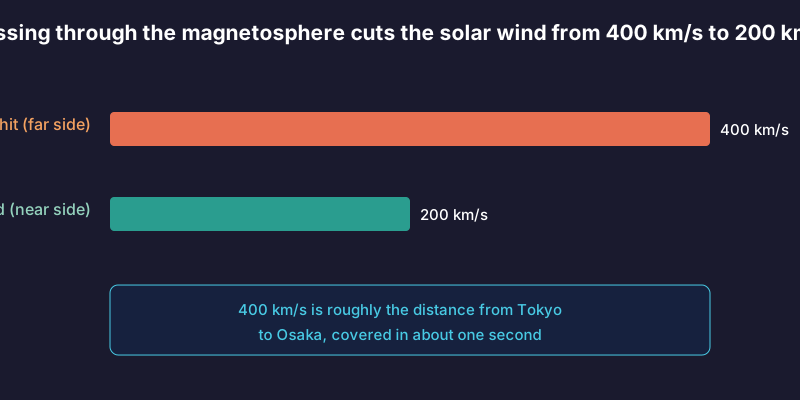
And extraordinary is the word. The solar wind typically travels at around 400 kilometers per second. To put that in perspective: at that speed, you could cross the distance from Tokyo to Osaka in about one second.
Over billions of years, this wind gradually wears down any surface exposed to open space, etching particles into it bit by bit. Earth’s thick atmosphere absorbs most of it before it reaches the ground, but the Moon has essentially no air at all. Its bare sand has been standing in that wind since not long after the Sun itself formed. Given that, you’d expect both hemispheres to have tanned equally.
The solar wind isn’t entirely disconnected from daily life on Earth, either. The auroras you see near the poles happen when solar wind particles slam into our atmosphere and glow. Strong solar wind can also scramble GPS signals and communications satellites. The reason most of us never think about any of this is that something is quietly protecting us.
Earth’s magnetic field turned out to be a windbreak
Here’s where it gets interesting. The Moon’s near side had a powerful bodyguard the whole time: Earth.
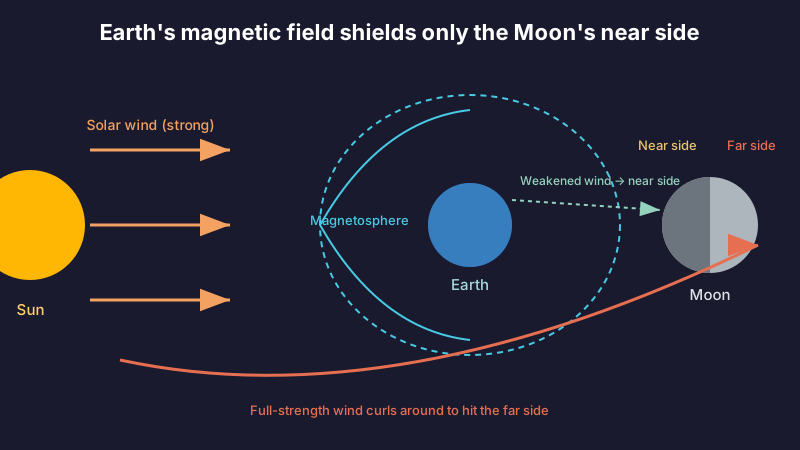
Earth behaves like a giant magnet, wrapped in an invisible shield of magnetic field lines called the magnetosphere. It’s the same shield that protects daily life on Earth from the solar wind. When the solar wind slams into that barrier, it loses momentum and slows down.
According to the research team, the solar wind decelerates substantially as it crosses the magnetosphere — dropping from around 400 kilometers per second to roughly 200. Inside that barrier lies a kind of wind shadow, a zone where the gusts have already been tamed.
Here’s the detail worth pausing on: the Moon always shows the same face to Earth. Its near side permanently faces us. Its far side permanently faces away.
That means the near side, tucked close to Earth, mostly receives a “breeze” that’s already been softened by the magnetosphere. The far side, turned away from Earth, takes the full, unweakened headwind directly. Whether you’re standing in Earth’s windbreak or not turns out to determine how hard the wind hits you.
Picture one arm with sunscreen and one without, both under the same sun. They tan completely differently. Earth’s magnetic field, in effect, had been applying sunscreen to just one side of the Moon.
Why the sand remembers the wind
Still, a question lingers: where exactly, in a grain of sand, does a record of ancient solar wind get stored?
The key is those noble gases again. When a solar wind particle slams into a grain of sand at high speed, it embeds itself inside the grain and stays there. The stronger and more energetic the wind, the deeper the particle burrows.
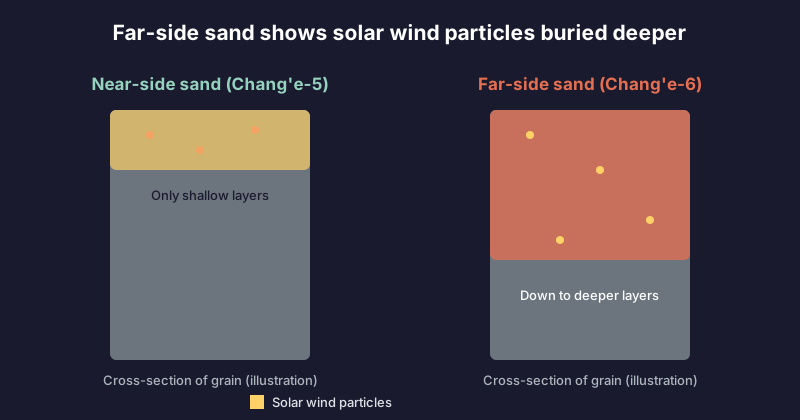
Researchers focus on noble gases precisely because how deep they end up tracks so cleanly with how strong the wind was. Heavier particles need a faster, more energetic wind to punch in deep. So scientists shave a grain down in thin layers, measuring the noble gas content at each depth. The result reads almost like tree rings — a layer-by-layer record of how much wind reached how far.
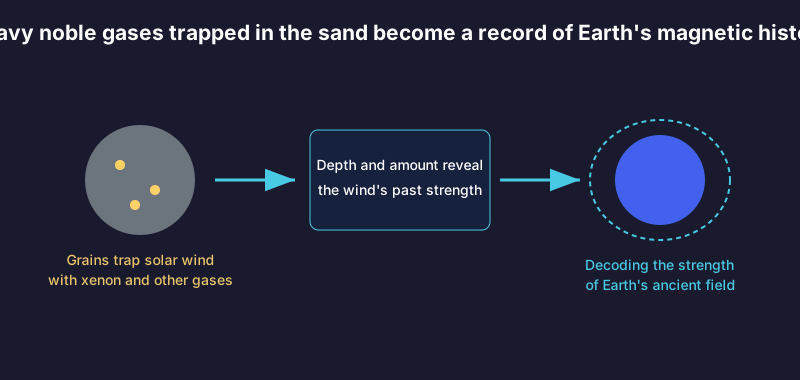
That’s why they pay special attention to a heavy noble gas like xenon: how deep it penetrated, and how much of it made it there, lets researchers work backward to reconstruct the wind conditions the grain once endured. The fact that particles reached deeper into the far-side sand is direct evidence of a stronger, more persistent wind.
I’ll admit it — for a long time, I dismissed this kind of analysis as tedious work, just “measuring old air.” In reality, each grain is a miniature time capsule holding billions of years of wind data.
A fossil record of Earth’s magnetic field, written in sand
And this discovery has an even bigger payoff. Lunar sand, it turns out, can tell us about Earth’s own past.
Earth’s magnetic field is what weakened the solar wind in the first place. Flip that around, and the intensity of solar wind traces preserved in lunar sand becomes a proxy for how strong Earth’s magnetic field was at any given time. The research team believes heavy noble gases trapped in lunar soil could serve as a “fossil record” of the ongoing exchange between Earth’s magnetic field and the solar wind.
Earth’s magnetic field is known to have strengthened and weakened over different periods in its history. It’s the reason a compass needle points north, and the reason living things are shielded from harmful cosmic radiation. Understanding how that field has fluctuated over time matters a great deal for reconstructing Earth’s broader history.
The trouble is, reconstructing that history from Earth’s own rocks alone is difficult. The older a rock is, the more likely later heat and pressure have overwritten its original record. Bringing in lunar sand as an outside witness offers a way to cross-check the story from a completely different angle.
Lunar sand may even preserve conditions from its era better than terrestrial rock does. With no atmosphere or water on the Moon, once a record gets etched into a grain, there’s no rain or wind to wash it away. Wind strengths from billions of years ago could be sitting nearly untouched inside these grains, waiting to be read.
It’s a strange thought: Earth’s own biography turns out to be buried in lunar soil, 380,000 kilometers away. And the clearest clues were hiding in the sand on the side that has spent its entire existence turned away from us.
A distant Earth, quietly standing guard
Picture standing on the Moon’s far side. Look up, and Earth never rises — not once, not ever. All you’d see is the Sun and a relentless headwind. Turn around, and there’s no blue Earth peeking over the horizon. And yet that invisible planet’s magnetic field had been quietly shielding the hemisphere right next door the entire time.
Two faces of the same Moon, separated by just a few thousand kilometers, have spent billions of years absorbing different amounts of wind and writing different histories. What separated them was a planet, far away and completely out of sight.
Next time you look up at a full Moon, remember this: the round, glowing face turned toward you has spent its whole existence in Earth’s shelter, on the leeward side of the wind.