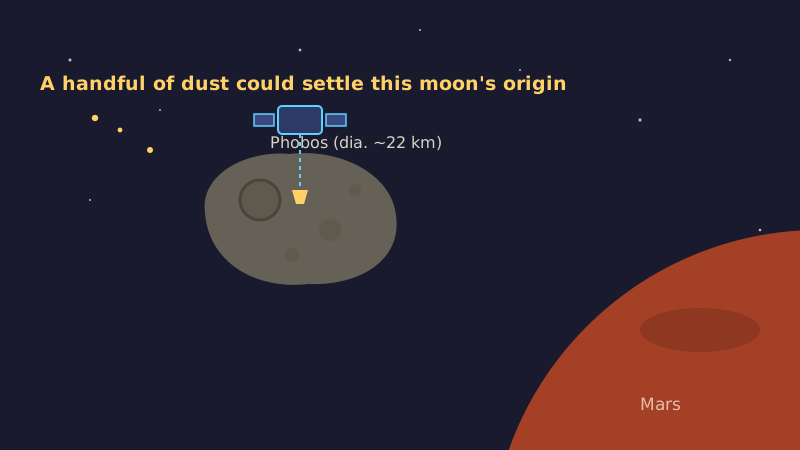
Sometime in fiscal year 2026, a spacecraft will touch down on a moon of Mars and try to scoop up nothing more than a handful of dust.
That small amount of soil could settle a decades-old argument about where this moon came from. And if things go well, the mission might also bring back a piece of Mars itself, without ever landing on the planet.
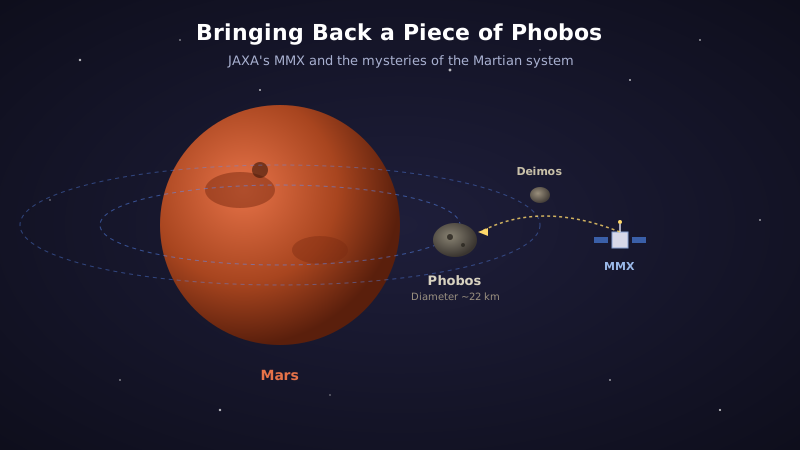
The mission is called MMX, short for Martian Moons eXploration, and it’s JAXA’s bid to finally crack the mystery of Phobos.
Mars Has Two Moons, and One Sits Uncomfortably Close
Mars has two moons: the larger one, Phobos, and the smaller one, Deimos. “Larger” is relative, though — Phobos averages just 22 kilometers across, roughly half the length of a marathon course, and it’s shaped like a lumpy potato rather than a sphere. Deimos is even tinier, at just over 10 kilometers wide. Neither looks anything like Earth’s smooth, round Moon.
What’s genuinely strange is where Phobos orbits. It circles Mars at an altitude of only about 6,000 kilometers — a dizzyingly low orbit. Compare that to the roughly 380,000 kilometers between Earth and our Moon, and Phobos is orbiting at less than a sixtieth of that distance.
It took a while for that scale to really sink in.
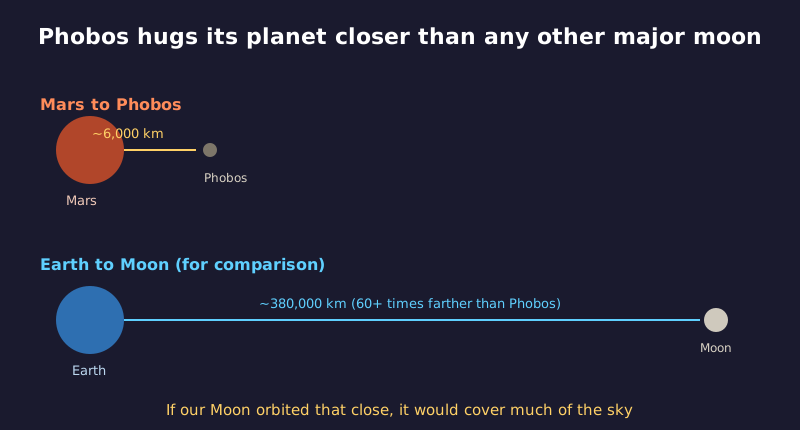
Being that close means orbiting fast. Phobos circles Mars once every 7 hours and 39 minutes — faster than Mars itself rotates. That means Phobos actually rises in the west and sets in the east, the opposite of Earth’s Moon, crossing the Martian sky more than twice a day.
Now imagine standing on its surface. Gravity there is roughly 2,000 times weaker than on Earth. Throw a baseball hard enough, and you could send it clean off Phobos and out into space.
So how did a moon this small, this oddly close, this lopsided, ever form?
Captured Asteroid, or Piece of Mars?
Two competing answers have been slugging it out for years.
The first is the “captured asteroid” theory. Phobos has a dark, reddish surface, and the way it reflects light closely matches asteroids from the outer solar system. The idea is that Phobos started out as a wandering asteroid that happened to drift too close to Mars and got snared by its gravity.
There’s a problem, though. Phobos travels in a nearly perfect circular orbit that hugs the Martian equator. A body captured on a chance flyby should end up in a much messier, more eccentric orbit. This one looks too clean for that story.
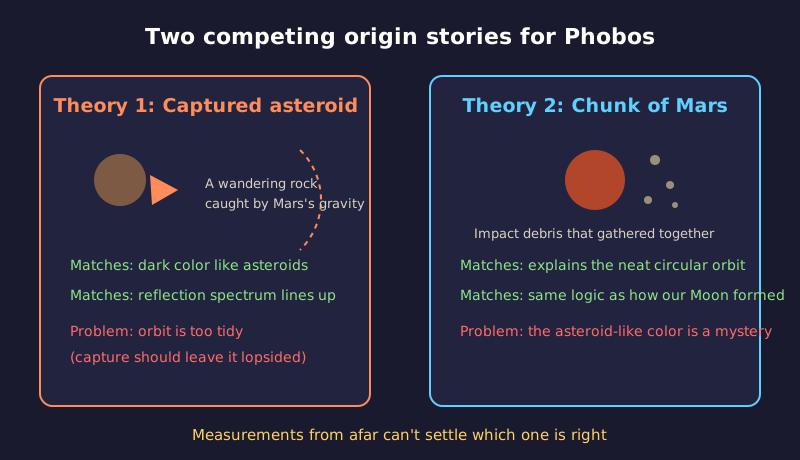
The second theory says Phobos is a “chunk of Mars.” Long ago, something massive slammed into the planet, and the debris that flew off eventually clumped together into a moon — essentially the same process thought to have formed Earth’s Moon. That story explains the tidy circular orbit beautifully.
But now the color becomes the sticking point. Debris blasted off Mars should look more like Mars, yet Phobos looks like an asteroid instead.
Each theory nails one piece of evidence and stumbles on the other. Measuring color and orbit from a distance just isn’t enough to break the tie.
The Answer Is to Bring the Soil Home
No telescope or flyby camera is going to settle this fight. Surfaces exposed to space for eons darken and redden through a process called space weathering, which means color alone is a shaky way to guess where something came from. The better approach: bring the actual dirt back to Earth and put it through rigorous lab analysis. That’s the whole premise behind MMX.
The spacecraft will first settle into a “quasi-satellite orbit” around Phobos, essentially flying in formation with the moon. From there it will study both Phobos and Deimos, land on Phobos to collect surface material, and carry that sample back to Earth. According to JAXA, this would mark the first time anything has been retrieved from a body in the Mars system.
So why does soil settle the question when nothing else can?
The key is isotope ratios — isotopes being versions of the same element that differ only in atomic weight. The proportions of these isotopes shift subtly depending on where a material originally formed, acting almost like a fingerprint for its birthplace. Measure the sample precisely enough, and you can trace where Phobos’s building blocks came from. Space weathering can disguise a surface’s color, but it can’t touch what’s inside the atoms. The dirt doesn’t lie.
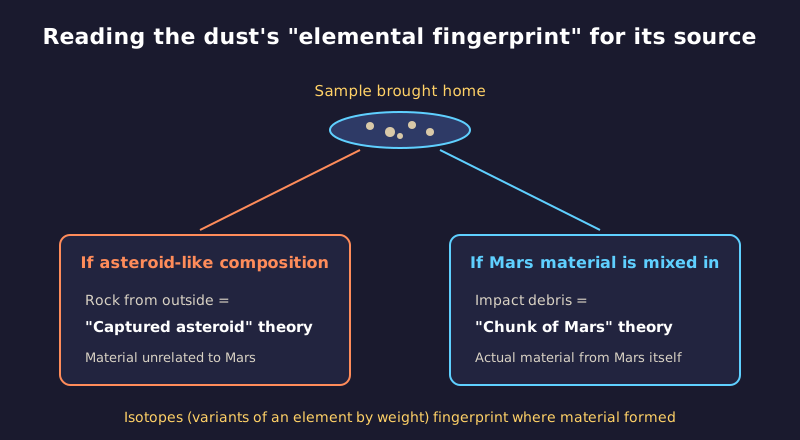
If the sample turns out to have an asteroid-like composition, that tips the scales toward the capture theory — Phobos really is a rock from somewhere else. If Martian material shows up mixed in, that favors the impact theory — Phobos really is debris from a long-ago collision. The research team believes this single handful of dust can finally close out a debate that has run for decades.
This wouldn’t be Japan’s first time bringing asteroid material home, either. Many people will remember Hayabusa2 delivering its capsule of samples from the asteroid Ryugu. MMX builds directly on that legacy.
Landing on a Rock With Almost No Gravity
Even so, none of this is easy.
As mentioned, Phobos’s gravity is roughly 2,000 times weaker than Earth’s. “Landing” isn’t quite the right word — it’s closer to gently setting something down. Touch the surface with any real force, and the spacecraft could simply bounce back off into space. There’s almost nothing for it to grip.
MMX is designed around this near-weightless environment, flying alongside Phobos and descending with extreme care. The plan is to touch down softly, scoop up surface material, and lift away again just as gently. A few seconds of work will decide whether the whole mission succeeds. Before the main landing, the team also plans to deploy a small rover named IDEFIX to the surface first. Built by Germany’s DLR and France’s CNES, its job is to check the ground’s firmness and texture before anything heavier arrives.
I’ll admit I once assumed Phobos was just a stopover on the way to somewhere more interesting. In reality, this is a genuinely international effort, with agencies including NASA, CNES, and DLR all contributing. Nobody puts this much engineering into a small rock unless they’re convinced it’s worth the trouble.
So is settling the origin question the only payoff here?
There Might Be a Bonus: Actual Pieces of Mars
Here’s the part I personally find the most exciting.
Remember that Phobos orbits just 6,000 kilometers above the Martian surface. That means whenever a meteorite strikes Mars and kicks debris into space, some of it could plausibly rain down onto Phobos over time. Researchers have raised the possibility that Phobos’s soil contains actual material from Mars itself, mixed in with everything else.
If that turns out to be true, this story gets even better.
Landing directly on Mars and returning a sample from there would take enormous cost and engineering effort. But simply scooping up dust from Phobos might hand scientists fragments that were blasted off the Martian surface — for free, essentially. And those fragments could be capsules of ancient Mars, preserving a record of what the planet looked like long ago. That, in turn, might offer clues about whether Mars ever hosted the right conditions for life.
The dust of one small moon could end up telling two stories at once: its own origin, and the deep past of the planet next door.
Reading a Falling Moon While There’s Still Time
There’s one more reason to hurry.
Because Phobos orbits so close, the tidal forces between it and Mars are slowly dragging it inward — just a few centimeters a year, but relentlessly, year after year. Researchers expect that far in the future, Phobos will either break apart into a ring around Mars or plunge into the planet altogether.
That’s tens of millions of years away, so there’s no need to panic. But it’s worth remembering: Phobos isn’t a permanent fixture. It’s a rock already on its way down.
Look up on a clear night, and Mars is visible to the naked eye as a small red point of light. Right beside it, an oddly shaped rock about half a marathon’s length across circles around and around, several times a day. Sometime in fiscal year 2026, a spacecraft will land there and scoop up a handful of dust, which will eventually make its way to a laboratory on Earth. Soon enough, we’ll finally know what story that dust has to tell.