Flick a lighter. Turn on a gas stove. Touch a match to a candle wick. Every flame you’ve ever seen points the same way: up, tapering to a point, like a teardrop turned on its head.
It’s easy to assume that shape is just what fire looks like.
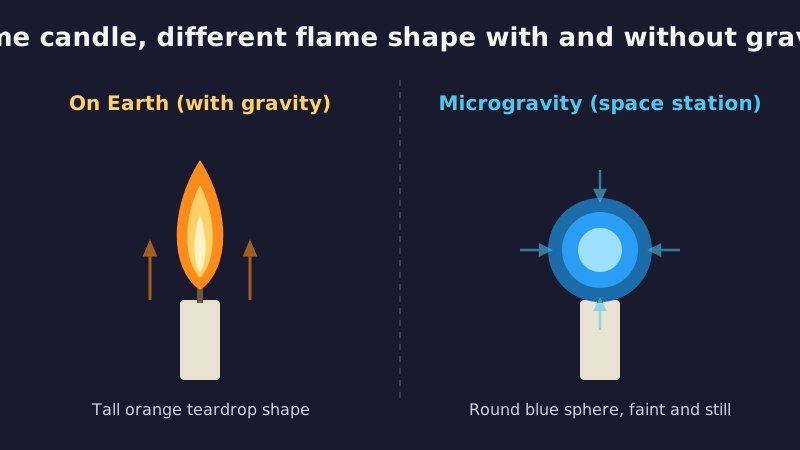
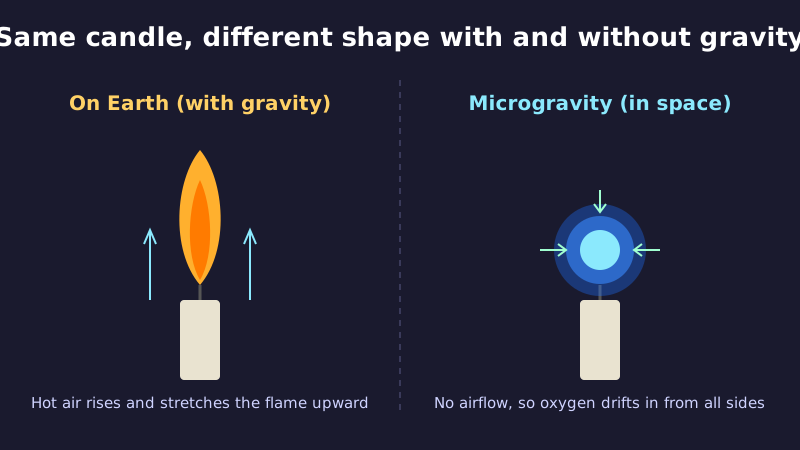
It isn’t. That teardrop is gravity’s doing, not fire’s. Take gravity away, and the very same flame rounds itself into a small blue sphere.
The flame doesn’t point up. The air around it does.
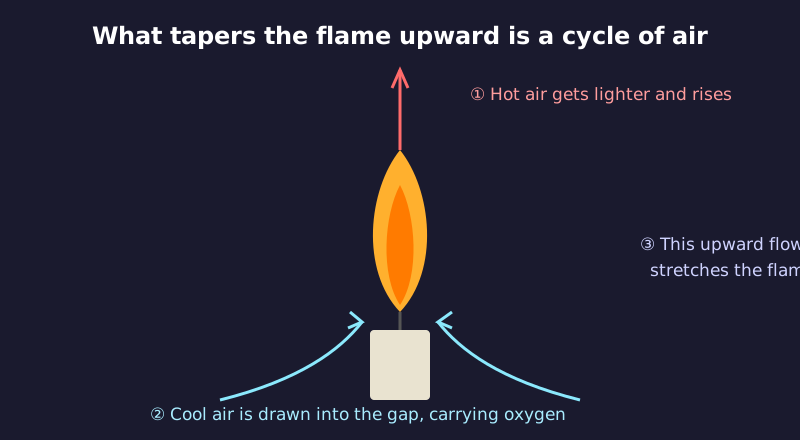
So why does a flame taper upward in the first place? The culprit isn’t the fire. It’s the air around it.
Air heated by the flame expands, gets lighter, and rises. As it rises, cooler, denser air gets pulled in from below to take its place, carrying fresh oxygen that keeps the fire fed. Hot air up, cool air in. The cycle runs on a loop, with no pauses.
NASA describes it this way too: gravity pulls cool, dense air down toward the base of the flame, and that inflow is what gives fire its familiar shape and its flicker. In other words, the shape of a flame is just a trace of the air currents moving around it, an updraft wearing a costume. The flickering happens because the incoming air is never perfectly steady, it’s turbulent by nature.
I’ll admit I misunderstood this for a long time. I used to picture the flame reaching upward on its own, as if it wanted to. It doesn’t. The air above it is leaving, and the flame gets stretched along with it. A flame, it turns out, is just along for the ride.
So what happens to a flame when there’s no up or down to stretch it toward?
Without gravity, fire turns into a silent blue sphere
This is where the International Space Station comes in.
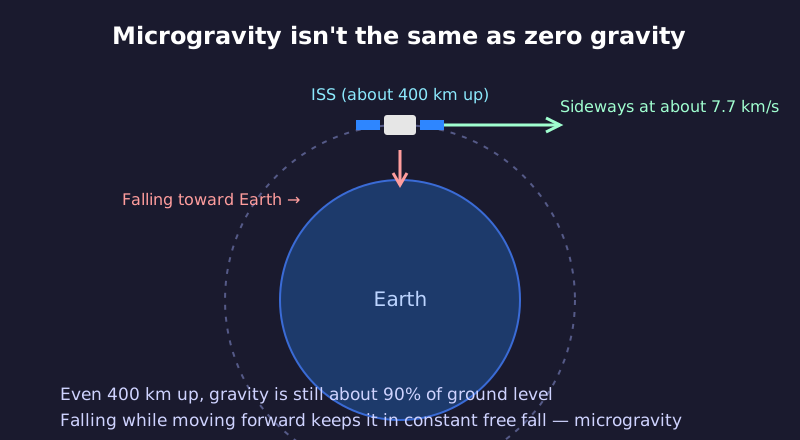
First, a common misconception worth clearing up: “microgravity” doesn’t mean zero gravity. The ISS orbits roughly 400 kilometers up, and at that altitude Earth’s gravity is still about 90 percent as strong as it is on the ground.
So why does everything float inside? Because the station is moving at about 7.7 kilometers per second, fast enough that it’s continuously falling toward Earth and continuously missing it. It falls forward instead of down, curving along with the planet’s surface, so it never actually hits the ground. Everyone and everything inside, including the air and any flame, falls together. And when everything falls at the same rate, nothing feels like it weighs anything.
That number didn’t mean much to me the first time I read it. 7.7 kilometers per second works out to roughly 28,000 km/h, fast enough to cover the distance from Tokyo to Osaka in well under a minute, and the station is doing that, continuously, in freefall.
Inside that falling room, air has nowhere to rise to. There’s no up, so there’s no updraft. Oxygen just seeps toward the flame slowly from every direction at once.
Without a direction to stretch toward, the flame loses its reason to lean anywhere. Every side faces the same conditions, so it settles into a sphere. NASA notes that weak flames in microgravity do round out, sometimes into near-perfect spheres. With nothing to disturb it, the flicker disappears too.
The color changes for a reason as well. The yellow-orange glow of an ordinary flame comes from tiny soot particles, created when the fire doesn’t get quite enough oxygen, glowing white-hot. In microgravity, with no air currents stirring things up, combustion proceeds more slowly and more completely, and barely any soot forms. Once the yellow glow is gone, what’s left is the flame’s true color: blue, the color of combustion itself. You could say the yellow of an ordinary flame on Earth is really the glow of unburned leftovers.
Picture lighting a candle aboard the ISS. The flame wouldn’t take a teardrop shape, and it wouldn’t flicker. A blue sphere about the size of a thumbnail would hover silently above the wick. It would look like a completely different kind of fire from anything you’ve seen on the ground, hundreds of times over. Wave a lit match near it, and the flame wouldn’t lean away. It would just swell, gently, into a slightly bigger sphere.
The fire that looks out, but keeps burning where you can’t see it
Here’s where it gets strange.
During NASA’s FLEX experiment, which burned droplets of fuel aboard the station, researchers noticed something odd. After the visible flame disappeared, something kept burning.
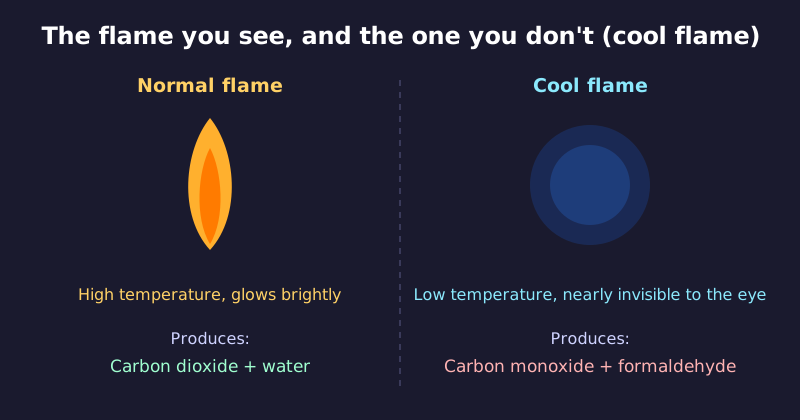
That something is called a “cool flame.” It burns at a lower temperature than an ordinary flame, which means it gives off very little light, so little that it’s practically invisible to the naked eye. The fire looks extinguished. It isn’t. It’s just burning where you can’t see it.
According to NASA, a normal flame produces carbon dioxide and water as it burns. A cool flame produces carbon monoxide and formaldehyde instead, an entirely different chemical signature. And in microgravity, cool flames were found to burn for longer than they do on Earth. On the ground, the updraft that forms around any flame quickly snuffs out weak combustion like this. Without that airflow in space, the weak fire lingers.
You think the fire is out, and in reality a flame you can’t see is quietly still burning. Imagine that happening inside a spacecraft, and it gets a little unsettling. A fire you believe you’ve put out, smoldering invisibly while it leaks toxic carbon monoxide, is not a reassuring scenario inside a sealed cabin. And that’s exactly the reason researchers bother burning fire in orbit in the first place.
Why bother burning fire in space: cleaner engines on Earth, safer ships above it
Worth pausing on this: combustion is something you’d think could be studied plenty well on the ground. Why go to the trouble of hauling an experiment into orbit?
The answer circles back to that updraft. On Earth, air currents constantly stir and disturb a flame, hiding the raw mechanics of combustion underneath. Microgravity removes that noise. With the disruptive convection gone, researchers get a clean, unobstructed view of what’s actually happening inside a flame. It’s a laboratory nobody could build on the ground.
NASA frames this research around two goals, describing the work as helping make “combustion on Earth cleaner, and space safer.”
The first goal points downward. Cool, low-temperature combustion like this also happens inside the engines of cars and generators. Understanding exactly how it works could lead to engines that burn fuel more completely and release less exhaust. The efficiency of the engine in the car you drive to work tomorrow traces back, eventually, to a small flame burned in orbit.
The second goal points outward. A fire aboard a spacecraft is close to the worst thing that can happen to a crew: there’s nowhere to run, and no fire department to call. That’s why NASA has run experiments (Saffire) that deliberately set large fires inside uncrewed cargo capsules after they detach from the station. Those tests revealed, among other things, that lowering air pressure slows how fast a flame spreads. A related experiment called FLARE, which studies how readily different materials ignite, includes Japan’s JAXA as a partner.
All of this research runs through a purpose-built combustion rig developed by NASA’s Glenn Research Center. It carries a 100-liter combustion chamber and rode to the ISS aboard Space Shuttle mission STS-126 in November 2008. There’s a proper furnace up there, built specifically for studying fire in space.
The taper in a flame is gravity’s fingerprint
Next time you light a candle, take a closer look at that small teardrop shape.
The point isn’t something the flame drew for itself. It’s the shape of a current: hot air rising, cool air pulled in to replace it, with gravity quietly guiding the whole motion upward. Even the flicker carries gravity’s signature.
Cut gravity out of the picture, and the same fire, pulled by nothing, becomes a silent blue sphere resting above the wick. And even after that sphere appears to go out, an invisible flame can keep burning for a while longer.
The shape of a kitchen flame you’ve glanced at a thousand times without a second thought turns out to be connected to a room falling, continuously, 400 kilometers overhead.