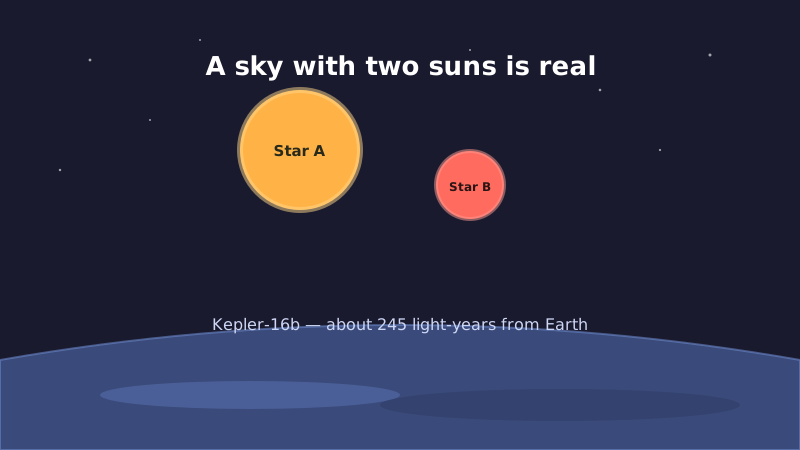
There’s a scene in the original Star Wars where the hero stands in the desert and watches two suns set side by side. As a kid, I assumed that was pure invention — a nice visual trick and nothing more.
Turns out a planet with two suns really exists. It’s about 245 light-years from Earth.
A planet with two suns actually exists
It’s called Kepler-16b, discovered in 2011 in data from NASA’s Kepler space telescope (the find was reported by a research team led by Laurance Doyle).
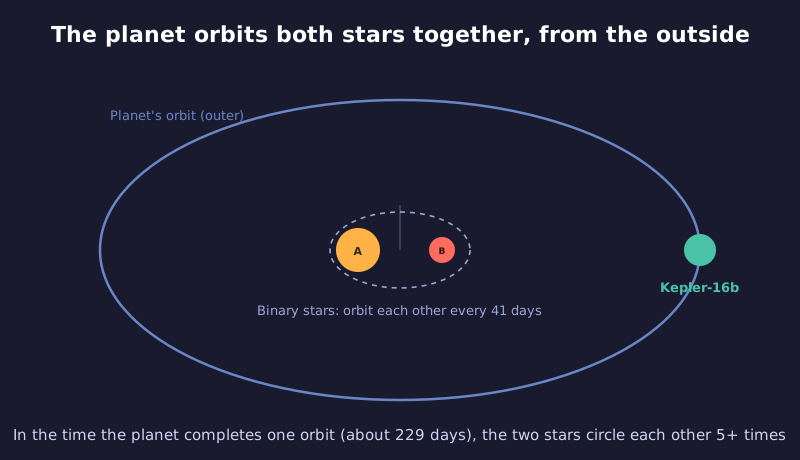
Here’s the remarkable part: the planet doesn’t orbit just one of the two stars at its center. It orbits both of them together, circling the pair as a single unit from the outside. Astronomers call this a circumbinary planet — one that loops around two or more stars at once.
The two stars at the heart of this system are both lighter than our sun. One weighs in at about 69% of the sun’s mass, the other around 20%. They swing around each other in a tight, fast loop, completing one orbit every 41 days. Compare that to Earth’s leisurely 365-day lap around the sun, and you get a sense of how frantic their relationship is.
The planet, meanwhile, takes 229 days to circle both stars as a pair. In size and mass, it’s roughly comparable to Saturn — a sizeable ball of gas.
I’ll admit that when I first heard about this, my gut reaction was skepticism. Two stars means gravity pulling from two directions at once, constantly rearranging itself. How does a planet avoid getting torn apart, or just flung out of the system entirely?
Why doesn’t a tug-of-war between two stars tear the planet apart?
Take a moment to think through why it doesn’t get torn apart.
The answer comes down to distance. Orbit too close to the pair, and you’re in trouble. One moment the star on your right is pulling hard, the next it’s the one on your left. The direction of gravity keeps flipping, and the orbit gets progressively more chaotic — until eventually the planet picks up enough speed to be hurled out of the system altogether.
But orbit far enough outside both stars, and the picture changes completely.
From a distance, two closely spaced stars start to look like a single point of light. The gravity acting on the planet becomes, essentially, the combined pull of “one big star” rather than two competing ones. The orbit settles into something just as stable as a planet circling an ordinary single star.
So how far out does a planet need to be to survive around a binary pair? Researchers have actually run the numbers. A 1999 study by Matthew Holman and Paul Wiegert calculated that there’s a minimum safe radius for planets circling a pair of stars — orbit any closer than that, and the system won’t hold together for long. That boundary sits a few times farther out than the separation between the two stars themselves, and its exact position shifts a bit depending on the stars’ mass ratio and how elongated their mutual orbit is.
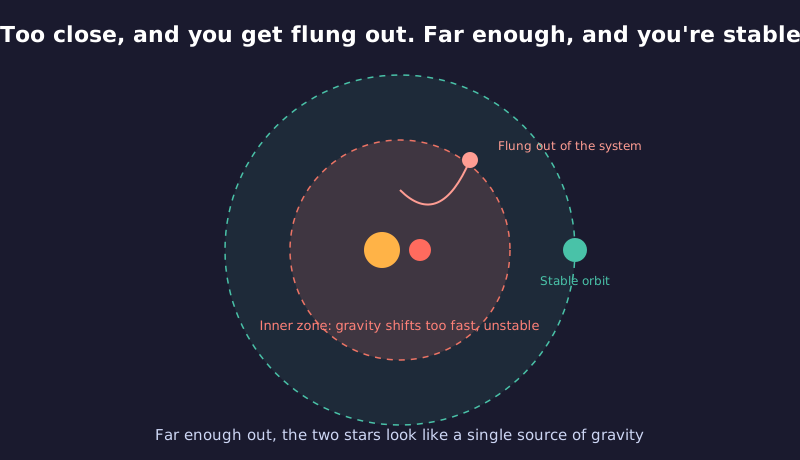
Kepler-16b sits comfortably inside that stable zone. While its two central stars whip around each other every 41 days, the planet cruises along a wider, calmer orbit, taking 229 days to complete one lap. Do the math, and in the time it takes the planet to finish a single year, its twin suns have already danced around each other more than five times. The system has held together for hundreds of millions of years precisely because the planet picked a safe distance and stuck to it.
How did we know it was orbiting two stars?
Here’s where things get interesting. Nobody pointed a telescope at a planet 245 light-years away and simply looked at it.
What the Kepler space telescope actually did was track a star’s brightness, continuously, for years. Whenever something passes in front of a star, it blocks a sliver of light, and that faint dimming is the giveaway. Astronomers call this detection method the transit method, because it catches the brief dip in light as an object transits, or passes in front of, a star.
Kepler-16’s light curve had an oddly complicated pattern of dimming.
First, the two stars periodically eclipsed each other, causing a dramatic drop in combined brightness. On top of that, much smaller and perfectly regular dips kept showing up at separate intervals. Those smaller dips turned out to be a planet crossing in front of the two stars. Two different kinds of dimming — stellar eclipses and planetary transits — were tangled together in a single light curve.
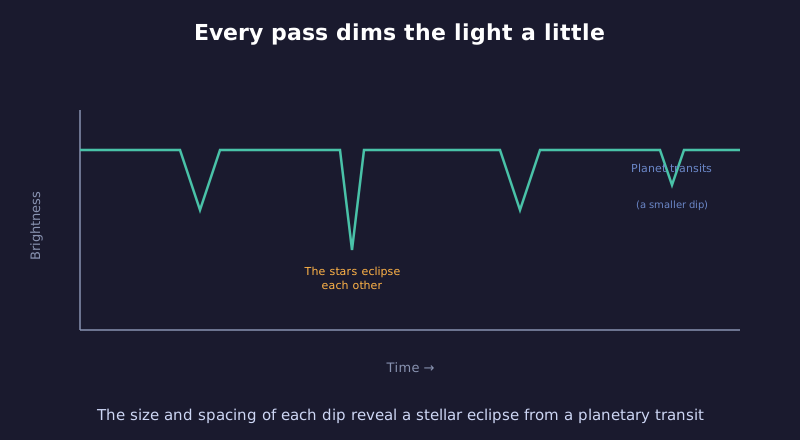
The real clincher was a subtle, telltale shift in the timing of those dips. As the planet moves, its gravity tugs on the two central stars just enough to nudge the exact moment their eclipses occur, earlier or later than you’d expect from the stars alone. That kind of precise, repeating offset doesn’t happen by coincidence. The research team used this gravitational fingerprint to conclude that two stars sat at the center of the system, with a third body — the planet — orbiting around both.
No photograph required. Just the flickering of starlight, decoded. Observational astronomy, it turns out, is really a detective’s job.
What would the sky actually look like from there?
Let’s pause and picture the view from that planet’s sky.
Two suns hang at slightly different positions. A bright orange primary star, and beside it, a smaller, dimmer red companion. In the morning, the two rise together, nearly in sync; by evening, they set with a gap between them. The distance between the pair shifts from day to day — sometimes they overlap almost completely, sometimes they drift apart.
Anything standing on the ground would cast two shadows: one dark, one faint. At your feet, the two shadows would slowly rotate and shift angle relative to each other throughout the day.
Of course, there’s a catch: you couldn’t actually stand there. Kepler-16b is a gas giant like Saturn, with no solid ground to stand on. To watch those twin sunsets and double shadows in person, you’d need a moon orbiting the planet. Even so, the basic fact — two suns hanging in one sky — isn’t speculation. It’s backed by observation.
One more detail: the two suns aren’t the same color. The primary star glows a warm orange, while the companion burns a dimmer, deeper red. So the real twin sunset would look noticeably redder than the pale double sunset depicted on screen.
Binary star systems turned out to be fertile ground for planets
Was Kepler-16b just a one-off fluke? Not even close.
Before this discovery, it wasn’t clear whether planets could even form in a system where two stars orbit tightly around each other. The dust and gas disk that eventually clumps into planets seemed like it should get stirred up and scattered by the gravitational chaos of two nearby stars. Kepler-16b became living proof that planets can, in fact, take shape and survive in exactly that kind of environment.
Once this one turned up, Kepler went on to find circumbinary planets one after another. The consensus among the observing teams now is that these two-star planetary systems are reasonably common across the galaxy, not some cosmic rarity.
Thinking about it, that’s not so surprising. Stars rarely form in isolation. More often, they’re born in pairs, or even triplets, locked together from birth. If binary star systems are common, it stands to reason that planets orbiting them would be too.
Exoplanets themselves have long since stopped being rare discoveries. More than 6,000 have now been confirmed, according to NASA’s tally. Somewhere in that list are worlds with two suns in their sky. Add in oddities like the frigid planet found circling the burnt-out ember of a white dwarf, and it’s clear that planets come in a far wider range of flavors than our own solar system would ever have suggested.
That point of light overhead might have twin sunsets of its own
A sky with two suns setting together turned out to be more than a movie fantasy. A pair of stars locked in a 41-day dance, with a Saturn-sized planet circling both of them every 229 days. By staying clear of the chaotic inner zone and settling into a sufficiently distant orbit, that world has kept spinning, undisturbed, for hundreds of millions of years.
Next clear night, look up. Among the stars visible to the naked eye, more than a few are actually pairs of stars standing so close together that they appear as one — hidden binary systems. And around one of them, right now, there might be a planet casting two shadows beneath a sky with two sunsets.


