Imagine the Sun vanished right now, replaced instantly by a black hole of exactly the same mass. What happens to Earth?
Most people guess it gets sucked in. The real answer is almost anticlimactic: Earth keeps circling the same orbit at the same speed it always has. The sky goes dark, sure, but the planet doesn’t fall anywhere.
The misconception runs deep enough that NASA dedicated an entire page to debunking it, titled “Black holes are like vacuum cleaners… NOT!” Today we’re going to untangle that myth using one of the plainest rules gravity has to offer.
Swap the Sun for a Black Hole, and Earth’s Orbit Doesn’t Budge
Let’s skip straight to the punch line. NASA puts it plainly: “Outside the event horizon, the gravity around a black hole is no different than the gravity around any other object of the same mass.”
The event horizon is the boundary where, once you cross it, there’s no coming back. We’ll get to that later. For now, the key phrase is “outside the event horizon.”
In other words, if two objects weigh the same, it doesn’t matter whether one is a black hole and the other an ordinary star. The pull you feel from a distance is identical either way. If the Sun turned into a black hole of equal mass tomorrow, the gravitational tug on Earth wouldn’t change by a single gram.
Which means the orbit doesn’t warp. The speed of revolution doesn’t change either.
I’ll admit I misunderstood this myself for a long time. I pictured black holes as having some extra, mysterious suction, grabbing anything nearby and dragging it in. That force simply doesn’t exist.
So where does the “sucks up everything” reputation come from? Before we get there, it helps to nail down what actually determines gravitational pull.
Gravity Only Cares About Two Things: Mass and Distance
The force pulling two objects together boils down to exactly two variables: how massive the other object is, and how far away it sits. That’s the whole story.
The same rule governs you and Earth right now. When you step on a scale, the number you see exists because Earth’s enormous mass is tugging on you from a certain distance. The planet’s shape, color, or internal composition has nothing to do with it. Mass and distance decide everything.
This, I think, is the single most important point in this whole piece. Gravity doesn’t care what an object is made of. A solid iron ball and a puff of cotton candy pull with exactly the same force, as long as their mass and distance match.
Now take the Sun and compress it, without losing a single gram, into a black hole. The mass hasn’t changed. The distance to Earth hasn’t changed. So there’s no mechanism by which the pull on Earth could change either.
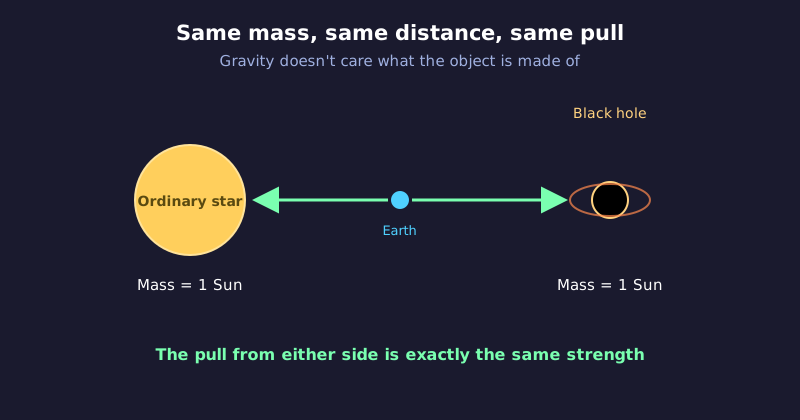
Think about it this way: if black holes really had some bonus suction power, they’d pull harder than an ordinary star of equal mass. But since gravity is defined purely by mass and distance, there’s no room for that extra pull to come from.
So the force itself doesn’t change. What does, then?
What Actually Changes Is How Close You Can Get
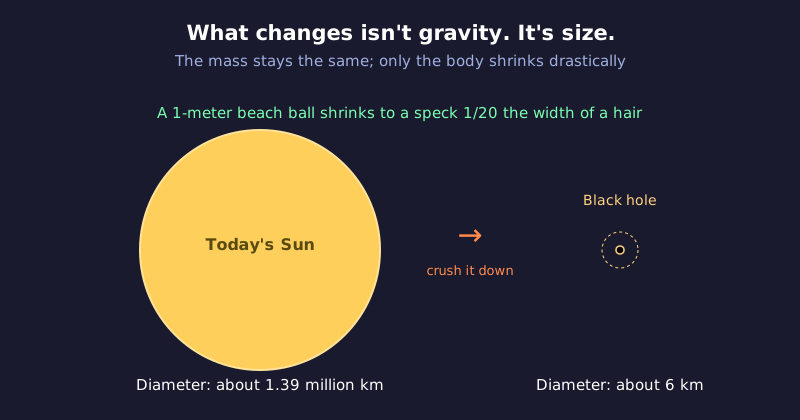
There’s exactly one thing that transforms dramatically when the Sun becomes a black hole: its size.
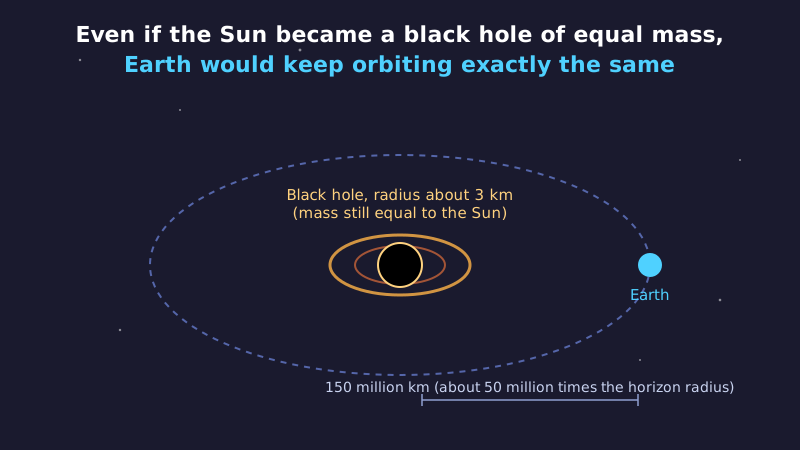
Today, the Sun measures roughly 1.39 million kilometers across, wide enough to line up 109 Earths side by side. But according to NASA, compress that same mass into a sphere with a radius of just about 3 kilometers, and you’ve got a black hole, roughly 6 kilometers across.
The numbers alone don’t mean much, so let’s rescale. If today’s Sun were a one-meter beach ball, the equivalent black hole would shrink to about 4 micrometers across, a twentieth the width of a human hair, smaller than a red blood cell. And it would still weigh exactly the same.
This is where distance comes back into play.
The surface of an ordinary Sun sits about 700,000 kilometers from its center, and Earth orbits far beyond that. So what Earth feels is a moderate pull from a considerable distance. You simply can’t get any closer than the surface, because the star’s own bulk is in the way.
Once that same mass becomes a black hole, though, its body shrinks to nearly a point. Suddenly, the region that used to be blocked by the star’s surface, the “deeper inside” that was always off-limits, becomes reachable in principle. And the closer you get to the center, the more sharply gravity ramps up.
So a black hole isn’t frightening because its gravity is stronger. It’s frightening because it lets you stand at a distance from the center that no ordinary star would ever let you reach.
You Only Get Pulled In Once You’re Right at the Horizon
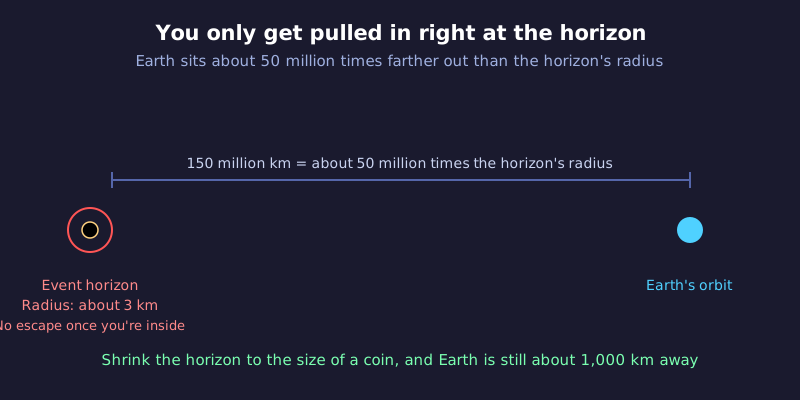
So where exactly does “getting sucked in” actually start? That boundary is the event horizon we mentioned earlier.
Inside it, the escape velocity needed to break free exceeds the speed of light. Even light can’t make it out, which is why the interior is pitch black and invisible from outside. As NASA describes it, anything that crosses the horizon is destined to end up at the central singularity.
But flip that around, and here’s the crucial part, as long as you stay outside the horizon, you are never pulled in. NASA states this directly too: “As long as you stay outside the event horizon, you will not be sucked in.”
For a Sun-mass black hole, that horizon has a radius of roughly 3 kilometers. Earth, meanwhile, orbits 150 million kilometers away, about 50 million times farther than the horizon’s radius.
Fifty million times. Shrink the horizon down to the size of a coin, about 2 centimeters across, and Earth would be circling roughly 1,000 kilometers away, like the distance between two major cities on opposite sides of a country. That’s an absurd distance to worry about being sucked into anything.
Now picture something different: suppose you were floating in a spacesuit just outside that horizon. Only there does gravity turn vicious enough to tear you apart. The pull on your feet versus your head becomes so lopsided that your body stretches out lengthwise. Researchers have a name for this, borrowed from pasta: “spaghettification.”
But that’s only what happens if you close the distance to a 3-kilometer horizon. From 150 million kilometers away, on Earth, it’s a story that belongs to an entirely different world.
So Where Did the “Vacuum Cleaner” Reputation Come From?
By now a natural question comes up. If gravity behaves just like any ordinary star, what about all those stories of black holes swallowing matter and growing?
Black holes genuinely do grow by consuming nearby gas and stars. But that’s not them “reaching out and sucking in distant objects.” It’s that some unlucky bit of matter happened to wander close enough to the horizon that it couldn’t pull back out, and fell in from there.
As that gas falls, it spirals furiously just outside the horizon, friction heats it to extreme temperatures, and it blazes with light. That glowing whirlpool is called an accretion disk, and it’s the dazzling spectacle you see in movies and news footage whenever black holes come up. Because it’s so visually striking, the “monster that devours everything” image stuck, even though it’s misleading.
Here’s the strange part: a real black hole, far from sucking things in, does essentially nothing unless something wanders close. Seen from a distance, it’s just another object of equal mass, sitting there quietly.
Which is why most of the gas and stars drifting through space sail right past black holes without incident, tracing their orbits as if nothing happened. A vacuum cleaner would pull in every speck of dust nearby. A black hole doesn’t work that way. Unless you’re on a collision course, its gravity is no different from that of any other star of the same mass.
The Sky Goes Dark, But Earth Keeps Spinning
Picture that scenario one more time: the Sun gone, replaced by a black hole of equal mass.
The Sun disappears from the sky. Day never comes again. The oceans freeze over. Life on the surface can’t survive. All of that is true. But the reason isn’t “we got sucked in.” It’s that light and heat stopped arriving. Earth itself keeps turning quietly through the darkness, tracing the exact same orbit it follows today.
A black hole isn’t terrifying because it reaches out across space with some invisible hand. It’s terrifying because it lets you accidentally wander into the one place in the universe you can never return from. Keep your distance, and it’s just another object of the same mass, one that happens to be black.
Tonight, when you look up and picture the direction of the Sun, hold onto this number for a moment. Even if the Sun were crushed down into 3 kilometers of darkness, your feet, 150 million kilometers away, would still be standing on the exact same orbit they always have.